




Humans are emotional creatures before they are rational ones. So, in order to get people to appreciate a rational argument, we must engage their emotions first. Mark Lilla here argues that having our beliefs challenged is often an emotionally unpleasant experience, and to counter this unpleasantness of being wrong and to counter humanity's will to ignorance, we must make reasoned debate emotionally rewarding.
Aristotle taught that all human beings want to know. Our own experience teaches us that all human beings also want not to know, sometimes fiercely so. This has always been true, but there are certain historical periods—we are living in one—when the denial of evident truths seems to be gaining the upper hand, as if some psychological bacillus were spreading by unknown means, the antidote suddenly powerless. Mesmerized crowds follow preposterous prophets, irrational rumors trigger fanatical acts, and magical thinking crowds out common sense and expertise. One can always find proximate causes of such surges in resistance to truth, whether historical events or social changes or new intellectual and religious currents promising a holiday from reality. The source lies deeper, though, in ourselves and in the world itself, which takes no heed of our wishes.
 SUGGESTED VIEWING
Philosophy at war
With Maria Balaska, Hilary Lawson, Paul Horwich, Lisa Randall
Knowing is an emotional experience. It is not simply a matter of the senses sending messages to the brain, synapses firing, propositions being formed and their logic tested. The desire to know is exactly that, a desire. And whenever our desires are satisfied or thwarted, our feelings are engaged. Even in trivial matters, we feel something about what we learn. Say, for example, a toaster I own breaks and needs to be fixed. I look at the manual, I watch videos, I ask questions, I tinker, and with any luck I learn how to make it work again. I feel satisfied, and doubly so. Not only can I use the machine again, I have also confirmed my sense of being the kind of person who can seek knowledge, find it, and use it. Toast and self-satisfaction: not a bad way to start the day.
Resisting knowledge is an emotional experience, too. Opposed to the drive to knowledge, Nietzsche wrote, is:
an apparently opposite drive, a suddenly erupting decision in favor of Ignorance, of deliberate exclusion, a shutting of one’s windows, an internal No to this or that, a refusal to let things approach, a kind of state of defense against much that is knowable, a satisfaction with the dark, with the limiting horizon, a Yea and Amen to ignorance.
Living in the shadow of the modern Enlightenment, we are accustomed to hearing curiosity extolled for the material benefits it brings and for the contribution it makes to what we today consider our most precious possession: inner freedom. For just that reason, perhaps, we are less accustomed to observing and reflecting on curiosity as a purely psychological drive charged with unruly passions. There is of course a long tradition of thinking that looks askance at the human passion for knowing and raises doubts about its value for life. Reasons can be given for the desire to know; reasons also can be given for constraining that desire.
But apart from this clash of reasons there is also a clash of unreasoning emotions, with the desire to defend and even cultivate our ignorance standing as a powerful adversary to the desire to escape it. Once one learns to recognize this clash of wills, one begins to see what an important role it plays in our individual and collective lives, and especially in how we think about those lives. As George Eliot put it: It is a common sentence that Knowledge is power; but who hath duly considered or set forth the power of Ignorance? That power is what I propose to examine here.
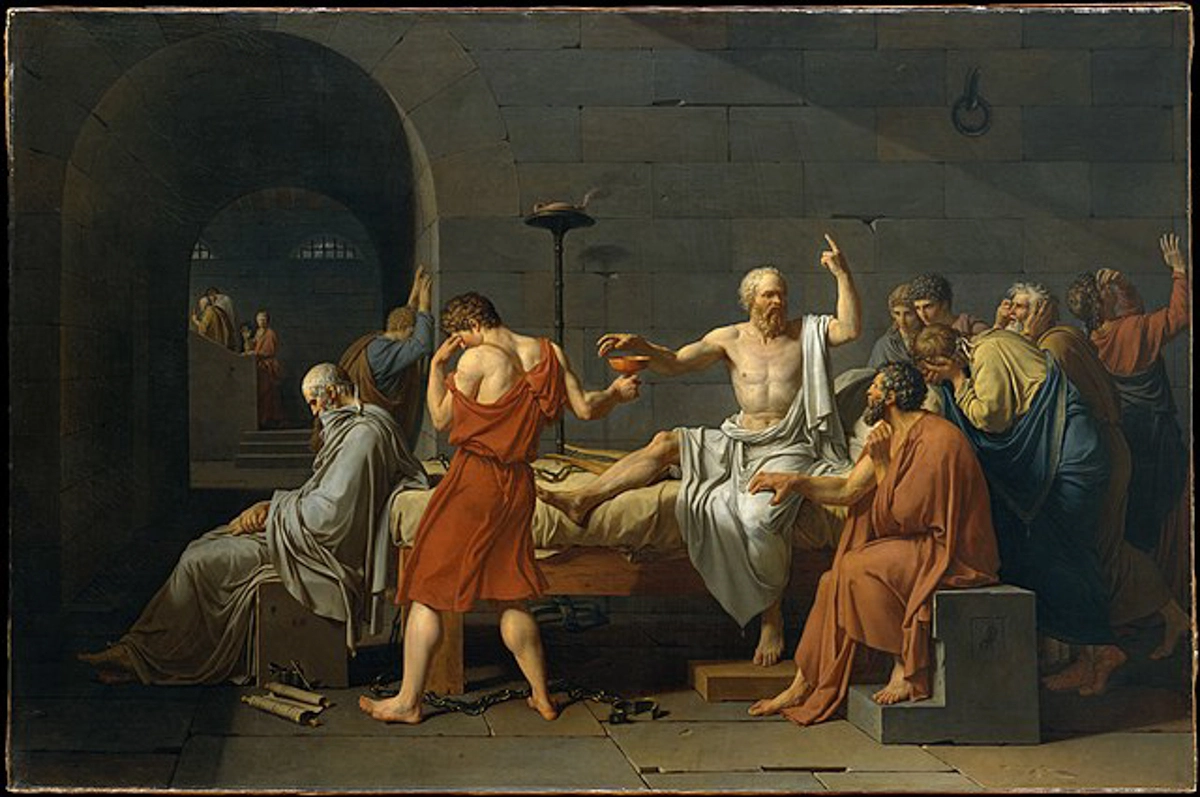
Consider Cephalus, a wealthy Athenian gentleman who lived near the Greek port of Piraeus, just down the hill from the city. One day Socrates paid him a visit and found him in the kind of “philosophical” mood that old rich men at their leisure tend to get into. Cephalus was eager to tell Socrates that he’d discovered the secret to a happy life. Having been freed from the passions of youth, especially erotic ones, he now saw that genuine happiness does not depend on satisfying desires, it depends on character and good cheer instead. As for money, only the just man really benefits from it, while it makes the unjust man more vicious and miserable. Ethics first, then grub.
Socrates seemed impressed by this proclamation, which has much to recommend it. But he also sensed that Cephalus had never inquired seriously about these matters or about himself and had only contracted a late case of piety. So he asked him a simple question: What do you mean by the term just? Cephalus was caught up short. Men of his age and standing are not in the habit of being examined, but they are experienced enough to sense a potential threat, no matter how politely put. So rather than answer Socrates’s question, he graciously excused himself and went to make sacrifices to the gods, turning the conversation over to his excitable, thickheaded son.
A great and instructive pleasure in reading Plato’s dialogues is witnessing what happens when a seemingly disembodied argument is expressed by a flesh-and-blood human being who has feelings and passions, in front of other human beings who have their own. Time and again we are reminded that arguments are not always transparent, that there can be a gap between what people in the heat of argument say they believe and what their behavior in the conversation reveals. Socrates’s philosophical concern is not only to find the truth about whatever he and his friends happen to be discussing. He also appears eager to understand people’s emotional response to the quest, and, in particular, how and why anyone would resist learning what is true.
Conversations with Socrates have a predictable arc. They begin with pleasantries, then get difficult and sometimes very technical. And then, very often, something goes awry. The conversation hits a thick wall, and no further advance seems possible. Other times a conversation with one of the speakers disintegrates when it runs into bad psychological weather. Something Socrates says sets off sirens and flashing lights, and the speaker flees, or turns on him. We’ve all had this experience in our everyday conversations. A discussion begins, and we feel ourselves in a partnership with the person we’re speaking with. Égalité et fraternité. Then something happens, a word or phrase or change in tone ruins the mood, and one of us gets frustrated or offended. We find an excuse to leave. Or we stay, and now the conversation is no longer about the matter at hand, but about the two of us. The contest for command begins, trenches are dug, barbed wire laid, mortars stockpiled. Victoria o muerte.
___
No one ever loses a truly philosophical argument: this was Socrates’s most radical teaching
___
In Socrates we witness a new way of doing philosophy that makes inquiry into the world dependent on inquiry into the self and its capacity for knowledge. But we also witness an afterbirth—anti-philosophical anger. Socrates pretended to be perplexed by the hatred caused by his activity, which was to wander around the city and engage people in conversation. No one was ever compelled to join these discussions, though sometimes Socrates had to be nudged. And all he tried to convey to people, he claimed, was that learning the truth, even about themselves, is always to their advantage. We should want to question our beliefs and the justice of our actions, he tells them, so we can improve our souls and be truly happy. We shouldn’t fear learning the truth, even about death, since it is meaningless to one who has lived well; if we haven’t lived well, then vice, not death, is our problem. Above all, we shouldn’t get angry with someone who points out contradictions in our thinking or refutes our arguments, especially when they concern the most important question, which is how to live. No one ever loses a truly philosophical argument: this was Socrates’s most radical teaching.
Plato’s dialogues show just how hard it is to accept such a teaching. Time and again we see that the inner citadels of Socrates’s interlocutors are guarded by a corps of resistances, and that no good argument can pass through unless the guards are disarmed or lulled to sleep. The most obvious resistance is rooted in fear. Socrates’s conversations almost always wend their way into sensitive territory, where people’s beliefs about ultimate things—morality, religion, mortality— come into question and they feel exposed. By questioning those beliefs, people risk upsetting ideas they’ve built their lives around, with no guarantee of finding satisfying new ones. We may think we’re brave enough for that, but how many of us are? Atheists who take comfort in a comfortless world would find it very uncomfortable to discover that the God of the Bible does, in fact, exist. Their little inner world would collapse.
If the search for truth were to take place in a state of total ignorance, there would be no reason or occasion to resist. That is not our case. Instead, almost all inquiry begins with received false opinions in which people have an emotional stake. That is why the philosopher must also be a psychologist when pursuing arguments with others, or even with himself. Socrates sometimes calls himself a midwife, a perfect metaphor for his craft. The people he speaks with bring to the conversation distinct emotions concerning their beliefs. Were the truth to be dumped on them, they would be incapable of digesting it and would reject it. And so it must be coaxed out of them in ways that are in accord with what they already are and how they think, and that avoid particular resistances. The contracted muscles that maintain ignorance must be relaxed.
No one can hold an opinion for us. It is ours—or, better put, it is an extension of our very self, a prosthetic device. When it is attacked or dismissed, we feel that something intimate has been touched. And when it fails, we feel ashamed. Socrates maintained that there is no shame in being wrong, just in doing wrong. He was right. But it’s not the way we initially feel, especially when someone else exposes our errors.
No argument is disembodied. Behind every assertion there is an assertor, and it is he, not his assertion, who wounds our pride. That is why serious conversations even among friends can go so wrong so fast. And it doesn’t matter what the subject is. Freud, whose science was all about the building and overcoming of resistance, was notorious for his unwillingness to accept criticism or emendation. Mathematicians and scientists debating matters at the furthest remove from daily life can be as dogmatic, partisan, and touchy as any xenophobe. A new boson has been discovered: Is that one giant leap for mankind or one point for our side? Socrates held that the spirit of philosophy, the love of wisdom (philosophia), was diametrically opposed to the spirit of combat, the love of victory (philonikia). Yet both spirits get activated when we engage in argument. That there is an International Mathematical Olympiad for national teams of young people tells us a lot about the human animal.
But there was something about Socrates and his manner that was particularly maddening to the Athenians. It had to do with the fact that he so often practiced his medicine in public, not in private, as physicians do. This ultimately sealed his fate in the eyes of his future Athenian murderers. Most of his conversations took place before an audience that he and his interlocutor were aware of, and which the reader must bear in mind. To be refuted by Socrates was a public humiliation, despite his insistence that there was no shame in it.
And Athens at the time was a democracy. Though ancient democracies were very different from our own, the psychology of democratic citizens has not changed. The fundamental article of democratic faith is that people are equal and that they know, individually and collectively, what’s best for them. Democrats are tetchy. As Socrates tells one young man, Athenians don’t mind your being clever; what they mind is your presuming to teach them and others what you’ve learned. Many Athenians were offended even when he simply asked questions, and perhaps rightly so. There was something coy about Socrates’s irony that gave the impression he was stringing you along, not taking you seriously as an equal—an important thing to democratic citizens. The rules of the road stipulate that everyone gets his say without fear of interrogation. That’s what freedom means to Athens. Inquiry into the truth is what freedom means to Socrates.
___
We prefer the illusion of self-reliance and embrace our ignorance for no other reason than it is ours.
___
At one point he took a little tour around the city, trying to ascertain exactly who knew what. He talked to craftsmen who knew their craft but believed that their knowledge applied to every area of life. He spoke with poets who had flashes of insight, but could not explain why what they saw was true. And he spoke in public with a famous, unnamed politician and showed to all assembled that this man knew the least. After that, Socrates told the jury at his trial, I became hateful to him and to many of those present. There is a large lesson in those italicized words. Even spectators who had not been humiliated turned against the man who asked too many questions. He had broken the social contract.
Athens, c’est nous. At some point we all decline the invitation Socrates makes to us to learn what really is the case. We willingly give up a shot to acquire true beliefs about the world out of fear that truths about ourselves will be exposed in the process, especially our insufficient courage for self-examination. We prefer the illusion of self-reliance and embrace our ignorance for no other reason than it is ours. It doesn’t matter that reliance on false opinion is the worse sort of dependence. It doesn’t matter that through stubbornness we might pass up a chance at happiness. We prefer to go down with the ship rather than have our names scraped off its hull. Socrates says he doesn’t understand why anyone would get angry at someone who wants to help him. He’s right, it makes no sense. But every child wants to zip his own coat.
This is an edited extract from Mark Lilla’s new book, Ignorance and Bliss: On Wanting Not to Know (https://www.hurstpublishers.com/book/ignorance-and-bliss/).












Join the conversation