Monday 7th December - 06:00 PM GMT
Main Debate: In the Name of Morality
Should we stop trying to be moral?
Across the world, to fight for a moral cause is seen as heroic, while the morally corrupt and dissolute are villains to be shunned. Yet, the outcome of claimed moral actions is often problematic. Western charitable efforts, such as Food Aid in Haiti, can collapse local agricultural infrastructure and devastate farmers. Mother Theresa, made a saint by the Catholic church for her work in the slums of Calcutta, used donors’ money to promote her fundamentalist Catholicism rather than helping those in need. School closures during the Covid pandemic were justified as saving lives, but are now seen by many as having harmed children and widened inequalities in education. Even admired principles can reinforce condemned practices, such as the use of Gandhi’s anti-violence to consciously maintain the Indian caste system.
Should we stop calling actions moral or immoral, and instead focus on their consequences? Is morality a rhetorical device to authorise our behaviour without further investigation? Or is morality essential to, not just society, but what it means to be human?
Join Carol Gilligan, Michael Huemer, Hanno Sauer as they debate these questions, Jonny Thomson hosts.
Big ideas in your inbox.
Updates from the world's greatest minds - plus offers and discounts.

Carol Gilligan
Leading voice in feminist ethics
Carol Gilligan is the psychologist who gave moral philosophy a new voice. In a Different Voice challenged Kohlberg’s stages of moral development and made the case for an ethics of care. Harvard University Press calls it “the little book that started a revolution.” She went on to found the Harvard Project on Women’s Psychology and Girls’ Development.
Her other books include Mapping the Moral Domain, Making Connections, Meeting at the Crossroads and The Birth of Pleasure. Her honours include the Grawemeyer Award in Education, the Heinz Award and, in 2025, the Kyoto Prize in Arts and Philosophy, and Time named her one of the 25 most influential Americans in 1996.
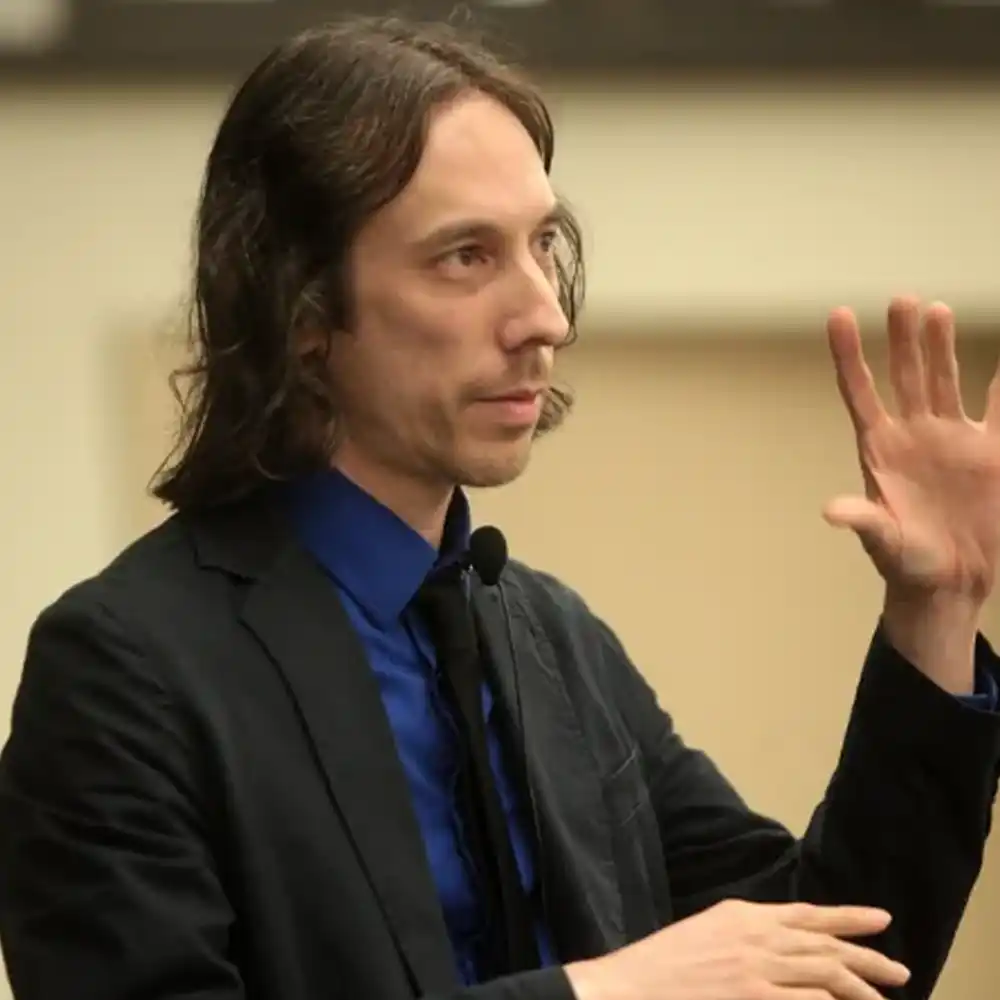
Michael Huemer
Avid defender of objective moral obligations
Michael Huemer is the philosopher who avidly defends the existence of objective moral truths. His book The Problem of Political Authority made him a defining voice of philosophical anarchism, whilst Ethical Intuitionism established him as a major figure in moral philosophy.
He has published more than ninety academic articles in ethics, epistemology, political philosophy and metaphysics. In 2013, he won the inaugural Adams Prize in Philosophy, a $50,000 award. His other books include Skepticism and the Veil of Perception, Approaching Infinity, Paradox Lost, Dialogues on Ethical Vegetarianism and Justice before the Law.

Hanno Sauer
Philosopher who sees good and evil as human inventions
Hanno Sauer is a philosopher who argues that good and evil are human inventions, and that the values we share run deeper than our divisions suggest. His book The Invention of Good and Evil: A World History of Morality traces five million years of moral history, from our earliest ancestors to today’s culture wars. It was a Der Spiegel bestseller, was nominated for the German Non-Fiction Prize, and was named one of the best books of 2024 by the New Yorker.
Sauer is Associate Professor of Philosophy at Utrecht University, where he works on moral psychology, metaethics and the philosophy of social science.
"Blend[ing] insights from evolutionary biology, cognitive science and anthropology ... Sauer has made a heroic effort to chart how morality has changed since the first humanlike animals began to populate Africa to predict how it might change in the future." ― The Economist

Jonny Thomson
Creator of 'Mini Philosophy'
Jonny Thomson is the philosopher who built one of the largest philosophy audiences on the internet, one bite-sized idea at a time. His first book, Mini Philosophy, has been translated into twenty languages, and Mini Big Ideas followed, bringing his three books to 22 languages in total. A columnist for Big Think, he writes on philosophy, theology and psychology, and is the author of The Philosophy Prescription. As Mini Philosophy has grown in fame, from his social media platforms to his award-winning international bestseller, Thomson has made one of the oldest and most forbidding subjects feel modern, accessible, and deeply engaging.