


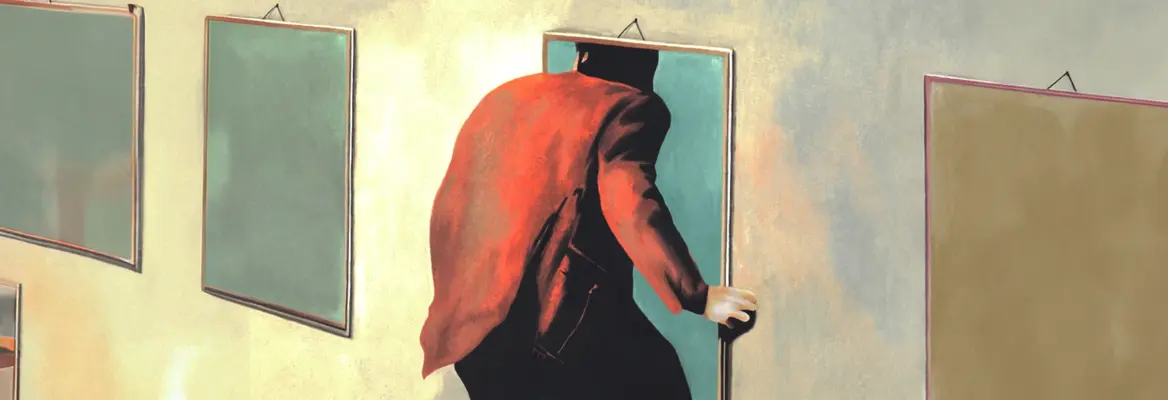

Art is often seen as a representation of reality, with style understood as a way of dressing the same neutral content in different forms. But philosopher Derek Allan argues that no such neutral content exists. Even photographs, silhouettes, or bare outlines already involve interpretation, and when stripped of style, images often become unintelligible rather than more “realistic.” Art, he argues, is an act of transformation that creates a rival world rather than mirroring the existing one.
The question of whether or not art is essentially a representation of reality has long been a bone of contention among philosophers of art, especially in the major branch of that discipline called the analytic philosophy of art, or analytic aesthetics. Some philosophers seem convinced that art is essentially representation, although they’re usually forced to resort to rather tortuous reasoning when it comes to music or non-figurative visual art, neither of which seem to represent anything in any usual sense of the word. Other philosophers, apparently struggling for a compromise, argue that while literature and visual art are representative arts, music is not—a claim that, unhappily, begs a question: if there are “representative arts” and “non-representative” arts, what common feature do they have that authorises us to call them both “art”? Representation being ruled out, we need to find a replacement essential feature.
I don’t wish to venture down the highways and byways of these debates. They’ve been going on, more or less fruitlessly, for decades now and are, in any case, among the more tedious areas of analytic aesthetics, which, at the best of times, tends to be a rather tedious affair anyway. Yet I suppose we do have to admit one thing. There is a tendency for many of us to assume, more or less unthinkingly, that art—especially visual art and literature—does, in some ill-defined way, “represent the world.” We struggle to apply the proposition to music (although some argue that so-called “program music” is representational) but it’s nonetheless hard to rid oneself of the belief that paintings like the Mona Lisa, or Titian’s Man with a Glove, for example, “represent” certain people, or that novels like War and Peace or Balzac’s Père Goriot—“represent” life at a certain period of history. And from there, it seems only a short step to assume that representation is what art is really about.
 SUGGESTED VIEWING
Truth and poetry
With Andrew Motion
SUGGESTED VIEWING
Truth and poetry
With Andrew Motion
Nevertheless, it is this belief that I plan to challenge here, building my case on an excellent analysis by André Malraux in one of his major works on the theory of art—The Voices of Silence—a work, incidentally, that philosophers of art rarely read and whose existence they often seem unaware of. Malraux does not, of course, argue that art—visual art, for example— never represents people or objects in an everyday sense of the word. Such a claim would obviously be untenable. But he does argue—and argues quite passionately—that the essential purpose of art is not to represent the world, whether or not, as in the case of the paintings just mentioned, something is plainly represented.
Let me begin in a down-to-earth way by considering three images. One is the magnificent image of a horse in the Lascaux caves, painted some 19,000 years ago and often reproduced; the second is Rubens’ spectacular baroque image of St George and the Dragon, with St George mounted on a rearing horse; and the third is a fairly unremarkable black and white photograph of a horse seen in profile.

Figure 1: three images of horses (Lascaux, Rubens, photograph)
Want to continue reading?
Get unlimited access to insights from the world's leading thinkers.
Browse our subscription plans and subscribe to read more.
Already a subscriber? Log in
Love the iai?
Sign up to get exclusive access.

Related Posts:
Related Videos:


10th February 2026

Join the conversation