


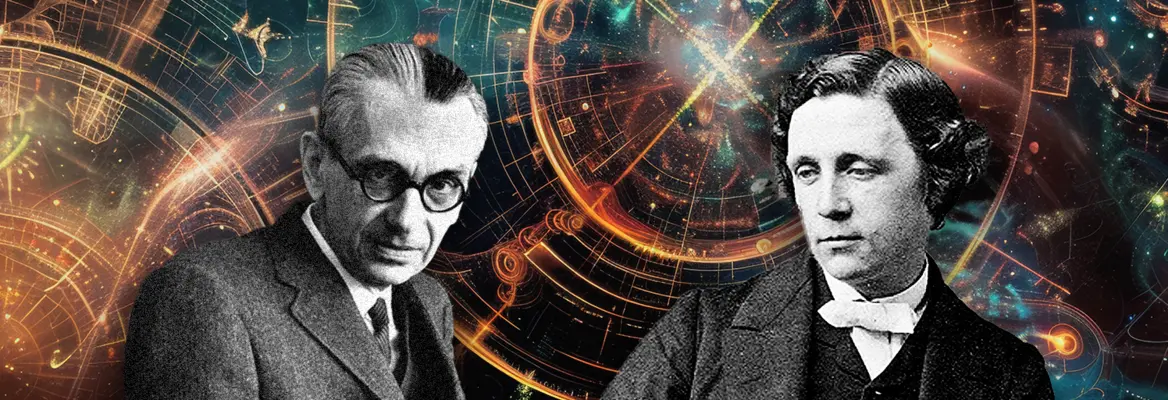

The classic story of science and mathematics was that reason could reach through to some pure, complete understanding of the world. But from Lewis Carroll’s work as a mathematician to Gödel’s incompleteness theorems, mathematics, and therefore the science it underlies, tells a different story. As Minh-Hoang Nguyen argues, the world, like that of Wonderland, is fundamentally incomplete. The notion that we live in a closed system that can be fully explained was not just unachievable; it was a philosophical mistake.
Mathematics is often mistaken for a discipline of quick calculations and precise answers. Yet mathematics is not fundamentally about arithmetic. At its deepest level, mathematics is an exercise of world-building.
Mathematicians start off with as small as possible a collection of assumptions, known as axioms. From this, they aim to construct an entire conceptual universe, be it to represent just mathematics or the physical world. Traditionally starting out with a simple notion of a set, increasingly complex structures emerge: numbers, functions, geometry, topology, and many of the abstract ideas that occupy contemporary research questions. Mathematicians, like architects or city planners, build up from a handful of principles to construct roads, boulevards and streets governed by internally consistent rules.
At the beginning of the twentieth century, the mathematical consensus was that we were reaching the end of the project. The success of Cantor’s set theory, further developed by Zermelo and Fraenkel, led the field to close in around Zermelo–Fraenkel set theory with the axiom of choice (ZFC). This system was thought to provide a secure and elegant system through which every mathematical truth could be proven, and through its formal structures no contradictions could lead us to falsehood.
And yet, in 1931, Kurt Gödel devastated many and inspired more by showing that the dream of a perfectly consistent and sound mathematical model was impossible. According to his theorems on incompleteness, no system of mathematics can prove all the true things that you can express in that language. Worse still, you could not disprove all the untrue things within that system either. Consistency, then, cannot ensure we can express all the truths we think we know about mathematics or the world.
Thinkers from Russell and Whitehead to Frege found themselves in a brand new situation. Their whole projects had been shown not only to be impossible, but for the very nature of mathematics to be flawed. So, no matter how we aim to construct mathematics, the language which forms the basis of our most assured conclusions, there will always remain truths and falsehoods we can never answer.
For human beings, whose cognition is biologically and evolutionarily oriented toward causality, coherence, and purpose, this can be undesirable because their epistemic desires and inner peace can never be fully fulfilled. When information from external reality proves incompatible with an incomplete epistemic system, it can become a source of uncertainty. If the system lacks the capacity to integrate new information coherently and consistently, the uncertainty can develop into moments of absurdity. This phenomenon can be further elaborated through the uncertainty–absurdity mutuality proposition illustrated in Vuong Quan Hoang’s Wild Wise Weird.
Want to continue reading?
Get unlimited access to insights from the world's leading thinkers.
Browse our subscription plans and subscribe to read more.
Already a subscriber? Log in
Love the iai?
Sign up to get exclusive access.

Related Posts:
Related Videos:


18th August 2026
Join the conversation