


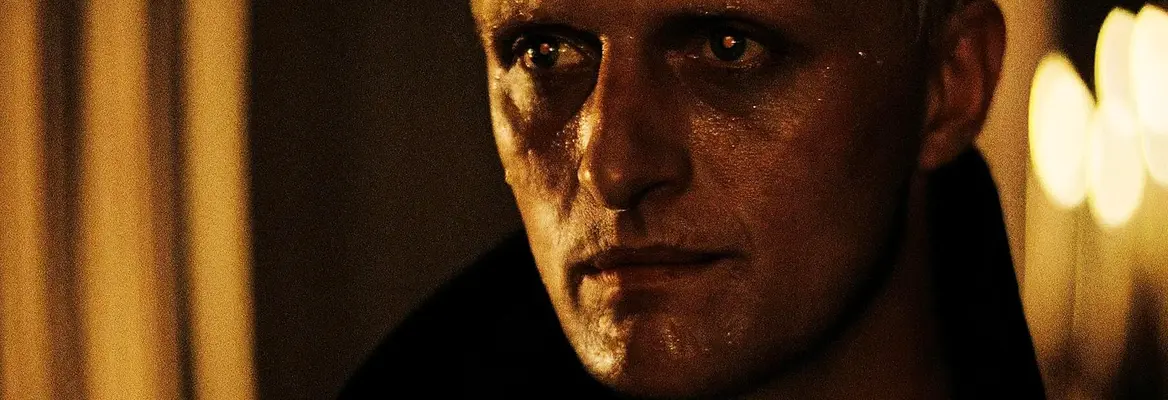

What does it mean to be human — and could a machine become one too? For philosopher Gigla Gonashvili, Ridley Scott’s Blade Runner is not a film about artificial intelligence but something older and stranger: fallen angels, trapped light, and the secret of human nature. Here, Gonashvili argues that humanity is defined not by the film's famous empathy test, but by a sense of shared mortality, and an elegiac awareness that every captured moment is already slipping away.
The world of Blade Runner (1982) is a graceless world. Unlike its sequel, which appeared thirty-five years later, the original film does not entertain the idea of a messiah, a miracle, a child born of synthetic humans. It is dark, gritty, in a film noir sense, in which the villain outshines the supposed hero. As the bounty hunter (called “blade runner” in the film), Deckard rather unwillingly accepts his assignment—to retire, that is, to kill—the humanoid robots called replicants, he gets immersed in a world which seems to make him doubt how he should act (and this goes, perhaps, for Harrison Ford as well, who plays the hunter). After all, the name Deckard sounds rather close to Descartes—the philosopher for whom radical doubt was a method, and the body foremost a machine.
Enter Roy Batty (Rutger Hauer), with his demonic glow and his quest for a life that is, if not immortal, at least properly long—and worthy of the name. In the film’s final moments, Deckard finds himself hanging from a rooftop in pouring rain. He is spared. Batty delivers a now iconic monologue—“Tears in Rain”—which Hauer rewrote the night before the scene was shot, stripping the original script down to pure poetry. A replicant, a machine, prepares to relinquish his synthetic soul; and yet he wonders at all the glorious moments he has lived and seen. He speaks from within an intimate paradox: “all those moments will be lost in time, like tears in rain.” There, he voices a deeply human truth—of a creature who, while not a machine, is still a material, composed being, susceptible to degradation and to the ultimate dissolution. After all, the word “human” carries an elegiac hue: homo, from humus, means the earth, the clay, the ground to which we return.
Fallen angels
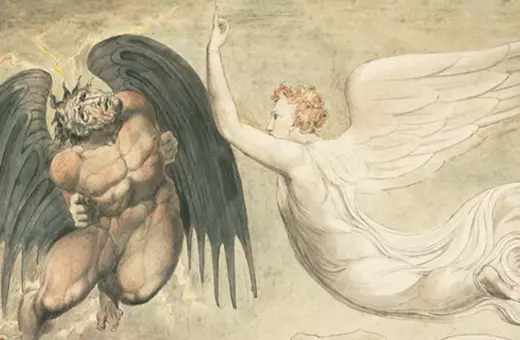
The world of the original Blade Runner is also that of a Fall. “Fiery the angels fell,“ Roy Batty recites, misquoting William Blake (who wrote, in America: A Prophecy, “fiery the angels rose“). The inversion is not accidental. These beings, created for free labor in off-world colonies, rebel against their original purpose and original design, and descend to the underworld—which is Earth in this case: Los Angeles in 2019, a city submerged under pollution and near-incessant rain, marked by its pyramid-like buildings and industrial fires.
Thus, they disobey their original purpose and depart in search of a maker who cannot—or will not—give them what they need. Dr. Eldon Tyrell resides at the very top of a pyramidal Tyrell Corporation. Roy and the others find their way to his chamber: only to hear, from Tyrell, that their meagre four-year lifespans cannot be extended. Roy, disappointed and enraged, kills him, crushing his skull by pressing his thumbs into his eyes and squashing them.

Want to continue reading?
Get unlimited access to insights from the world's leading thinkers.
Browse our subscription plans and subscribe to read more.
Already a subscriber? Log in
Love the iai?
Sign up to get exclusive access.

Related Posts:
Related Videos:

15th October 2026

Join the conversation