



Chinese philosopher Tongdong Bai recently argued in IAI News that democracy and liberalism are fundamentally at odds. Electoral majorities often support illiberal policies, and this, he thinks, will lead to the demise of Western “liberal democracies.” Today, Princeton political philosopher Philip Pettit responds, arguing that liberalism is essential to democracy. Tongdong’s mistake, he argues, is to equate democracy solely with elections. The point of democracy is to give people power over government, but elections alone are not enough to do this. Ordinary people must also be able to contest those in government through a free media, in independent courts, and without fear of persecution. Only liberal values and institutions make this possible.
Tongdong Bai’s article, “Democracy and liberalism are incompatible,” like all his work, offers an intriguing Confucian perspective on democracy. He begins from the assumption that democracy is about “the rule of the majority,” and that it is built around the idea that “each individual should have an equal say in the political decision-making process”: that is, around “the convention of one-person-one-vote.” On this assumption, government is “by the people” and that, he suggests, raises a problem. For there is no guarantee within a majoritarian electoral system that it will be “for the people”; more specifically, that it will provide for the “equal opportunities and equality before the law” that he associates with liberalism. On the contrary, he says, recent experience has taught us that it is liable to give rise to a right-wing populism which threatens to erode liberal rights of that kind. Among a range of baneful effects that he lists, “it often encourages the majority to silence minorities,” perhaps even “leading to ethnic cleansing in fledgling democracies.”
I agree with Tongdong that a purely electoral system of the kind he imagines is certainly liable to generate devastating problems. But the question I want to raise is whether it is fair, in theory or in practice, to equate democracy with such a system, distinguishing it from liberalism. I think of democracy as a system under which the collective people exercise a checking power over government and thereby guard individuals against state abuse, and I believe that such a system needs to have a liberal or constitutional aspect as well as an electoral one. More on that later. First, however, a little history.
 SUGGESTED READING
Democracy and liberalism are incompatible
By Tongdong Bai
SUGGESTED READING
Democracy and liberalism are incompatible
By Tongdong Bai
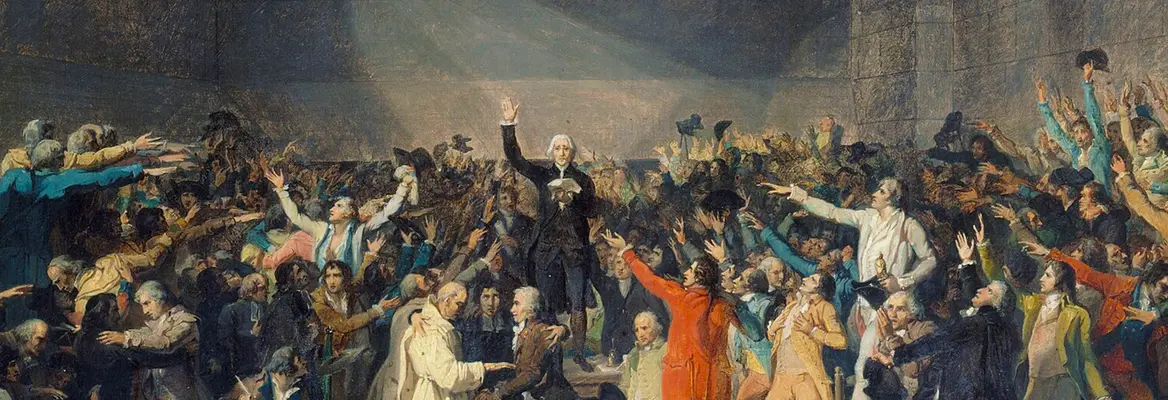
The idea of an electoral democracy—a system where the suffrage ceases to be significantly restricted—entered public thinking over the last few hundred years under a different name: that of a representative system, which was described by James Mill (father of John Stuart Mill) in 1819 as “the grand invention of modern times.” And as the representative system evolved within Britain, the United States, France, Australia and other countries, it was taken to be just one element in a wider cultural and legal setting. In that setting, a written or unwritten constitution laid down the rules on how legislative, executive and judicial authorities should be organized, on how different authorities should be required to perform individually and in tandem, and on what protections should be available to ordinary citizens under the authority of the state; the citizenry gradually expanded but remained limited in early days on grounds of gender and property.
Want to continue reading?
Get unlimited access to insights from the world's leading thinkers.
Browse our subscription plans and subscribe to read more.
Already a subscriber? Log in
Love the iai?
Sign up to get exclusive access.

Related Posts:


Related Videos:
10th September 2026

Join the conversation