



In a culture obsessed with optimisation, equanimity — the quality of maintaining inner balance and steadiness — is widely praised as a productivity tool. But what if its defining feature is its absolute uselessness? Psychoanalyst Michael Uebel argues that even within philosophical Buddhism and psychology, equanimity is too often treated as a means to an end, when its essence lies instead in aiming at, and achieving, absolutely nothing.
The value of practicing equanimity is widely celebrated and indeed taken for granted—for example, in ancient Greek philosophy and Buddhism, and especially in the contemporary psychologies that derive from both. But what if the facet of equanimity that most clearly reflects its essence is its absolute uselessness? Here, I want to explore the meanings of equanimity, both received and radical, in order to highlight the nonutility at its core, where nothing is aimed at, and nothing is finally achieved. It is precisely in this “nothing” that I think equanimity finds its true value.
Equanimity is one of those words that immediately evokes positivity. Who doesn’t want to be calm, cool, and collected in the face of life’s adversities and vicissitudes? Steady, imperturbable, not easily overwhelmed? Count me in. And as news events and social media storms relentlessly demand of us that we quickly, sometimes uncritically, choose a side—right or wrong, objective or subjective, rational or emotional—wouldn’t it be ever so restorative to stand above heated debates that often pull us into defending or condemning points of view held as singular Truths?
___
With the flourishing of the earliest Buddhist texts (after the 1st century BCE), equanimity attains the status of a spiritual virtue rooted in insight and mindfulness.
___
Consider the word equanimity. It is derived from aequus, a Latin adjective meaning level, equal, or fair. Combined with animus (soul or mind), as in the phrase aequo animo, the notion of acting “with an even mind” emerged. It wasn’t until early in the 17th century that English speakers, in keeping with the Latin phrase, began using the term in the now obsolete sense of “fairness or justness of judgment.” Equanimity quickly came to connote keeping a cool head under pressure and, eventually, it acquired the extended sense of general balance and internal harmony, even peacefulness.
As an essential virtue, equanimity has long held a kind of hallowed place in the Western moral imagination, from the ancient Greeks until the present day. Originally a dimension of eudaimonia (often translated as flourishing or happiness), it was understood along Aristotelian lines in the context of living in accordance with virtue. We may recognize its echo in closely related Latin terms, including tranquillitas and serenitas.
Reaching back to pre-Socratic thinkers like Democritus and Greek philosophical schools, most notably Epicureanism and Stoicism, a constellation of words would give expression to a series of similar dispositions: euthymia (good mood or cheerfulness), athambia (having a mind free from fear); hesychia (stillness or silence); ataraxia (freedom from mental distress); and apatheia (undisturbed by the passions).
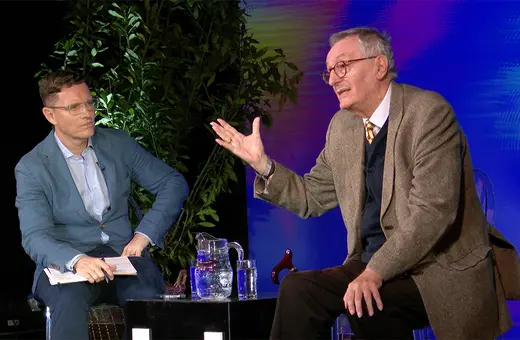
 SUGGESTED VIEWING
How to be a Stoic
With Massimo Pigliucci
SUGGESTED VIEWING
How to be a Stoic
With Massimo Pigliucci
The difference between the sage and the fool, in the Stoic view, is that the former accepts what comes with equanimity, while the latter, through egotistical striving, accepts only what he likes and refuses what he does not. Importantly, ataraxia was never the ultimate goal in Stoicism but a natural byproduct of commitment to virtue and living in accord with nature. While in the Epicurean view equanimity was an end in itself, the Stoic approached it as a state that arises spontaneously through virtuous action and rational management of judgment and desire.
Want to continue reading?
Get unlimited access to insights from the world's leading thinkers.
Browse our subscription plans and subscribe to read more.
Already a subscriber? Log in
Love the iai?
Sign up to get exclusive access.

Related Posts:



Related Videos:


16th February 2026


Join the conversation