


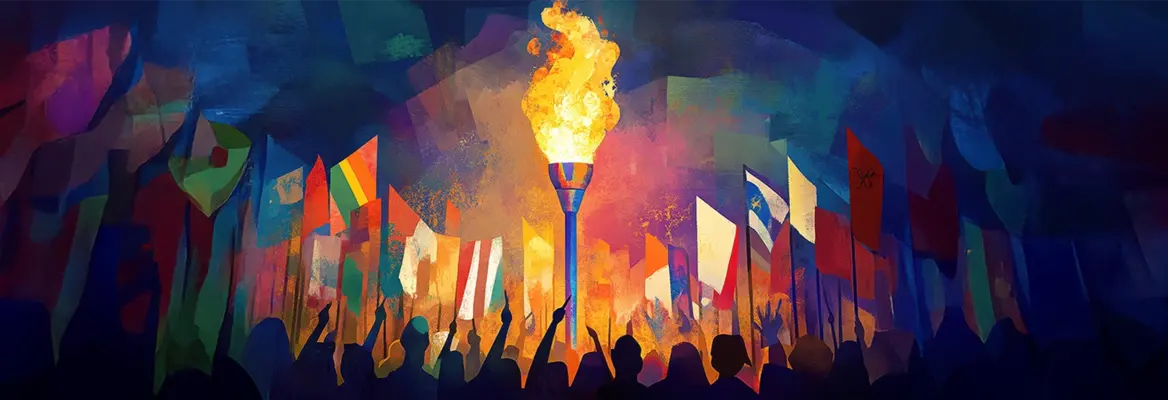

Nationalism tends to be seen as radical and is associated mainly with far-right politics. However, Siniša Malešević argues that this understanding of nationalism is narrow and misleading. In fact, nationalism is ubiquitous within our culture, from national pride to sport to religion. Progressives must therefore repurpose nationalism, not by copying the discourse of the political right, but by looking back to nationalism’s origins in the French Revolution and the ideas of liberté, égalité and fraternité. Progressives must focus on commonly built and used institutions, shared everyday values and practices, and the common lived experiences of citizens inhabiting the same nation-state.
In contemporary public discourse, nationalism is regularly associated with radical politics. This label is typically attached to far-right movements that deploy populist rhetoric and promote nativist ideas and militant anti-immigrant policies, such as the Sweden Democrats or National Rally of France. Alternatively, this term is used to characterize radical political parties that advocate separatism and independence of new states or promote the unification of two territorial units, such as Vlaams Belang in Belgium or Sinn Féin in Northern Ireland. Nationalism is also linked to violent events such as wars, terrorism and genocide—from the 1990s wars of Yugoslav succession, to Sri Lanka’s LTTE’s suicide missions for Tamil independence, or the mass killings of Interahamwe militias in the name of the Hutu nation in Rwanda.
Nevertheless, such an understanding of nationalism is too narrow and misleading. This social phenomenon is not necessarily radical, as most forms of nationalist activities are distinctly non-violent and ordinary. The popular association of nationalism with radicalism conceals how significant this phenomenon is in the contemporary world. Rather than being a marginal or radical political project, nationalism is, in fact, the dominant form of modern subjectivity, and this is reflected in nearly every aspect of social life.
___
As numerous public polls indicate, the great majority of people in the world identify strongly in national terms.
___
As I argue in my new book Nationalism as a Way of Life: The Rise and Transformation of Modern Subjectivities (CUP 2025), nationalism is deeply embedded in the dominant institutions, social practices and values of contemporary societies. Nationalism is a worldview that posits the nation as a principal unit of collective solidarity and political legitimacy. This highly flexible and multifaceted discourse underpins the everyday practices, beliefs and lived experience of billions of people today. Nationalism is not confined to the political right, centre or left—it can easily amalgamate with any political ideology. Moreover, once the nation-state has become the dominant form of territorial organization in the world, nationalism has acquired this hegemonic position.
Since all nation-states legitimize their existence through ideas of popular sovereignty, cultural authenticity, political equality, and national independence, they inevitably rely on and promote nationalist principles. This dominance of nationalism is achieved through the ever-increasing organizational capacity of states and other social organizations, their ideological penetration within contemporary societies, and their ability to successfully tap into the micro-level solidarities of close kinship and friendship networks. In this way, nation-centric idioms and practices become normalized and naturalized in everyday life.
Want to continue reading?
Get unlimited access to insights from the world's leading thinkers.
Browse our subscription plans and subscribe to read more.
Already a subscriber? Log in
Love the iai?
Sign up to get exclusive access.

Related Posts:



Related Videos:




6th January 2026


Join the conversation
Chris Thirkell 8 January 2026
Personally, I consider nationalism a form of delusion, and the sooner we leave it behind, the better.