




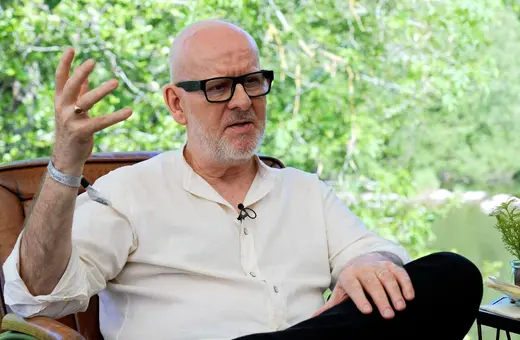
We never see tables in two places at once or cats that are both dead and alive—yet this is exactly what quantum mechanics predicts. As a result, it has typically been assumed that quantum mechanics only applies to small scales. But according to Oxford physicist Vlatko Vedral, this is a radical mistake. The universe is quantum at every scale, and we only get paradoxes of quantum mechanics when we insist on a classical world outside it. In this interview, IAI contributing editor Ozbir Kip challenges Vedral on whether reality is really quantum all the way up.
Kip: Your work is primarily in quantum information. Most of us are familiar with or have heard of quantum mechanics. Can you tell us a bit about what quantum information is as a field of study?
Vedral: Yes, this was a big revolution that started maybe in the ‘60s and ‘70s. It was a realization that how much information you can encode into a physical system and how quickly you can process this information are not abstract mathematical laws, but fundamentally depend on the laws of physics.
That was a huge step because in the ‘60s and ‘70s, various researchers realized that the laws of classical physics are not sufficient if you’re ultimately going to encode information into quantum systems. And even more excitingly, not only does classical physics fail; actually, quantum mechanics allows you to do better. You can store more information and you can process it much faster. And that’s really the field of quantum information.
You start your book by talking about the different interpretations of quantum mechanics, and you don’t think any of them succeed. Why is that?
Yes, I think that’s extremely interesting as a question, which is not obvious at all: how what we call the Copenhagen interpretation really became the dominant interpretation of quantum mechanics. The name comes from the fact that Niels Bohr, the Danish physicist, one of the pioneers of quantum physics, really was promoting it in the mid-’20s, right when quantum mechanics was discovered. He had a number of people in his group—Heisenberg was there, Pauli was there—and a number of other luminaries, who I think agreed more or less with Bohr that this was the way to think about it.
 SUGGESTED READING
100 years of quantum mechanics: a new approach is needed
By Emily Adlam
There were a number of other possibilities there. Some people advocated that maybe there will be a return to physics that looks more like classical physics—that there would be some kind of hidden variables that we may be able to find that go beyond quantum mechanics and actually turn it back into a form of classical physics. And we have a lot of other interpretations.
I think the closest to reality, in my view, is what is known as the many-worlds interpretation. I object more to the name of this interpretation than what it says. I think the details are correct—maybe not all the details. In the Copenhagen interpretation, people advocate that in order to understand the quantum realm, we always need an outside classical domain. And that’s what I’m arguing against in my book. The argument in the book is really that no hybrid account—a universe which is half classical and half quantum—will really be able to capture all of the phenomena that we are aware of. It’s ultimately inconsistent in my view.
Want to continue reading?
Get unlimited access to insights from the world's leading thinkers.
Browse our subscription plans and subscribe to read more.
Already a subscriber? Log in
Love the iai?
Sign up to get exclusive access.

Related Posts:


Related Videos:
Ozbir Kip
29th October 2026


Join the conversation