


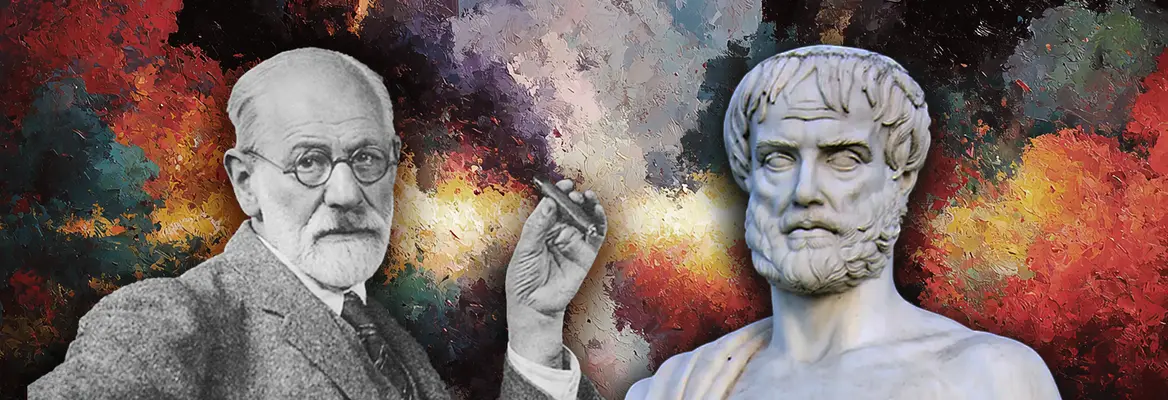

Many have sought to harmonize our human nature with the demands of society. Some philosophers like Aristotle even thought the perfection of our human nature and the demands of civic life went hand in hand. Freud disagreed. Drawing on Freud's persistent pessimism, philosopher Edward Harcourt argues that civilization and our instincts are permanently at odds. Contrary to many forms of contemporary psychoanalytic thought, Harcourt argues that psychoanalysis cannot make this conflict go away. It can only bring it more sharply into view.
Freud and Aristotle aren’t always spoken about in the same breath, but though Freud gets filed under “psychoanalysis” and Aristotle under “philosophy,” they grappled with many of the same questions. So if we want to understand Freud’s pessimism, Aristotle is a good place to start, not because he shared it but because he didn’t.
Aristotle thought our “first nature”—what we’re born with, our biological endowment—is capable of thoroughgoing transformation by culture, education, induction into a society and its ways: what the Germans call Bildung. And the results of that transformation are twofold: first of all, the acquisition of the virtues and, secondly, eudaemonia or happiness. For Aristotle thought not only that we are made for virtue, but also that virtue and happiness go together. The human beings who perfect their natural endowments will not only be happy, but also more or less effortlessly inhabit civic life. Pursuing political ambitions—even pursuing personal fame and greatness—fit into this account, since self-denial doesn’t have the same place in Aristotle’s view of the virtues as it does in later Christian or post-Christian formulations. (“Lack of proper ambition” is an Aristotelian vice.) But such pursuits must be equipped with motivations of truthfulness, justice, kindness, and fidelity to promises—civic virtues—all under the guidance of practical wisdom, so these apparently competing motivations can be navigated without conflict.
___
In one of [Freud's] most frequently quoted remarks, psychoanalysis replaces neurosis with “ordinary unhappiness”.
___
That’s an attractive picture because the virtues and self-realization—taking the developmental path that your nature has laid down for you—come together as part of a single package. And with some variations, it’s a picture we also find outside philosophy, in some post-Freudian psychoanalytic thinkers, DW Winnicott, for example. Though he has a broader conception than Aristotle of what Bildung brings with it—art, religion, and play are in there—these are all part of the proper development of our natures, not in tension with it.
Freud rejects this optimistic picture. To be sure, he thinks—not unlike Aristotle—that it’s part of our human natures to shape up for civic life as we develop. In fact, he thinks we need to do so in order merely to survive: if we lived by the pleasure principle alone—hallucinating the objects that satisfy our instincts—we wouldn’t last long. The trouble is that in shaping up for civic life, our “first natures” are not, as in Aristotle or Winnicott, transformed without residue. On the contrary, all sorts of inconvenient and conflicting impulses stick around, creating the possibility for psychic conflict and potentially making mischief all our lives long.
Want to continue reading?
Get unlimited access to insights from the world's leading thinkers.
Browse our subscription plans and subscribe to read more.
Already a subscriber? Log in
Love the iai?
Sign up to get exclusive access.

Related Posts:
Related Videos:


8th June 2026


Join the conversation