


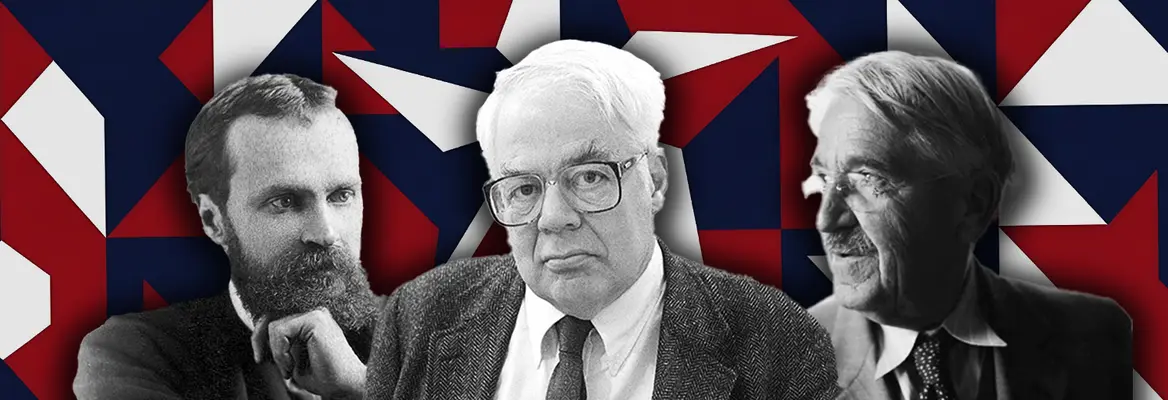

America has long been seen as a latecomer to philosophy, trying to play catch-up with Europe. But according to philosopher Steve Fuller, this misreads what pragmatists like James, Dewey, and Rorty were up to. The American Pragmatists weren’t joining the existing Western philosophical tradition. They were hijacking it, recasting truth, meaning, and reason in terms that placed America at the center of history.
Richard Rorty was the greatest Pragmatist philosopher of the second half of the twentieth century. He didn’t have much competition. Pragmatism had effectively died with John Dewey in 1952, if not earlier. Before Rorty burst on the US philosophical scene in the 1970s, self-described “Pragmatists” were usually teaching the history of philosophy, as Rorty himself was at Princeton. By the lights of the dominant analytic school of philosophy (both then and now), history is a low-rent district. However, if the low-rent district is located in America’s premier philosophy department, ideas coming from there could have impact, a prospect that Rorty fully exploited.
Rorty sometimes called his philosophy “Neo-Pragmatism,” but it was really a reinvention of the original movement, a “Pragmatism 2.0.” Rorty had the advantage of living after Pragmatism 1.0 had run its course, which allowed him to see it in what Kant would regard as “aesthetic” terms. In the Critique of Judgement, Kant famously said that art is purposive while lacking a purpose. We might now say that art is meaningful even if we don’t know the exact meaning—or even if such a meaning is to be known. The same applies to philosophical movements. In Pragmatism’s heyday, philosophers argued about whether its reduction of meaning and truth to instrumental value did sufficient justice to these hallowed concepts. But once that discursive moment had passed, the question remained, “What was that (Pragmatism) all about?” Rorty’s “Neo-Pragmatism” was an answer to that question.
Pragmatism’s doctrines had precedents in what was then the recent history of European philosophy, especially Kant’s association of “practical reason” with will power and Mill’s expansive conception of utility to include all human value. Its elevation of these moral theories into a general worldview reached back to medieval nominalism’s attitudes towards language and truth. But above all, Pragmatism came from the United States of America, a newcomer to the philosophical conversation that was taken seriously by its European interlocutors, even as they disagreed with what the likes of William James and John Dewey were propounding. In our decidedly “postcolonial” times, the introduction of such non-European voices was notable, since it started a generation before the balance of global power had begun to shift decisively across the Atlantic.
___
Before he died in 1830, Hegel had predicted (prophesied?) that the United States was the next landing zone for the world-historic spirit.
___
And while it was fashionable for virtually all twentieth-century schools of philosophy to blame Hegel for everything wrong with the field, he can be reasonably credited with inspiring the nascent American philosophical community to assert itself on the world stage. Hegel famously proposed that the world-historic spirit, like the sun, rose in the East and set in the West, perhaps to rise again. (China now banks on that.) Before he died in 1830, Hegel had predicted (prophesied?) that the United States was the next landing zone for the world-historic spirit.
Want to continue reading?
Get unlimited access to insights from the world's leading thinkers.
Browse our subscription plans and subscribe to read more.
Already a subscriber? Log in
Love the iai?
Sign up to get exclusive access.

Related Posts:



Related Videos:



28th May 2026

Join the conversation
Brian Balke 9 June 2026
A pox on all your houses. Except Wittgenstein.
1. Language did not evolve to convey truth. It evolved to stimulate and organize the operation of the imagination. To prioritize truth is to lobotomize human ingenuity.
2. Stated alternatively, what is true is not nearly as important as what is possible. The magic of science is that it helps us to create new truths. Look around you.
3. The value of an idea is not found in its commercialization. It is found in the fecundity of the thought processes known to those who assimilate it. If you want to know truth, as Jesus testified to Pilate, you must choose love. Attempts to control knowledge drive it into hiding. Strangely, to my knowledge the closest echo comes from the Nazi, Heidegger.
Bry Willis 28 May 2026
As an American steeped in this (and other) traditions, it's genuinely hard to escape the gravitational forces and the ontological grammar. It may be harder still to recognise when one is arguing from within an ontological commitment. I'm not certain one can truly and fully escape this, let's say, programming.
CarlDavidson 31 May 2026
Nice work, but it needs to include a bit more. George Herbert Mead, Dewey's sidekick, is the founder of social psychology, and if pragmatism has a metaphysical side, we'll find it in Mead. And don't minimize Dewey's instrumentalist theory of truth. I could make a good argument that it rescues dialectical materialism for the 20th and 21st centuries.