


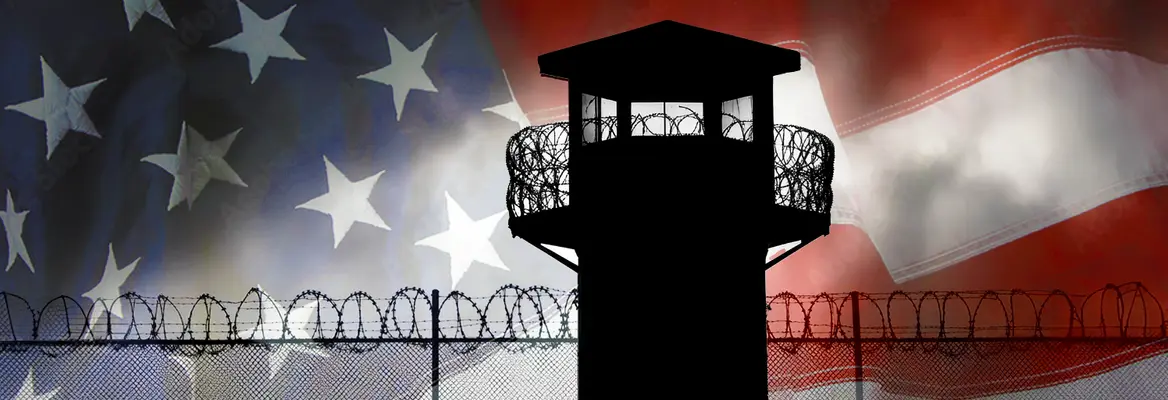

America claims to be a nation built on freedom that views state intrusion into individual liberty as the ultimate tyranny – so why does it have the world’s largest prison population? NYU law professor David Garland argues that this clash between a professed love of liberty and a massive apparatus of confinement is the logical outcome of the country’s political economy. Rather than prioritising dignity and flourishing, America’s freedom has always centred around markets, and free markets need a penal state to control the wreckage that they leave behind.
In the early 1830s, Alexis de Tocqueville, the first and still best-known theorist of American society, formulated a paradox about the young nation. America was, he said, a land “of the most extended liberty” and yet its prisons “offer the spectacle of the most complete despotism.” Freedom and unfreedom were juxtaposed in a way that surprised the French visitor and struck him as ironic.
Nearly two centuries later, commentators still find it puzzling that liberal America deploys its penal power more extensively and intensively than any other country in the world. How could America, that storied land of liberty, be home to mass incarceration, police killings, and racialized law enforcement? How could it be a comparative outlier on virtually every dimension of criminal justice.
In a recent book, entitled Law and Order Leviathan: America’s Extraordinary Regime of Policing and Punishment, I argue that there is nothing paradoxical about America’s reliance upon a massive penal state. The liberalism characterizing modern America is, first and foremost, an economic liberalism, dedicated to “free enterprise” and the free rein of market forces rather than a political liberalism concerned with the dignity and flourishing of every individual.
___
Rather than protect all from each, as in the Hobbesian social contract, America’s penal state provides protection to some groups and some places while oppressing and excluding others.
___
Since the collapse of the New Deal order in the 1970s, the nation’s politics have been dominated by a tough-minded market fundamentalism that empowers corporations and the business class; renders working families insecure; holds individuals responsible for their fate; and pays little heed to the liberty interests of poor people—particularly if they are Black and accused of a crime. In such a system, extensive penal control is a corollary of the nation’s values—not a contradiction. If there is a tension between America’s social arrangements and the fact of mass incarceration, it exists chiefly in the domain of ideology and national self-regard—and we know from the history of slavery and segregation that ideological dissonance of that sort can be tolerated for long periods of time.
Capitalism is always a socially disruptive force, and historically it has been especially disruptive in the US, where comparatively few restraints have been imposed on corporate power and market forces. In American cities between the 1970s and the early 1990s, these long-standing conditions were dramatically intensified first by deindustrialization, then by the retrenchment of federal urban policy, and finally by a resurgent, “free market” capitalism that generated levels of social disorganization, disorder, and violence rarely witnessed in the developed world.
In the face of this disorder, and against a background of deepening economic insecurity, a substantial part of the American electorate came to fear crime and violence—and threats to their property values—more than they feared the illiberal use of state power. The result was a new kind of social contract between Americans and their government: a “law and order” covenant in which voters repeatedly gave their consent to policies promising public safety through penal control.
Want to continue reading?
Get unlimited access to insights from the world's leading thinkers.
Browse our subscription plans and subscribe to read more.
Already a subscriber? Log in
Love the iai?
Sign up to get exclusive access.

Related Posts:
Related Videos:



21st August 2026

Join the conversation