



The conventional story says societies grow more tolerant as they grow richer—but this comforting Enlightenment idea now looks distinctly old-fashioned. Nowhere is this clearer than in attitudes towards sexuality, where classicist and historian Harry Tanner argues the real driver of homophobia is neither wealth nor mere bigotry, but something stranger: a politics of self-restraint that takes hold when economies come under stress. In ancient Athens, plague, war and rising inequality bred a cult of discipline in which acting on desire became a mark of the untrustworthy and the unfit-to-govern. Queer citizens, once celebrated, were suddenly prosecuted. The same logic, Tanner suggests, recurs from Renaissance Florence to the populist right today.
Why wasn’t there more shock when Nigel Farage very publicly disagreed with same-sex marriage on LBC? Homophobia has long been an odd quirk of right-wing parties. All over the world, a populist movement is gaining momentum that places LGBT+ people’s rights under attack. In Japan, a new hard-right Prime Minister has voiced her opposition to same-sex marriage; in Hungary, a far-right government banned Pride; in Poland, the MEP Grzegorz Braun has attacked LGBT+ exhibitions; Giorgia Meloni is attacking queer parents and so-called “gender ideology.” Donald Trump has urged Republicans to deploy anti-trans messaging during the mid-term elections, and the Republican campaign has spent $200 million on anti-trans ads. Trump himself has previously expressed support for trans people, having supported them in the past, but sees transphobia as a political tool. The question is: why does this work? It’s easy to say it’s about “scapegoating” or the politics of distraction. But there’s a pattern linking society’s attitudes to wealth and sexuality that better explains the Right’s position.
As a classicist studying the ancient world, I’m all too aware that queer love has flourished and been destroyed by puritanical zealots throughout history. Ancient Greece, Rome, and Mesopotamia were known, perhaps even notorious, for their tales of same-sex love, but that tolerance didn’t last. How was it that civilizations turned against the queer citizens they’d once celebrated? A new way of thinking emerged in societies which faced sustained economic and societal pressures—an increasingly frightening and uncontrollable world led people to police themselves. An intense politics of self-control emerges in these pressurized societies. Women’s sexuality becomes more fiercely policed and queer identities are erased.
___
When we look closely we can see a repeating pattern throughout history—a sudden rise in inequality is often followed by a period of rampant homophobia.
___
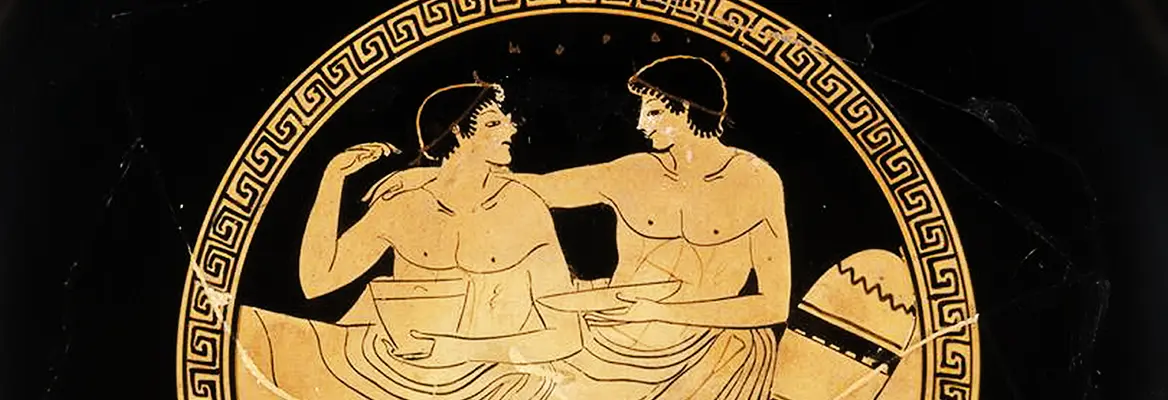
There is good evidence that gay men could live openly with their partners in archaic Greece, particularly in Boeotia where archaeologists have discovered depictions of what look like same-sex marriage ceremonies. Achilles and Patroclus have been said to have been lovers, in a tale widely popularized by both the contemporary novelist Madeline Miller and by the ancient Athenian playwright Aeschylus. The Athenians in particular manufactured vast quantities of what I call “porn pots,” which often depict graphic sex between people of the same sex. But, for some mysterious reason, by 450 BCE they stopped making them. And only a couple of decades later, things had taken an abrupt turn for the worse. Not only had Athenians turned away from artistic depictions of gay sex, but they’d started prosecuting gay men.
Want to continue reading?
Get unlimited access to insights from the world's leading thinkers.
Browse our subscription plans and subscribe to read more.
Already a subscriber? Log in
Love the iai?
Sign up to get exclusive access.

Related Posts:



Related Videos:




25th June 2026



Join the conversation