
Silicon Valley's quest for immortality is a mistake

Living forever would make life meaningless

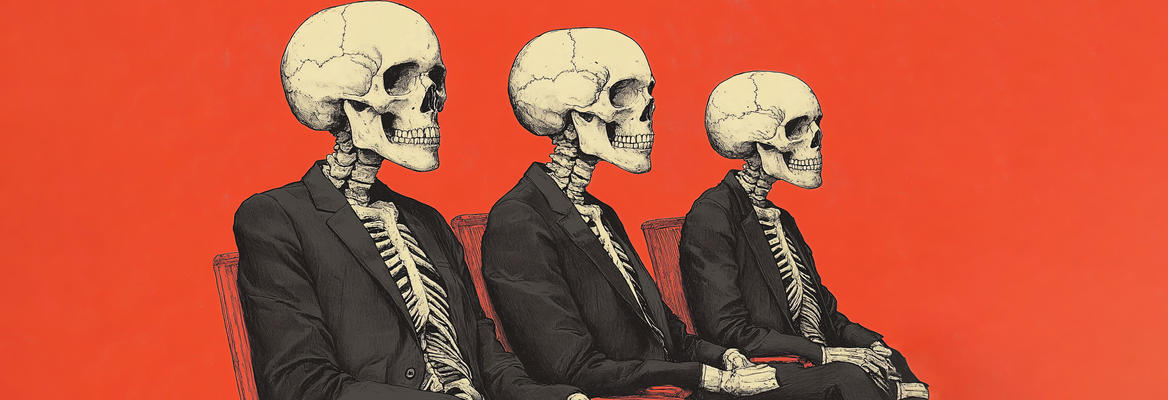
Three skeletons in black suits sit on red chairs against a bright red background, each with a distinct expression.

If you could live forever, would you? Modern medicine has allowed us to drastically increase our lifespans, and science doesn’t appear to be slowing down. Some in Silicon Valley have embarked on a “quest for immortality” in the hope that advances in medicine and technology will make eternal life possible. But if immortality became possible, would it necessarily be desirable? Philosopher Todd May argues that we should not hope to be immortal since it would make our lives shapeless, aimless, and boring.


I like a good slice of pizza.  A lot.  Not that stuff you get from chain pizza places like Papa Johns or Domino’s.  No, a serious slice from a local place, preferably a little grungy looking, that doesn’t have another franchise down the block or even in another city.

I could eat a good slice or two on most days.  And I could do that for many years.  But how many years?  Could I do it for three hundred years?  Probably.  Three thousand?  Maybe.  How about twenty thousand or thirty thousand?  At some point, I think, I’ll have had enough pizza to last…well, you get the idea.

___

Immortality is not something that most of us – probably any of us – would want.

___

Currently there are a number of folks in privileged positions, many of them living and working in Silicon Valley, that are keen on the possibility of living forever.  Among their various goals, such as making people hate one another through social media and then replacing them with artificial intelligence, is that of gracing our planet with their presence forever.  And among the rest of us there might be many who would envy them, should they succeed.  Well, let me spend this short essay convincing you that you shouldn’t.  Immortality is not something that most of us – probably any of us – would want.

death SUGGESTED READING 5 philosophers on how to face death By Steven Luper The great writer Jorge Luis Borges once penned a story called “The Immortal.”  In it, a man finds himself in a land where everyone lives forever, the City of the Immortals.  He’s surprised to find the place is utterly neglected.  The immortals live only in their thoughts.  The physical world means nothing to them, and, in fact, their thoughts mean little more.  There is nothing that needs to be done, because there is time for everything.  Literally, everything.  One of the immortals, the poet Homer as it turns out, explains that, although he “composed the Odyssey; if we postulate an infinite period of time, with infinite circumstances and changes, the impossible thing is not to compose the Odyssey, at least once.”  There is no need to fix or do anything, because there’s always time to fix it or to do it.

___

By removing our lives from their mortal trajectory, we wind up making them shapeless.  Because there is time for everything, nothing has any urgency.

___

Here is the core problem with immortality.  By removing our lives from their mortal trajectory, we wind up making them shapeless.  Because there is time for everything, nothing has any urgency.  Whatever there is to do can be done tomorrow, or in ten thousand years.  As Homer tells the man who has arrived in the City of the Immortals, in a quote dripping with irony, “Death (or its allusion) makes men precious and pathetic.  They are moving because of their phantom condition; every act they execute may be their last; there is not a face that is not on the verge of dissolving like a face in a dream.  Everything among the mortals has the value of the irretrievable and the perilous.”

There are things we value participating in, things we love to do.  But can we do them forever?  At some point, wouldn’t they begin to lose their lustre?  Think of the things you most want to do or to be?  Playing music, becoming a poet, spending time with loved ones.  Now, think of what happens if you were to know that you would be doing these things, not three or four hundred, but ten or twenty or fifty thousand years from now.  Doesn’t that weigh upon you and remove from those activities “the value of the irretrievable and the perilous”?

Some people I discuss this with are not impressed.  “Sure,” they say, “I could do that forever.”  I think this involves a certain failure of imagination, though.  Let me offer a scenario I heard about it back in high school which has stayed with me since.  Imagine a desert the size of the Sahara.  (The Sahara itself will do.)  And now imagine a bird that flies over it, dipping and plucking one grain of sand in its beak and then flying off.  Ten thousand years pass before the bird returns and takes another grain of sand.  And then another ten thousand years.  In the time it takes for the bird to clear the entire Sahara Desert of sand, not an instant, not a flicker of immortality would have passed.

I think we can agree, then, that immortality lasts a long time.  What’s more, if somebody knows they’re immortal, it’s going to weigh on everything they do or consider doing.  Thus, the City of the Immortals.

Other people I’ve discussed this with bring up a different objection.  “Sure,” they say (these objections always begin with “Sure” for some reason), “doing the same thing over and over again, even if I love it, might begin to be a drag, but the world evolves.  There’s always something new and different to do, and so we would never need to get bored.  Our lives would just move from one thing to another.”

But, as the philosopher Bernard Williams suggests in an article on immortality entitled “The Makropulos case:  reflections on the tedium of immortality,” what I value doing, what is meaningful for me to be engaged in, has to have something to do with my life and history.  Although he focuses on philosophical reflection, the lesson here is a wider one.  As a result of our engagements with our various social, political, and economic environments – probably sprinkled in with a dash of genetics – we develop certain values and interests.  Some things are important to us and other things are stuff we just like.  The rest is background.  We may not hate most of it, but we’re indifferent to it.  Sometimes we can become interested in something that didn’t move us before – learning about painting did that for me – but there are things that just don’t move us to appreciation or participation.

That’s what it is to have a personality.  If we could be equally interested in anything, there wouldn’t be anything to us.  We’d be completely scattered, moving from one activity to another without any motivation or reason.  To put it another way, there wouldn’t be anything we cared about.

For me, a life of, say, fishing, bowling, and church would be alien to me.  I could live that life if I had to (I did spend 31 years in South Carolina), but it wouldn’t be my life.

With immortality, then, the fact that there might be lots of new things to do and experience wouldn’t by itself be enough to keep a person’s life vital to them.  The new stuff would have to connect to their values and interests.  And, as time went on, it’s likely that the connections would diminish, as it often does as people get older.

___

Immortality, when you think about it, is not all it’s cracked up to be.

___

So here we are:  doing the same thing for hundreds of thousands of years doesn’t offer a meaningful life, nor does the emergence of new and different things to do.  Immortality, when you think about it, is not all it’s cracked up to be.

This doesn’t mean that death is great or that our lives wouldn’t be better if they were longer.  For most of us, a longer life – assuming we’re healthy enough – would be welcome.  And death is not, unusual circumstances aside, an event to be embraced.  Instead it’s something necessary, something that must exist for our lives to have the shape they do, or any coherent shape at all.  Our lives require urgency:  the urgency of the irretrievable and perilous.  Which is why I think I’ll head out for a slice right about now.

Want to continue reading?

Get unlimited access to insights from the world's leading thinkers.

Browse our subscription plans and subscribe to read more.

Start Free Trial

Already a subscriber? Log in

Latest Releases
Join the conversation