


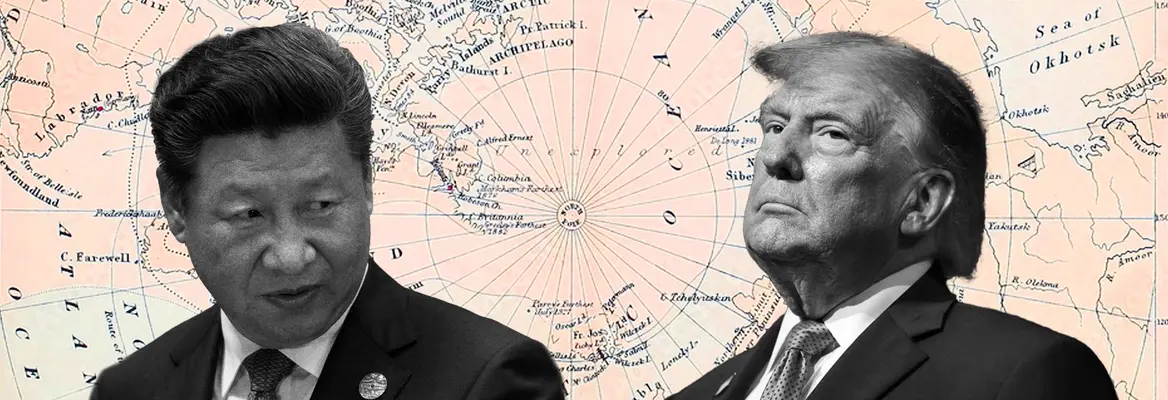

The battle over the Arctic shows why China’s economic philosophy is superior to America’s, argues Financial Times columnist Rana Foroohar in an interview with IAI’s Felix Butcher. As melting ice opens shipping routes in the Arctic and access to resources, power belongs to those with the industrial might to seize it. America assumed markets knew best and let its industry decline. China saw industrial and military power as connected. It prioritised shipbuilding, and now has 5,500 ocean-going vessels compared to fewer than 200 for America. America’s free-market fundamentalism showed a flawed understanding of geopolitical power. Building things matters.
Felix Butcher: You’re a Financial Times columnist and the author of several books, including most recently Sea Change: America’s New Great Game in the Arctic Circle. You argue that the Arctic is becoming the next arena for great power competition between the US, China and Russia. Could you explain why that is?
Rana Foroohar: In a couple of words: global warming. Nobody cared as much about what was happening in the Arctic until the poles started to melt. Arctic climate change is proceeding at a more rapid rate than climate change in other parts of the world, and one of the results of this is that the ice that had covered large swaths of the Arctic is now melting. The result of that is that transportation pathways are opening up. So you can now get ships through several months out of the year.
In fact, in September, China launched the first weekly shipping route across the poles, through the Northern Sea Route, which is largely controlled by Russia. This is a way of getting around choke points in the Strait of Hormuz, Suez Canal, Panama Canal, etc.
At the same time, you’ve got the US suddenly taking an interest in places like Greenland, and you’ve got a US-Canada trade war. There’s a race for rare earth minerals and for natural gas. Fishing in the Arctic is very rich still; it’s one of the largest untapped sources of protein on the planet. So there’s a lot going on in the Arctic.
In this book, not only did I take a trip up on America’s only icebreaker in the high north, which is the kind of ship that’s required to get up to the Arctic, but I also looked at the way in which the paradigm today really mirrors the great game of the nineteenth century. That was the rivalry between the British Empire and the Russian Empire that went on for decades, a hundred years by some measures. It roped in buffer states; you had countries coming in and out of the conflict at different times and in different theaters. That’s very much the paradigm that we’re headed for today, and the Arctic is a perfect example of it.
Want to continue reading?
Get unlimited access to insights from the world's leading thinkers.
Browse our subscription plans and subscribe to read more.
Already a subscriber? Log in
Love the iai?
Sign up to get exclusive access.

Related Posts:
Related Videos:
Felix Butcher
19th November 2026



Join the conversation