


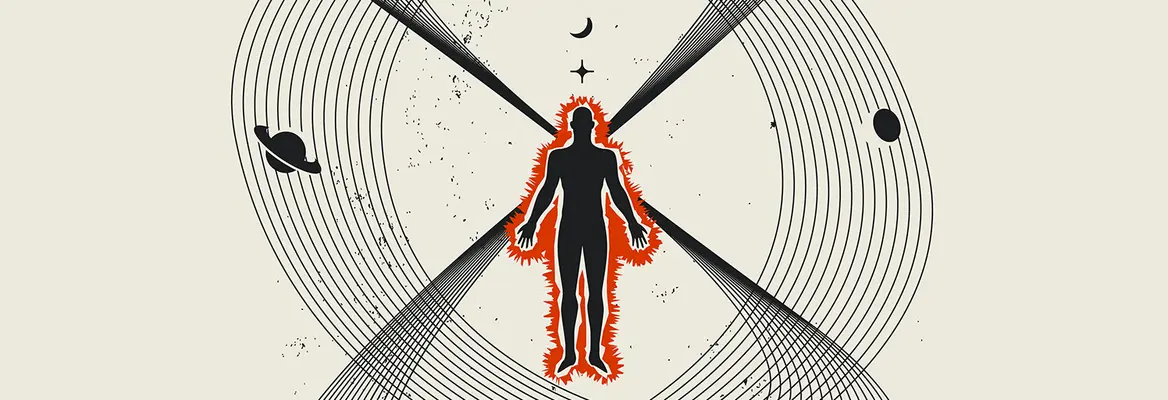

We treat the human being as though we are a finished project. We are not. Humanism gave us dignity and protection, and modern society has become expert at educating, employing and managing humans within set roles. But this misses what it means to be human, argues philosopher Leon Tsvasman. To be human means to be in a constant state of becoming, towards an unknown potential. We must protect our agency in the face of AI automation, and build new institutions to enable this human potential.
The humanist achievement harbors an ambiguity that becomes all the more apparent as the institutions founded upon it grow more technically proficient. Humanism liberated the dignity of the individual from inherited rank, utility, religious or political designation, and from the presumption of any authority to decide whose existence merits recognition. Nothing in my argument should be misconstrued as a trivialization of this achievement. Yet, the human being it protected was, at the same time, a creature already shaped within a specific web of survival imperatives, societal expectations, and institutional legibility. Protecting a human being and recognizing what that being might become are not the same thing; the remarkable success of the former may even obscure how rarely the latter has been attempted at all.
My concern, therefore, is neither the discovery of a supposedly authentic human nature nor the creation of a more highly developed specimen. Both endeavors would project into the future a definition whose very authority ought to be called into question. The question raised is less comforting: What if the human being—whose dignity civilization has learned to defend—remains, in crucial respects, the product of conditions that oriented human life primarily toward the perpetuation of those very conditions? One can be free from the explicit command of a ruler and yet remain almost entirely occupied with reproducing a sense of relevance, without ever having been in a position to determine for oneself the criteria by which one is actually measured. To equate the lifting of an external prohibition with the emergence of an autonomous orientation is to confuse a necessary historical victory with a complete anthropology.

How does a human being become legible to modern civilization? Whether as a student, a customer, an employee, a patient, a citizen, or a taxable economic entity—or perhaps as a profile whose characteristics allow a system to anticipate one’s next action—these descriptions are by no means fictional; in many cases, they are even indispensable. Institutions cannot respond to a living being in its entirety. They reduce complexity in order to provide treatment, education, care, coordination, protection, and so on. The problem arises at a level that is rarely recognized as such. The categories developed to facilitate a specific practice or operation—through constant repetition and evident practical success—gain the authority to determine what is even considered relevant regarding the individual to whom that practice is applied. Whether a patient is being rendered medically quantifiable, a learner is being assessed, a citizen is being represented, an employee is being prompted to perform, or a user is being served, the question of who actually establishes the criteria by which these actions are defined as such disappears, becoming absorbed into the practice itself.
It is entirely possible to be comprehensively represented without ever developing the capacity for self-orientation.
Want to continue reading?
Get unlimited access to insights from the world's leading thinkers.
Browse our subscription plans and subscribe to read more.
Already a subscriber? Log in
Love the iai?
Sign up to get exclusive access.

Related Posts:


Related Videos:
26th November 2026
Join the conversation