


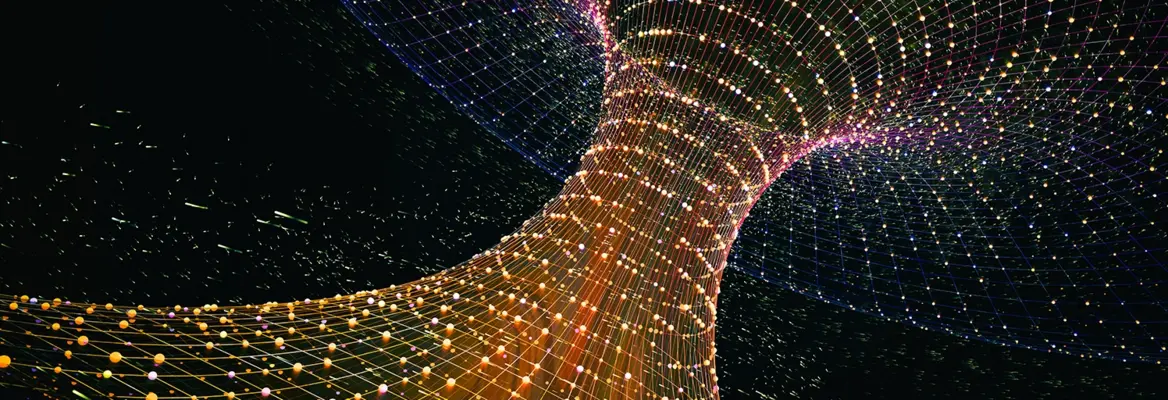

From gravitational wave “echoes” to claims that invisible tunnels lace the universe wormholes continue to capture our collective imaginations. But with no empirical evidence for their existence, the real story is how a speculative metaphor has drifted from mathematical tool to metaphysical claim. By returning to the original theory of an Einstein-Rosen bridge, philosopher of science Mathias Vogel argues that the most interesting lesson of wormholes has nothing to do with shortcuts through space, and everything to do with time, symmetry, and how physics mistakes elegant equations for reality itself.
Despite frequent references in headlines and popular accounts, there remains no empirical evidence for the existence of wormholes. It is easy to dismiss the whole phenomenon as media hype. But that misses the point. The interesting question is not why journalists like tunnels through spacetime, but why physicists keep returning to them, and what work the idea is actually doing.
Wormholes sit in an awkward place. They begin as mathematical solutions permitted by general relativity. In public discussion, however, they are often treated as objects that might one day be discovered. Somewhere in that shift, the distinction between formal possibility, a conceptual tool, and an ontological claim starts to blur. Wormholes have not merely survived despite the lack of evidence; they have flourished precisely because of their theoretical versatility. Wormholes can be made to do work in general relativity, quantum gravity, black hole physics, and quantum information theory. Their survival then is explained not by plausibility but by utility.
___
Maintaining such a structure would require forms of matter with negative energy density, something never observed and only fleetingly permitted in highly constrained quantum effects.
___
To see how this happened, it is necessary to disentangle several ideas that are frequently run together. Some use of wormholes are just solutions that are mathematically allowed by Einstein’s equations. Some constructions of tools for thinking through a thought experiment. And some claims are about what actually exist. Trouble begins when mathematical permission is quietly treated as endorsement for it being real.
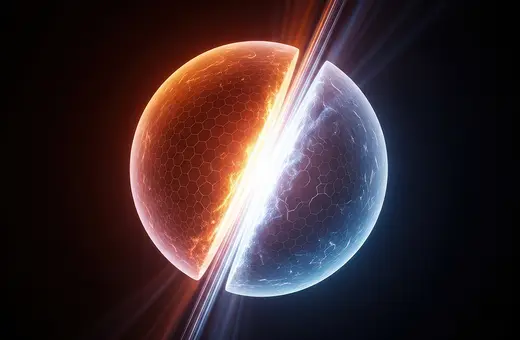
The historical origins of the wormhole concept already illustrate this slippage. In 1935, Albert Einstein and Nathan Rosen published a paper titled The Particle Problem in the General Theory of Relativity. Their aim was not to imagine shortcuts through space, but to address a technical difficulty within classical relativity: the presence of singularities. They identified a peculiar solution to Einstein’s equations in which two symmetrical regions of spacetime are mathematically connected. They referred to this construction as a “bridge”.
This Einstein–Rosen bridge was not proposed as a physical passage, let alone a novelist's deus ex machina for travel between distant galaxies. It was a formal device, introduced to preserve certain theoretical commitments within the equations. In fact, on many accounts, the bridge is non-traversable. Its geometry collapses too quickly for anything to pass through. The modern image of a stable tunnel through space is absent from the original work.
 SUGGESTED VIEWING
Down the wormhole
With Katie Robertson, Eric Weinstein, George Ellis, Matt O'Dowd
SUGGESTED VIEWING
Down the wormhole
With Katie Robertson, Eric Weinstein, George Ellis, Matt O'Dowd





18th February 2026

Join the conversation