



It’s no coincidence that a lot of philosophers are big fans of science fiction. Philosophers like to think about far-fetched scenarios or ‘thought experiments’, explore how they play out, and think about what light they can shed on how we should think about our own situation. What if you could travel back in time? Would you be able to kill your own grandfather, thereby preventing him from meeting your grandmother, meaning that you would never have been born in the first place? What if we could somehow predict with certainty what people would do? Would that mean that nobody had free will? What if I was really just a brain wired up to a sophisticated computer running virtual reality software? Should it matter to me that the world around me – including other people – is real rather than a VR simulation? And how do I know that it’s not?
Questions such as these routinely get posed in sci-fi books and films, and in a particularly vivid and thought-provoking way. In immersing yourself in an alternative version of reality, and by identifying or sympathising with the characters and seeing things from their point of view, you can often get a much better handle on the question. Philip K. Dick – whose Do Androids Dream of Electric Sheep?, first published in 1968, is the story on which the 1982 film Blade Runner is based – was a master at exploring these kinds of philosophical questions. Often the question itself is left unstated; his characters are generally not much prone to philosophical rumination on their situation. But it’s there in the background nonetheless, waiting for you to find it and to think about what the answer might be.
Some of the questions raised by the original Dick story don’t get any, or much, attention in Blade Runner. Mercerism – the peculiar quasi-religion of the book, which is based on empathy and which turns out to be founded on a lie – doesn’t get a mention in the film. And while, in the film as in the book, the capacity for empathy is what (supposedly) distinguishes humans from androids (or, in the film, replicants; apparently by 1982 ‘android’ was considered too dated a word), in the film we don’t get the suggestion that the purported significance of empathy, through its role in Mercerism, is really just a ploy: a way of making everyone think that androids lack, as it were, the essence of personhood, and hence can be enslaved and bumped off with impunity.
__
"A philosophical issue that is raised in the film – and to some extent in a more interesting way than in the book – is the issue of personal identity and its connection with memory. Does what you can remember make a difference to who you are?"
___
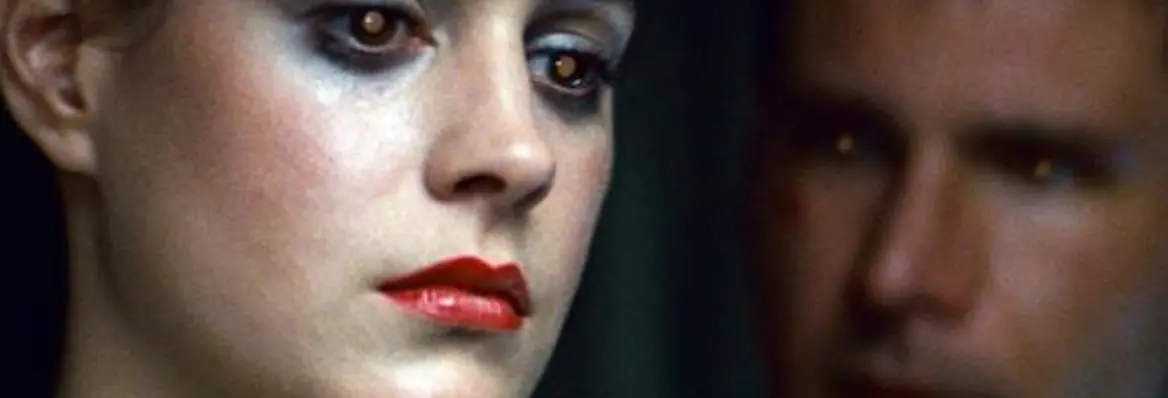
That said, the question of personhood is still very much alive and well in the film. The rogue Nexus 6 replicants, who have illegally escaped from the off-world colonies to Earth, are unhappy with their status as mere possessions – slaves, basically. And they are particularly unhappy with their four-year life-spans (genetically engineered to stop them developing their emotional capacities too much); their aim in coming to Earth is to find a way to live longer. They have, they think, been treated unfairly – and they want to get out of the terrible predicament inflicted on them by their makers, the Tyrell Corporation. While all the replicants apart from Rachael (who is not an escaped slave but an employee of the Tyrell Corporation on Earth) have decidedly psychopathic tendencies, it’s hard not to sympathise. If you were enslaved and were facing imminent ‘retirement’, you would most certainly, and rightly, think that you had been unfairly treated, and perhaps you would go to similar lengths to try and put the situation right. And of course Rachael, who gets pretty close to passing the Voight-Kampff empathy test, is even more difficult to conceive as a mere machine and not a genuine person.
But another philosophical issue that is raised in the film – and to some extent in a more interesting way than in the book – is the issue of personal identity and its connection with memory. Does what you can remember make a difference to who you are? In one sense of ‘who you are’, the answer is clearly yes. Our character, our hope and fears and ambitions, why we love some people and are indifferent to others – these are all shaped by our memory. Some of the replicants – including Rachael – have been endowed with false memories. As Tyrell puts it: ‘If we gift them with a past … we create a cushion or pillow for their emotions and consequently we can control them better’.
For Tyrell, then, ‘implanting’ false memories is a means of controlling the replicants: perhaps it makes them more emotionally stable and hence less prone to unpredictable outbursts. The more easily you can predict a replicant’s behaviour, the easier it is to keep it under control. But what about the role of these false memories for a replicant herself? (Or should it be ‘itself’? That’s the question of personhood again.) In the case of the rogue replicants, it’s unclear what role the false memories play. One of the replicants, Leon, keeps photographs, some of which presumably connect in some way with false memories. Apparently he feels some kind of emotional attachment to them, even though he has (we may assume) never been under the illusion that they are photographs of his real past; he must always have known that he was a replicant, given his enslaved status.
For Rachael, things are different. She finds out in the course of the film that she is a replicant; she previously thought she was a human being. She starts out thinking that those memories are really her memories. So for her, the discovery that she is a replicant is a double shock: she discovers not only that she is not a human being (and therefore that she does not have very long to live; she’s likely to be bumped off by a blade runner, but in any case only has a four-year lifespan), but also that her entire life has been a lie: the childhood she remembers never really happened.
__
"[Blade Runner] is manna from heaven to a philosopher teaching personal identity, because Rachael personifies a tricky concept: the concept of a ‘q-memory’."
___
It’s at this point that – at least with a certain amount of imagination –things get really interesting, because what Rachael previously thought of as her childhood did really happen: it happened to Tyrell’s niece. The things she thought that she had done or experienced in her childhood were really things that Tyrell’s niece did or experienced. (This marks an interesting difference with the book. In the book, Rachael starts out thinking she is Tyrell’s (Rosen’s) niece – but we don’t know whether Rosen ever had, or still has, a niece, or whether Rachael’s false memories are simply fabricated. In the film, by contrast, it seems that Rachael never thought she was Tyrell’s niece; she just thought she had a childhood. She didn’t realise it was that childhood. But we do know that her false memories are not simply fabricated: they are memories of someone else’s experiences.)
All of this is manna from heaven to a philosopher teaching personal identity, because Rachael personifies a tricky concept: the concept of a ‘q-memory’. As we already saw, there is a sense in which what you can remember makes a difference to who you are. But does what you can remember literally make a difference to who you are, in the sense that the fact that the human being that’s currently reading these words can remember doing X, Y and Z twenty years ago, or last Tuesday, is at least part of what makes the human being who did all those things you can now remember the very same person as you, now?
Back in the late 17th Century, the philosopher John Locke thought so. He came up with what’s often referred to as the ‘memory theory’ of personal identity: person A (at some time t2) is the very same person as person B (at some earlier time t1) just in case A can remember some of B’s experiences. So for example suppose that Dr Jekyll really can’t remember any of the heinous crimes perpetrated by Mr Hyde. Then on Locke’s view Dr Jekyll and Mr Hyde really are two different people – and, correspondingly, Dr Jekyll is not morally responsible for Mr Hyde’s crimes. (Though presumably he would still be indirectly responsible for them as a kind of accessory, having knowingly brought Mr Hyde into existence through drinking the serum.)
There is something very appealing about the memory theory (or I think so anyway). But it suffers from a number of major flaws as it stands, one of which is that the theory is blatantly circular. That’s because it’s just part of the concept of memory that you can only genuinely remember your own experiences. If you claim to remember starring as Deckard in Blade Runner, your claim is only going to be true if you are Harrison Ford. So we can’t use whether or not you remember starring in Blade Runner to establish whether or not you are Harrison Ford; we’d already need to know the answer to the second question in order to answer the first one. So we can’t use memory as the criterion for personal identity.
Enter – nearly three centuries later – two philosophers, Sydney Shoemaker and Derek Parfit, who in the early 1970s tried to solve this problem. They appealed to the idea of a ‘quasi-memory’ or q-memory. A q-memory is just like a real memory, except without the requirement that the experience that you q-remember must be a memory of your experience. And the (hotly contested) idea is that we can define personal identity over time in terms of q-memory rather than memory, thus neatly sidestepping the circularity objection.
What exactly is a q-memory, though? Well, a q-memory must be a q-memory of somebody’s experience – if you seem to remember visiting the rings of Saturn, then that’s definitely just a delusion and not a q-memory, because nobody has had that experience.
Also, the q-memory must bear the right sort of causal connection to the original experience. So for example imagine you have a particularly vivid imagination and have been obsessively following Donald Trump’s activities recently. One day you have a really vivid seeming-memory as of giving his speech to the Boy Scouts of America. It’s not like just remembering the footage of the speech; the seeming-memory, let’s suppose, is as of actually giving the speech. And imagine that this seeming-memory is exactly like Trump’s real memory of giving the speech. Trump’s seeming-memory is a real memory all right; it was him giving the speech in the first place. Yours isn’t a real memory; you weren’t even there. And – crucially – it isn’t a q-memory either, because there isn’t the right kind of causal connection to the original experience (that is, to Trump’s experience of giving the speech). You have somehow managed to concoct your seeming-memory on the basis of seeing the footage and imagining yourself in Trump’s position. So the causal history of your seeming-memory is completely different to the causal history of Trump’s (real) memory, which has whatever kind of causal history memories normally have (the experience was somehow encoded and stored in his brain for later retrieval, however that works). So – according to Shoemaker and Parfit – your seeming-memory isn’t a q-memory any more than is your seeming-memory of visiting the rings of Saturn; it’s just another delusion.
This is where Rachael from Blade Runner comes in. From what we’re told in the film, it looks like she really does have genuine q-memories of Tyrell’s niece’s experiences. (Tyrell’s niece in the film doesn’t have a name, but let’s call her Jane.) Jane saw that spider outside her window, and she didn’t tell anyone about it – not even her mother. And yet Rachael has a seeming-memory of that experience just as it actually happened to Jane. So it looks as though the only way that seeming-memory could have found its way into Rachael’s head is if it was somehow extracted from Jane’s head and fed into Rachael’s. (It’s not as though the seeming-memory could have been concocted in something like the way you concocted your seeming-memory of giving Trump’s speech. There are no videos, no transcripts, no basis on which Rachael or Tyrell or anyone else could have done that.) Rachael’s seeming-memory, that is, has the right kind of causal connection to the original experience. So it really is a q-memory.
__
"If you do think that Rachael would then be the same person as Tyrell's niece, what should you say in a slightly different case where the ‘original’ is still alive? They can’t, surely, both be Jane."
___
Where does that get us? Well, as I said, the point of the notion of q-memory is to use it – instead of the notion of memory – as the basis for a version of the ‘memory theory’ of personal identity. But we can’t just substitute q-remembering for remembering in Locke’s requirement (so that A is the same person as B just in case A can q-remember B’s experiences), since that would make Rachael the same person as Jane, just by virtue of q-remembering the spider. That definitely seems wrong. So – at the very least – we would have to require that A q-remembers a lot of B’s experiences. (How many? That’s a tricky question, and any answer is going to seem pretty arbitrary. But let’s ignore that problem.)
But what if Rachael was given a much more comprehensive ‘implant’ of Jane’s (real) memories – say, the full set of Jane’s memories up to the age of 20? Would that make her the same person as Jane? Imagine that Jane was suffering from a terminal illness, and – perhaps as a way of ensuring her survival but in a different physical form – Tyrell implanted all of her memories into a Nexus 6: Rachael. Maybe then it would be right to say that Rachael is the same person as Jane? After all, maybe this isn’t so different from what happens all the time in Star Trek: when Captain Kirk is ‘beamed up’ to the alien planet, his body (on the ship) is destroyed and an exact duplicate is constructed on the planet. It’s a new body, definitely; but it looks as though Kirk-on-the-planet is the same person as the previous Kirk-on-the-ship: it’s still Captain Kirk. Or at any rate, that’s what the Star Trek narrative requires us to think. So maybe our Jane/Rachael case is like that?
Well, this question raises a whole host of other questions. One is the question raised earlier about whether a Nexus 6 is a person at all. If Rachael isn’t a person, then she definitely can’t be the same person as Jane; she’s just a replicant non-person that’s had a q-memory implant. And if you do think that Rachael would then be the same person as Jane, what should you say in a slightly different case where the ‘original’ Jane is still alive and well and living in Ohio? They can’t, surely, both be Jane.
Questions, questions. That’s the trouble with philosophy: you try and fix a problem to make your theory work, and a whole host of others then come along that you have to fix as well. But I hope one thing is clear: if you’re a science fiction fan, you’re probably a philosopher at heart.
Image Credit: Sean Young and Harrison Ford in Blade Runner (Warner Bros, 1982)





5th October 2017



Join the conversation
Dale Benson 14 May 2024
Elija libremente el péndulo según sus preferencias en Geometry Dash APK Android, juegue en su teléfono sin problemas en cualquier momento y en cualquier lugar.
Sanya Geniy 29 February 2024
Thanks for the opinion in the article. You know, I don't like philosophers at all, because I think that they just talk a lot and often do nothing. Life is less about talking and more about doing, as Papa Louie games does in his games.
Anaya Kapoor 25 August 2021
She will add flavor to your evening! A similar repetitive preacher [url=http://www.escortdehradun.com/] Dehradun Escort Service[/url] sex can make individuals very exhausted. Your better half/sweetheart stays inert under you.
Raju ban gya 6 August 2021
Already watched blade runner movie on https://flixoid.net/ and I must say this is one hell scary movie
geometry dash 3 August 2021
I agree with you. This post is truly inspiring. I like your post and everything you share with us is current and very informative, I want to bookmark the page so I can return here from you that you have done a fantastic job.
[url=https://geometrydashfree.com/] geometry dash[/url]
Dave Stawinski 14 July 2021
@Richard Baron - in the sequel, things are further complicated by the fact that G (likely, but not certainly a natural human being) put those memories into H based upon G's own memories (and possibly q-memories and probably also fabrications) of G's own lived experience. Not unlike creating a narrative using the sci-fi magical memory-designing media technology in the movie. So, some or even all of H's memory (and, therefore personhood) may be "q-q-memories." The sequel is, maybe, saying something about storytelling and the role that media plays in personhood, just as the original film was exploring personhood in a more general way. My own take-away from the original film (not from the book--they are very different, I feel) was that all the Replicants are people, and that anyone who knows their fate is living life at peak experience and should be learned from. The second film, like many narratives these days, had a lot more to say about a lot more things, but did not follow them all the way down to their essentials as well. A good example is the story of K's simulated partner. Her personhood is defined by K's (another person's) emotional responses to her. And we see by the end of her arc that this relationship humanizes her, and changes K as well. The film's POV is clearly that she, too, fits the definition of "person", but she is ultimately disposable, and her "life" only ends up serving K's actualization (not very feminist). So, to me, it left more unsolved problems and less narrative resolution than did the original's more, I think, brave statement about the boundaries of life and/or "artificial life." Blade Runner makes a statement: If a being possesses empathy, it is a person. Blade Runner 2049 is a good film, but more muddled in my opinion. It exists more to extend and explore the ramifications of the first film, I think, than to fearlessly define personhood in the internet age.
Richard Baron 9 October 2017
As I understand it, the new film, Blade Runner 2049, offers us an extra twist on memory transfer, which will allow us to ask more questions. (I have not seen the new film, only read a plot summary, and what follows is worded so as not to provide a spoiler.)
It seems that in the new film, an entity G deliberately puts one of G's own memories (rather than any memory of a conveniently available niece) into another entity H. (I won't say whether G and H are humans or replicants.)
If it were only one memory, or a small selection of memories, then the fact that it was G's own memory, rather than the memory of a niece, would not seem to matter much. But suppose it were a complete package of memories, G's whole life history in the form remembered by G (which probably includes gaps and creative imaginings to fill those gaps that are noticed).
If this happened mid-way through G's life and H stuck around, G would say "Yes, conversations with H are sometimes uncanny, but I know how we got here, and I am fully aware that H is not me".
Now suppose G did this at a time when he or she was aware that death was an hour away, with the intention of surviving death. (G would presumably want to transfer habits of thought as well as memories.) There would be a short period when it would be hard for anyone (including G) to say without explanation that G was H, because we are all aware that 2 does not equal 1. But if G were to say "Yes, H is me, I have ensured my survival", we would understand what G meant, and we would take it at as close to face value as we could while not committing ourselves to thinking that 2 equalled 1. And I suggest that it would be important to our having this respect for what G said that the transfer to H was G's own choice, made for G's own purpose of ensuring survival.
Abraham Joseph 8 October 2017
All the questions raised will be answered once all of mind,intelligence and Reason sit together and introspect,whether Sciences have thoroughly checked,probed and verified the way man knows. He is stuck at his observation, experience methods,based on the old idea of how he knows.
Has he thoroughly checked,how he ascertain the ' certainty' of his theories?
It is a delicate theme,until the above class get to know how badly they depend upon our mystery sense or faculty of Reason for the job!
Would share here a paper, that depicts Faculty of Reason as a mystery internal sense organ that detects or senses 'order' or sense of what we believe:https://isreasonasenseorgan.blogspot.in/2013/09/is-reason-internal-sense-organ-super.html?m=1