


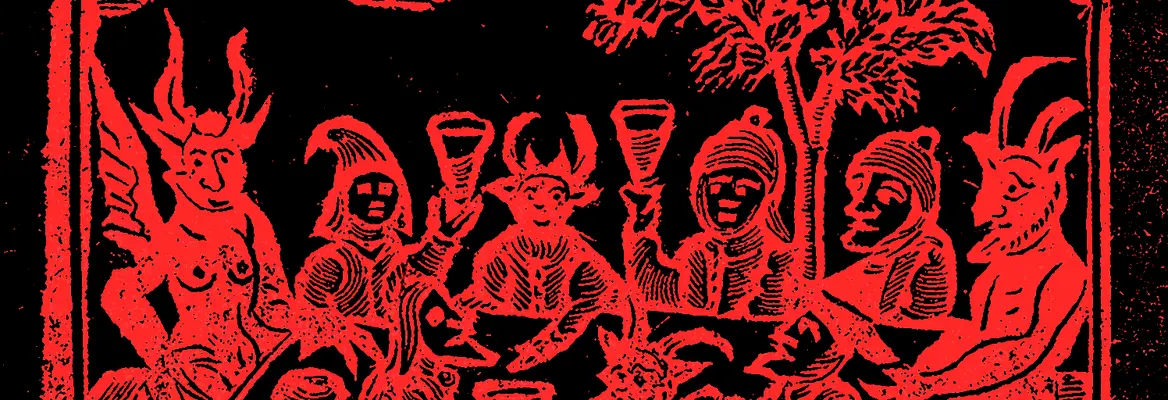

Our politics has not escaped the 'witch trials'. For over thirty years, historian Marion Gibson has traced the words of those accused of witchcraft back through Elizabethan England and beyond, uncovering not myths and caricatures, but real lives caught in cycles of suspicion, confession and punishment. Now she draws a direct line from those trials to politics’ adoption of the phrase 'witch hunt'. From Donald Trump to Rahul Gandhi, Gibson exposes the logic of good and evil, angel and demon, monster and mythic, that culture still uses to spark political outrage.
Google the words “witch hunt” and you’ll see two main categories of result. One set of suggestions will relate to the period from the fifteenth to the eighteenth centuries when Europe and the colonized Americas saw tens of thousands of people executed as witches. The other set will relate to modern politicians’ speeches and social media posts, especially those of Donald Trump.
Trump posted the phrase “witch hunt”—or, more usually, “WITCH HUNT!”—over 700 times on Twitter before decamping to Truth Social, where his usage of the term further accelerated. Other politicians or their allies use it too: Hillary Clinton, Benjamin Netanyahu, Indian Opposition leader Rahul Gandhi, Suella Braverman, Boris Johnson, Bjorn Höcke, the Thuringian chair of Germany’s AfD. The phrase is used more often by right-wingers than left. Its use has spread beyond politics into the wider media. Sometimes it denotes an unfair pile-on affecting a public figure, while in other cases it appears to be a deflection from provable misconduct. But what’s the relationship between the witch hunts of the historic past and those of the political present? Are they related at all? In some ways no, in other ways yes.
In the fifteenth to eighteenth centuries, a witch was defined as a person who was suspected of causing magical harm to other people. In most village or small-town settings, that might have been imagined as an attack on near neighbors, perhaps thought to have been carried out by verbal cursing. The suspected witch could have had a disagreement with their neighbor over a request for a charitable gift, a business deal, religious or political tensions, or family arguments. Harsh words would have been uttered and perhaps the witch had said something like “I’ll get even with you” or “you’ll be sorry you crossed me!” After that, their neighbor would have experienced some harm, at the level of inconvenience or tragedy: anything from a cart that tipped over in the street to the death of a child or spouse. And they would have blamed that harm on the person who had fallen out with them, believing that individual to have cast a malign spell—which would mean they were a witch. This was the commonest type of witchcraft accusation.
Want to continue reading?
Get unlimited access to insights from the world's leading thinkers.
Browse our subscription plans and subscribe to read more.
Already a subscriber? Log in
Love the iai?
Sign up to get exclusive access.

Related Posts:




Related Videos:


5th November 2026


Join the conversation