


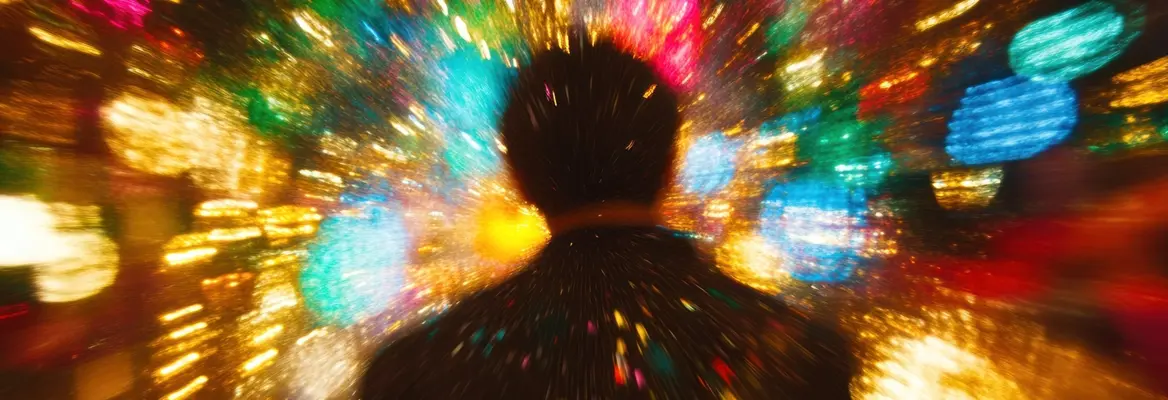

Conscious experiences of change, from seeing a bird take flight to listening to a melody, cannot be broken down into ever smaller units of experience. They must inhabit what William James called the “specious present,” a sliding window of time where the immediate past and present overlap. Philosopher Lyu Zhou argues that this exposes a deep rift between mind and matter. When the physical world undergoes change, it does so through succession – one physical state replaces another, and the past is gone – whereas consciousness requires the active retention of the past inside the present, revealing its fundamentally non-physical nature.
1. Consciousness, change and time
You are now conscious as you read this article. Is your consciousness physical? Many today think it is. They claim that it either is a physical system made of matter – most likely the neural network of your brain – or is realized by matter through a physical process, most likely by your brain through a neural biochemical process. However, I hope to convince you that this view is wrong. I hope to show you that your immediate present consciousness has certain features that physical systems and processes cannot have.
What is so novel about my argument? The most often cited reason for denying that consciousness is physical is the so-called Hard Problem of Consciousness. The Hard Problem is that it is deeply mysterious how the physical process in your brain can give rise to subjective experiences with qualities such as what it is like to see red or smell the malodor of a long-rotten potato. The apparently intractable nature of this problem suggests that consciousness is likely not physical. But the problem I want to raise today is a different and novel one. Unlike the Hard Problem, which focuses on the qualitative aspect of consciousness, my argument highlights a certain structural feature of your immediate present consciousness that nothing physical could have: it is holistic. Let me explain.
___
Your immediate present consciousness is an extended whole: it is not like a snapshot, but like a short movie.
___
No doubt you are currently experiencing some change, e.g. objects moving from one place to another. But what it is for there to be a change is simply for there to be different states at different times. Therefore, if you experience change at all, as you indeed do, you must experience there being different states at different times. The experience involved cannot be like a snapshot: it cannot be restricted to a mere instant. Rather, the experience must be like a short movie with a brief duration: it must have a temporal span so as to encompass different states at different times.
The snapshot conception of your immediate present consciousness faces at least one other serious problem. You seem to have a stream of consciousness in which various states come and pass away in time. These states appear before, after, or at the same time as one another along a temporal dimension that is very much like a continuous extended line. It is not without reason that it is often spoken of as a timeline. However, the sum of any number of zeros must remain zero. Likewise, the addition of any number of durationless instants—snapshot experiences—cannot give you any continuous extended timeline.
 SUGGESTED READING
Consciousness, cosmology, and the collapse of common sense
By Eric Schwitzgebel
SUGGESTED READING
Consciousness, cosmology, and the collapse of common sense
By Eric Schwitzgebel
Want to continue reading?
Get unlimited access to insights from the world's leading thinkers.
Browse our subscription plans and subscribe to read more.
Already a subscriber? Log in
Love the iai?
Sign up to get exclusive access.

Related Posts:

Related Videos:


18th December 2025

Join the conversation
benja lakruege 5 January 2026
damn this writing sucks
Larry Greer 22 December 2025
How much do the following questions cause problems (if at all) for the proposition that "There is no more basic unit of your temporal consciousness than this temporal field" the holistic nature of consciousness is built on in this interesting article: What about the physical effects in real time of conscious experience and what about the consciousness of consciousness and so on and what about the physical effects of a consciousness of the real physical effects of consciousness and perhaps an infinite host of other ways to maybe complicate the notion that consciousness is one holistic thing and not made of many parts roughly along the lines of what physical stuff is made of? Could a consciousness of consciousness possibly feature stuff that doesn't rely on the wholeness of the latter to even be a thing?
And I think a third possibility with respect to what consciousness might be if it's not physical is that it's what actually creates the physicality that we conscious beings separate from the stuff of consciousness. I'm sure there are tons of other possibilities as well in this universe given to dropping stuff like the hard problem of consciousness in our laps all the time.
Kevin Rigley 21 December 2025
Really interesting piece — and I agree with Zhou on the experience of the “specious present.” Consciousness absolutely feels like a short movie, not a series of snapshots.
But I don’t think that means consciousness must be non-physical.
A theme of modern biology shows that some physical systems really are holistic: network synchrony in the brain, heart–brain coupling, immune and metabolic states shaping neural access, and even state-dependent epigenetic changes. These aren’t discrete, frame-by-frame processes — they’re time-spanning, integrated, and genuinely whole-system.
So the fact that consciousness feels extended and unified doesn’t necessarily point to a non-physical substance. It might just point to a form of physical organisation that’s dynamic, synchronised, and far more holistic than the old atomistic picture of “matter.”
In other words: Zhou is right about the phenomenon — but the explanation might be biological, not metaphysical.