


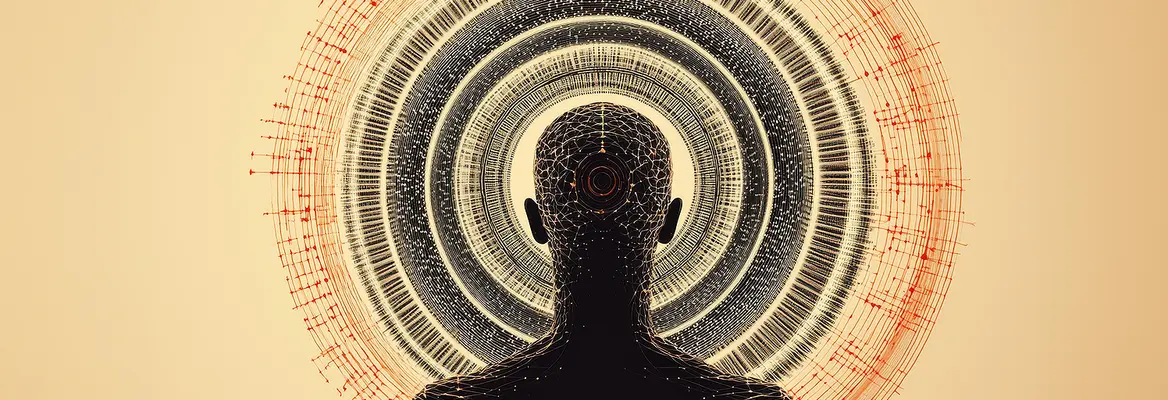

In a world in which everything feels like a copy of a copy, and where we are told that the laws of physics remain constant always and everywhere, it can feel like there is little room for the radically novel or new. Here, philosopher Victoria Trumbull argues that consciousness provides the space for the possible to become real. In a universe driven by laws, consciousness is the creative factor.
Artificial intelligence has recently acquired a strange and unsettling power: it can produce things that look like human creations. An AI model can write an essay, compose a melody, and generate an image in the style of a Renaissance painter. It can mimic coherence, originality, and even something like inspiration. This cultural moment has forced a perennial philosophical question back into view: what is so special, if anything, about human consciousness? Is there any meaningful difference between a human mind that creates, and an algorithmic system that, when prompted, produces satisfactory results?
The common temptation is to raise this question by asking whether machines are on their way to becoming “conscious”—or, at least, “intelligent,” provided that we can somehow conceptually isolate intelligence from consciousness to begin with. But the first difficulty in attempting to answer questions of this kind is that we do not yet understand what consciousness, in us, actually is.
In mainstream cognitive neuroscience, consciousness is often understood in terms of information processing involving the ingestion and integration of sensory inputs, the construction of internal representations, and the regular coordination of motor patterns. There are many different versions of this picture: some emphasize neural correlates, others predictive processing, others global broadcasting. But they share a common assumption: that mind can ultimately be explained in mechanistic or computational terms.
___
If mental life follows the laws and rules of a predetermined programme, however complex, then it becomes increasingly difficult to make sense of this kind of novelty.
___
Yet something in this picture remains incomplete. Computational models of mind struggle to account for a phenomenon so familiar that it is easy to overlook: the emergence of genuine novelty, irreducible to the mere recombination of existing elements. Contemporary philosophers of mind such as Jaegwon Kim have pressed this picture to its limits by raising the problem of “mental causation”: if the physical world is causally closed, how is it possible for mind to influence our own behaviour, let alone to interact with the world around us?
Since the earliest days of philosophy, the mind or “soul” of the human person has been identified to some degree with an active power or internal force which acts as a proper cause relative to the world. Plato in the Laws (896a) defines the soul as that which is “self-moved” and “self-moving,” in contrast to an inert body which is influenced only by external forces. There is an immediate sense by which we recognize this “internal force” within ourselves: I am the initiator of actions which radiate from the interior of my being out to the world around me. We experience this inner force most clearly in moments of decisive importance. When we hesitate between alternatives, when we act in a way that feels not merely caused but chosen, we do not experience ourselves as executing a programme. We feel that we are doing something new—so much so that we are often surprised by the results. This capacity for bringing about novelty into the world is often what we recognize in others as the quality of “genius,” whether in scientists, inventors, thinkers, entrepreneurs, poets, artists, or musicians.
Want to continue reading?
Get unlimited access to insights from the world's leading thinkers.
Browse our subscription plans and subscribe to read more.
Already a subscriber? Log in
Love the iai?
Sign up to get exclusive access.

Related Posts:

Related Videos:

21st May 2026


Join the conversation