


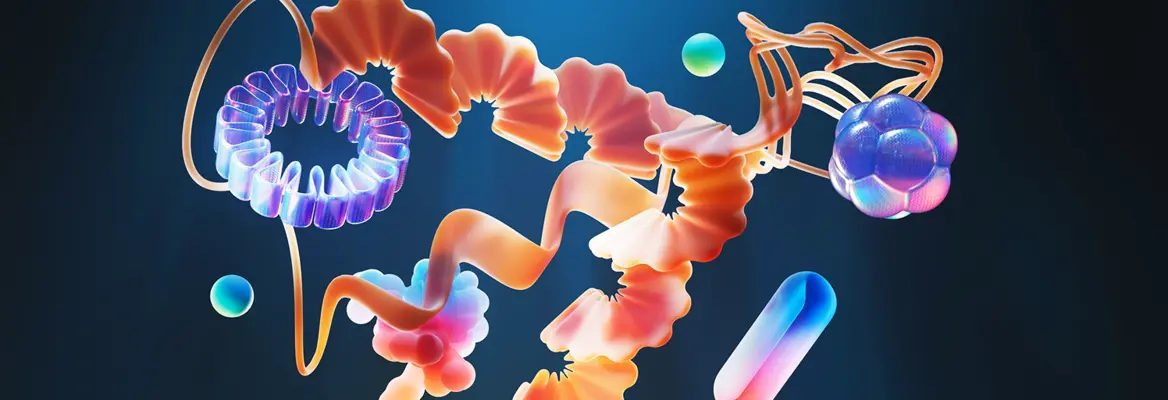

For centuries, scientific progress meant taming complexity with simple, unified theories, guided by Occam’s Razor. Newton and Einstein captured vast, intricate systems in just a handful of elegant equations. But philosopher Eric B. Winsberg, a leading voice on the use of computer simulations in science, argues we’ve entered a revolutionary new scientific age, in which progress no longer requires crafting simple theories. Breakthroughs are being powered by machine learning systems like AlphaFold, which solve previously intractable problems like protein folding using vast datasets, and no simple, elegant theory at all. While there may be regions of reality in which traditional scientific theorizing is helpful, there’s no reason to insist that this applies to reality in its entirety.
If you walk through Cambridge on a rare sunny day you can go straight from Trinity College, where Isaac Newton formulated the laws that govern the motion of everything from cannonballs to comets, to the Biomedical Campus, where the science of protein structure was born. Three centuries apart, these are both triumphs of prediction. Yet they are triumphs of a very different kind. The difference tells us something important about how AI is reshaping science. In particular, it is reshaping what we value in science.
Newton and the classical ideal
Newton set a high bar when it comes to producing simple, elegant, unifying theories. You start with just three laws of motion and one law of universal gravitation. From only these four equations you can derive the orbits of the planets, the trajectory of a thrown ball, and the rhythm of the tides.
This is the paradigm case of what philosophers of science call theoretical virtues: simplicity, elegance, explanatory power, unification. A handful of principles, and the heavens fall into order. For centuries, these theoretical virtues were treated as more than just things we happen to like for aesthetic reasons. They were taken to be guides to truth. Occam’s Razor is the oldest formulation of this instinct. Eugene Wigner’s famous 1960 essay on “The unreasonable effectiveness of mathematics in the natural sciences” was another expression of this point. The tacit assumption was that the right theory will be simple because nature is fundamentally simple. If your equations are ugly, they are likely not the right equations.
AlphaFold, simplicity, complexity, and biology
Protein folding is a problem that refuses to bend to this method. A protein is made up of a chain of amino acids. The exact sequence of amino acids in the chain determines the shape the protein will crumple into. The shape of the protein, in turn, determines everything about what it will do in the body—what biological functions it will perform, what it will bind to, what it will catalyze, etc. Predicting the shape from the sequence alone was one of the hardest problems in biology for over 50 years. This is sometimes referred to as Levinthal’s Paradox: even a small protein has so many possible configurations that an exhaustive search would take longer than the age of the universe to complete. But there is no tidy set of laws that maps sequence to structure. Part of the reason is what physicists call scale separation. Newton could write simple laws for planets and cannonballs because at those scales the fine-grained details wash out: you can predict a planet’s orbit without tracking its individual atoms. Protein folding affords no such luxury—the shape of the whole molecule depends on the interactions of individual atoms, hydrogen bonds, electrostatic effects, and solvent forces, all operating at roughly the same scale and all mattering at once.
___
Want to continue reading?
Get unlimited access to insights from the world's leading thinkers.
Browse our subscription plans and subscribe to read more.
Already a subscriber? Log in
Love the iai?
Sign up to get exclusive access.

Related Posts:




Related Videos:

3rd July 2026



Join the conversation
John V Morris 4 July 2026
“Beyond the knowledge gained from the individual sciences, there remains the task of *comprehending*. In spite of the fact that the views of philosophy sway from one system to another, we cannot dispense with it unless we are to convert knowledge into a meaningless chaos.” : Hermann Weyl (1922) ‘Space-Time-Matter’; 4th edition. With Weyl’s *emphasis*.