


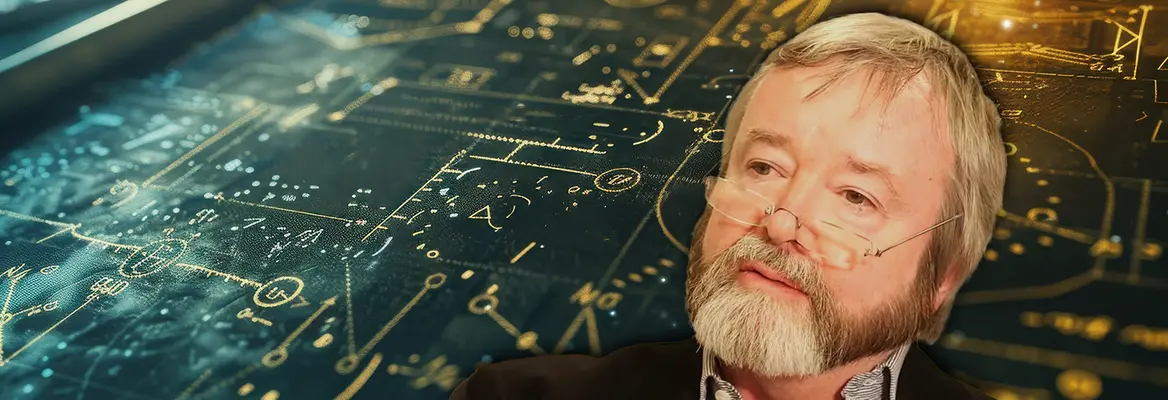

We assume advances in science are driven by rigorous adherence to the scientific method. Reductive analysis, reason, and evidence are said to be the engines of progress. But according to world-renowned psychiatrist and philosopher Iain McGilchrist, the great advances in science occur not by following a rigid set of rules, but by breaking them. In conversation with Oliver Adelson, he argues that only by seeing the world in its holistic, interconnected form are we able to make the leaps of logic which science needs to discover new paradigms.
Oliver Adelson: The left hemisphere of the brain is said to be the rational, analytic side. And yet it’s your contention that what we’ve had is too much, not too little, of left hemisphere thinking. Can you explain what led you to this view?
Iain McGilchrist: What we’ve got here are two halves of the brain. For evolutionary reasons, all creatures have had to develop two ways of attending to the world, and one is with a very narrow, targeted attention to a detail—they already know what it is, and they know they want to get it, and having it will make them powerful. So that’s very important. One whole half of the brain is dedicated basically to that process. The other half of the brain is doing everything else. It has open, sustained attention to everything, and this is the one that actually understands the whole.
Now, when you come to look at how they construe the world, the left hemisphere sees the world as made up of bits. And the bits are separate from one another. They don’t change, they don’t move, they are fully known, they are explicit. They’re also abstract, they’re taken out of context, they’re categorical in nature, and effectively inanimate—something like a diagram or a map of the world rather than the world itself.
The right hemisphere, however, sees the closest we get to knowing what the world is like. It sees a world in which everything is connected, in which everything is not fixed and unchangeable, but is constantly flowing and changing, in which the implicit is vastly more important than the explicit, in which context is everything. Things are unique and they’re not just exemplars of categories. And this world is a living world, and it presences to us, as Heidegger would have said, rather than just being represented in the way the world of the left is. So that’s it in a very, very brief nutshell.
If the relationship between the world presented by the left hemisphere and reality isn’t simply a mirror relationship, if the left hemisphere doesn’t just mirror reality with its categorical bits—what then is the relationship between the world presented by the right hemisphere and reality? Do you think that is a sort of mirror of the way that reality is, or we need to discard the mirror metaphor altogether?
Want to continue reading?
Get unlimited access to insights from the world's leading thinkers.
Browse our subscription plans and subscribe to read more.
Already a subscriber? Log in
Love the iai?
Sign up to get exclusive access.

Related Posts:


Related Videos:




Oliver Adelson
22nd July 2026



Join the conversation
Grey Louis 27 July 2026
THE LOST DATABASE IS COMPLETELY RECOVERED BY A LICENSED EXPERT: ALPHA KEY
I was initially terrified since I was unaware that AI can occasionally be dishonest, like when Google Maps misbehaves by providing wrong directions. However, Alpha Key has been amazing thus far. I wish to utilize this little area to educate everyone who is depressed as a result of blunders, such lost cryptocurrency funds, bank debits, credit card debits, database access loss, and many more. For the chance to post your testimonial here as well, get in touch with Alpha Key Recovery immediately. I believe they are the best accessible at the moment because scammers are so common.