


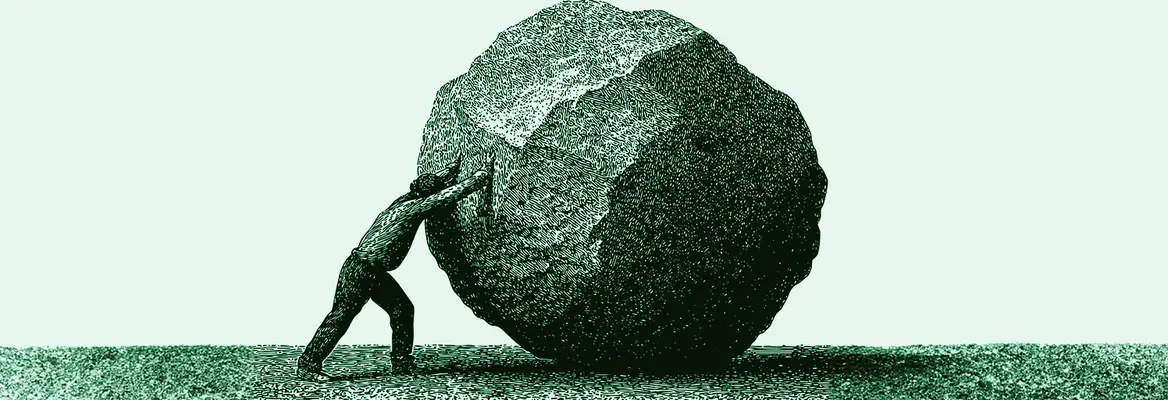

The wage economy once appeared natural. It linked labour to production, income, and survival. But AI is making these links unstable: societies can produce more with less human work. Philosopher Manuel Delaflor here argues for a new economic framework, one in which we should draw a line between survival and competition. Survival should be guaranteed to everyone, whether they work or not. Essentials such as food, shelter, healthcare, and energy should be given to all and kept outside the competitive economy. Once survival is taken care of, work will then be left to satisfy ambition, innovation, meaning, purpose, and status.
I bet that you are not interested in another fight between “capitalism” vs “communism,” “left” vs “right,” “individualism” vs “collectivism,” as if these old ideologies were the only ones available for thought. They never were, of course. That old boxing ring is becoming useless, and it is time to put them to rest. These categories are too small for what is coming. They were built for a world in which human labor remained the central route through which society produced, distributed, disciplined, and rewarded itself. But AI is beginning to pull that world apart, and things will get ugly if we keep pretending that our inherited models, the ones we didn’t choose no matter how hard some people have bought into them, can simply stretch a little more and cope.
And I want to talk about this with hope. Actual hope, not the sterilized palliative of marketing campaigns. Think about it: for the first time in history, we are approaching the possibility of producing and coordinating immense portions of social life without needing every adult body to pass through the wage machine as the primary condition of survival. That alone is astonishing. We should be honoring the hard labor of every generation before us, and opening our imagination to the amazing possibilities within reach… and yet most public conversation is still responding with fear shaped by obsolete categories: how do we save jobs, retrain workers, keep consumers consuming?
___
A society that must tax its own productivity to prevent its distribution system from collapsing has revealed something deeper than a policy problem: that the wage route to life is becoming incoherent.
___
I take those as the wrong questions. Let us change the angle. The best way to do that is to turn ourselves into temporal zoologists. Desmond Morris became famous by looking at humans zoologically, as animals wrapped in symbols, rituals, mating displays, dominance games, and social habits. His 1967 book The Naked Ape approached humans as a species, not as the elevated protagonists of their own self-flattering story. That perspective is exactly what we need now. We need to stop treating “wages,” “debt,” “wealth,” “property,” “jobs,” as if they were tangible and given, like trees or tigers. Such abstractions are convenient labels that have overextended their utility.
The epistemic framework called Model Dependent Ontology comes in handy at this point. Not as a political banner or economic theory, but as an instrument: MDO does not ask what the world “really is”; it asks what a model makes possible, and what it hides. From MDO, ontologies are not discovered; they are instantiated: a species builds a model, the model works, and its outputs start being treated as furniture of the world. That is the trick: when a model works long enough, these primates start calling it “reality,” confusing their own construct with an unchangeable feature of nature. The wage economy is one of those constructs.
Want to continue reading?
Get unlimited access to insights from the world's leading thinkers.
Browse our subscription plans and subscribe to read more.
Already a subscriber? Log in
Love the iai?
Sign up to get exclusive access.

Related Posts:

Related Videos:
12th August 2026



Join the conversation