


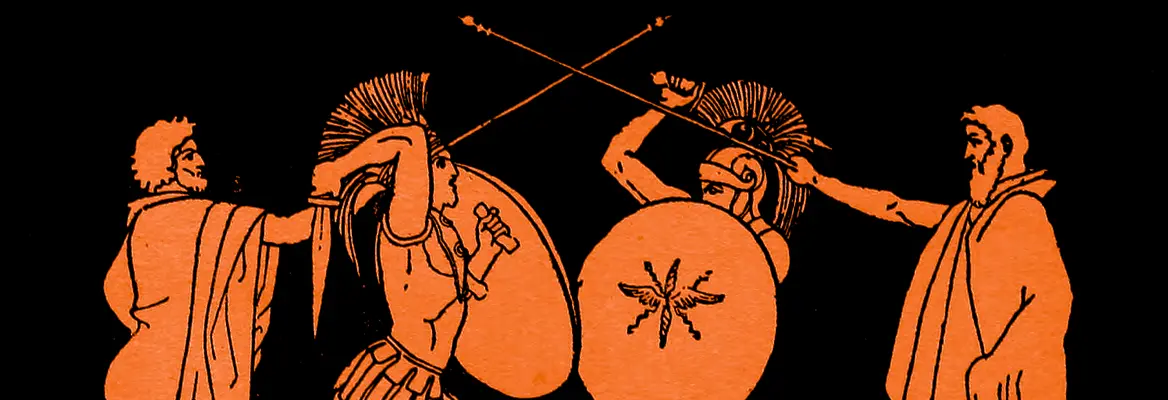

In Homer's Iliad, we rarely encounter the original Greek word for 'I' or much that refers to internal thought or decision-making. In this challenging article, cultural theorist Brian J. McVeigh argues Princeton psychologist Julian Jaynes got it right when he claimed the Homeric Greeks had no internal life or self-awareness. On the 50th anniversary of Jayne's classic book, The Origin of Consciousness in the Breakdown of the Bicameral Mind, which inspired the HBO series Westworld, McVeigh argues that the ancient Greeks took the voices of their gods as their impetus for action and that they indeed had no inner life.
Imagine a theoretical framework that solves a long list of mysteries: the origin of religion and its concomitant features—supernatural visitations, ancestor worship, monumental mortuary architecture, divination, oracles, spirit possession, and the vestiges of archaic spirituality still visible in churches, temples, and mosques. This approach also explains otherwise inexplicable phenomena, such as hallucinations, hypnosis, glossolalia, and children’s imaginary companions. Moreover, this theoretical approach has clinical value: its argument about the originally nonpathological, adaptive nature of hallucinations helped establish an intellectual climate conducive to the Hearing Voices Network, which regards voice-hearing as a meaningful experience. Moreover, this framework comes with hypotheses waiting to be tested.
Such a framework can be found in The Origin of Consciousness in the Breakdown of the Bicameral Mind (1976) by Julian Jaynes (1920–1997). He theorized that until about three thousand years ago (with some geographic variation) humans possessed a “bicameral” (“two-chambered”) mentality in which the right hemisphere communicated with the left hemisphere using command hallucinations. These were interpreted as the voices of gods, ancestors, or godlike rulers. But population expansion and social complexity put pressure on this dual psychological system of supernatural superior and mortal subordinate. During the late second millennium BCE, this two-tier neurocultural arrangement collapsed. In response, languages—by developing metaphoric “mind words”—upgraded psychological processes. Jaynes identified the new mentality as “consciousness” (or in a wordier rendering, subjective introspectable self-awareness). Jaynesian consciousness is neither an innate, biologically fixed trait, nor something identified with sensation, thinking, or being awake. It is a learned cultural innovation.
In the modern world, residues of a preconscious, bicameral mentality greatly influence us. Sacred architecture, less intense but still relevant religious beliefs, rites of passage wrapped in hallowed ceremonies, and the watered-down divine right of kings that echo through our governmental institutions—these are all so ubiquitous that their spiritual origins have faded into the background. The challenge, then, becomes defamiliarizing ourselves with what we thought we understood by re-examining what is hidden in plain sight using a Jaynesian interpretation. I introduced this essay with some provocative claims. Let’s unpack them.
Challenging establishment psychology
Jaynes was a comparative psychologist who, like other researchers in his discipline, initially assumed that “consciousness” was a feature of all organisms and was a result of evolution. But his search for the earliest references to something akin to conscious mentality in the historical record led to a surprising discovery: texts of ancient languages that we have from before 1,000 BCE lack psychological terminology. Jaynes was also struck by the overwhelming ubiquity of descriptions of divine revelations. He did not deny the principles of biological evolution. However, he eventually realized the limitations of evolutionary psychology; by itself, this otherwise powerful paradigm cannot explain the origins of consciousness. Jaynes concluded that though consciousness is grounded in our neuroanatomy, it is fundamentally an ideational phenomenon that is transmitted through socialization, not genes.
Want to continue reading?
Get unlimited access to insights from the world's leading thinkers.
Browse our subscription plans and subscribe to read more.
Already a subscriber? Log in
Love the iai?
Sign up to get exclusive access.

Related Posts:

Related Videos:

11th November 2026
Join the conversation