


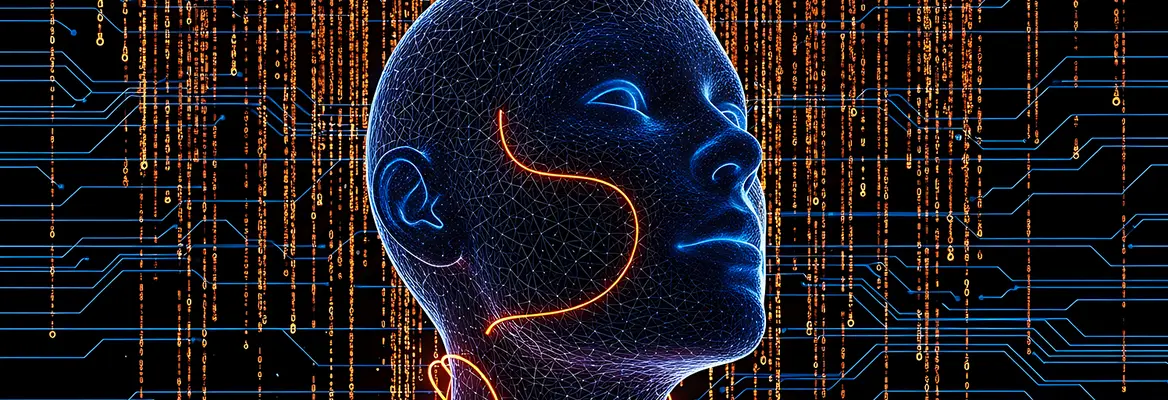

Artificial intelligence is advancing on the assumption that the brain is essentially a computer and if that is true, replicating the mind in silicon is only a matter of time. Philosopher Dorothea Olkowski argues this is one of the biggest mistakes in the history of science. Consciousness does not originate in the cortex, the seat of reasoning and language, but in the brainstem, the most ancient part of the brain, shaped by body chemistry and emotion. The brain's signalling system is too chemically complex, too slow-acting, and too entangled with the whole body to be reduced to the simple yes/no binary logic that underlies all computation.
The dominant assumption behind artificial intelligence is that the brain is essentially a computer—that thought is computation, and that consciousness, given sufficient processing power, can be replicated in silicon. The neuroscience tells a very different story. What the most important recent research reveals is that consciousness is not primarily a cortical function at all, let alone an algorithmic one: it arises from the oldest, most primitive part of the brain, is saturated with body chemistry, and is constitutively shaped by emotion.
The science I wish to focus on is neuroscience, and the first neuroscientist I would like to bring to your attention is the Estonian-American neuroscientist and psychobiologist Jaak Panksepp, whose work came to light for me when I started doing research for a course on cognition and emotion. Panksepp’s family fled Estonia for the US when he was still a child. He completed his graduate studies at the University of Pittsburgh and the University of Massachusetts. His distinguished career began as Head of Affective Neuroscience Research at the Chicago Institute for Neurosurgery and Neuroresearch and the Falk Center for Molecular Therapeutics, along with two simultaneous university positions. Given this remarkable career, one wants to investigate what has prevented Panksepp’s work from being more widely known.
Panksepp was a pioneer in the research of affective neuroscience—the study of the biological bases of emotion. Insofar as the field initially relied on the study of animals to understand humans, it was either ignored or discounted by a majority of researchers in the field. Beyond this, the study of human emotions was also not much respected—this has been the case for my field, philosophy, as much as for neuroscience. Nevertheless, Panksepp’s associates and students recognize him for creating “a grand unifying, neuroevolutionary theory about the brain substrates of the ancient mind that all mammals still share,” a theory which they compare to the “paradigm-shifting discoveries of more famous twentieth-century scientists”—notably Albert Einstein and Richard Feynman.
Panksepp is currently widely recognized for providing significant evidence that optimal brain development requires healthy play experiences, which he characterizes as the most complex and recent of positive emotions. With this research in hand, Panksepp fled the cudgel of behaviorism—the supposition that all behavior is merely an effect of external forces on an otherwise blank-slate mind—to study so-called “primary process mechanisms”: seeking, rage, fear, lust, care, panic, and grief. What makes his work so radical is his assertion that these primary processes, including play, do not originate in the neocortex—the most recently evolved region of the brain, responsible for reasoning and language—but rather, they arise from the most ancient one, the brainstem.
___
What appears to consciousness is not raw sensory signals transmitted from the periphery, but rather predictive inferences derived from memory traces of such signals and their consequences.
___
Want to continue reading?
Get unlimited access to insights from the world's leading thinkers.
Browse our subscription plans and subscribe to read more.
Already a subscriber? Log in
Love the iai?
Sign up to get exclusive access.

Related Posts:

Related Videos:


21st July 2026


Join the conversation