




Chaos, uncertainty, and noise are often thought of as getting in the way of an organism's plans. Animals, for example, need predictable food and water sources, without them life is a constant struggle. However, science journalist Conor Feehly here argues that biologists are increasingly revealing how life necessarily uses chaos as a creative tool for adapting to an uncertain world.
The very substrates of life can be as unpredictable as the chaotic world in which life resides. Our informational molecules mutate. Hearts skip a beat. Neurons flicker on and off. This natural variability in the hardware of life causes significant hurdles for the goals of living systems. In response, life at large has developed a set of mechanisms to dilute the effects of noise—the uncertain nature of physical systems—from within, and from the outside.
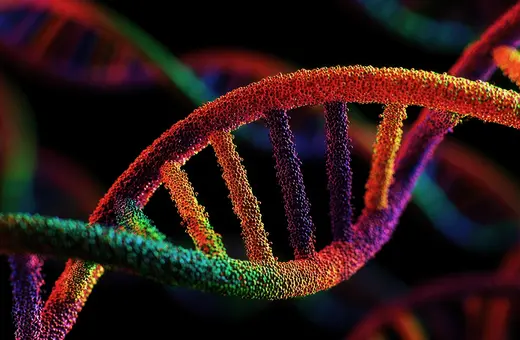
Error correction enzymes ensure DNA is reliably copied. Immune systems seek and destroy hostile invaders. Nervous systems build predictive models. This view, however, that life is unwittingly subject to, and constantly trying to minimize the effects of, its noisy environment and components, ignores a crucial lesson that has increasingly come into focus as scientists have unraveled the problem-solving capacities of life at every scale of biological organization.
Namely, that life harnesses noise as a creative search mechanism to explore solutions to survive and thrive in a changing world. Like a musician spontaneously trying new chord progressions, rhythms, and melodic hooks to see what might stick when they set out to write a new song, life similarly explores new configurations and behaviors through noisy search processes.
“I cannot think of any work I have done that does not rely on the adaptive channeling of noise,” says David Krakauer, evolutionary biologist and president of the Santa Fe Institute (SFI), an organization dedicated to the multidisciplinary study of complex systems. “The other way to say that is for exploration, or discovery, or innovation, that constellation of ideas about finding new things, then you need noise.”
Genetic noise
We have had clues pointing to the power of noise in biology for some time. Perhaps the most well-known example, from the late 19th century, is the Baldwin effect, named after early evolutionary biologist James Baldwin. He noticed that when there was a dramatic change in environmental conditions, you would observe more variation in the phenotypes—physical characteristics—of species that occupy that environment. He was the first to say that this could serve an adaptive purpose.
___
Evolved evolvability is underwritten by the capacity of an organism to modulate the inherent noisy nature of its genetic hardware.
___
For any given species, you are no longer optimized to your environment because the context has changed. The old adaptation no longer fits—now you have to find something new. The modern name for this is cryptic variation, and evolutionary biologists have been working to uncover the genetic mechanisms that contribute to an organism’s talent for driving up the variability of its phenotypes in response to an environment in flux.
To take one example, in recent experiments, Michael Barnett, an evolutionary biologist from the Max Planck Institute of Evolutionary Biology, alternated lineages of bacteria between two environments that would exert different selective pressures on the bacteria. He found that changing the environment first caused elevated transcription rates—the process of copying DNA where mutations are most likely to occur—so as to increase the likelihood that adaptive mutations could arise in new copies of DNA.
Want to continue reading?
Get unlimited access to insights from the world's leading thinkers.
Browse our subscription plans and subscribe to read more.
Already a subscriber? Log in
Love the iai?
Sign up to get exclusive access.

Related Posts:

Related Videos:
24th April 2026



Join the conversation