


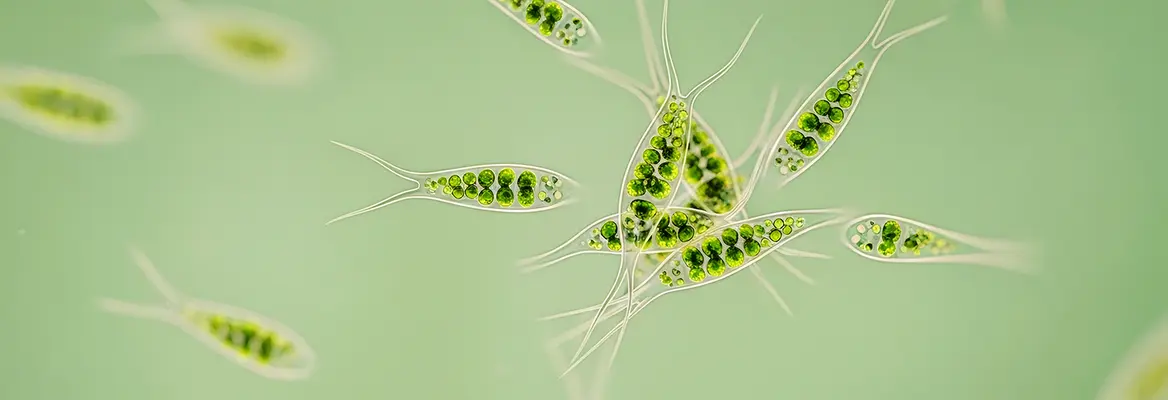

We assume consciousness requires a human or animal brain—an assumption that author and philosopher of science Natalie Lawrence argues is the biggest obstacle to understanding what the mind actually is. Our tools for investigating cognition were built in our own image, leading us to over-attribute "life" to AI while dismissing complex organisms like slime moulds. Drawing on her research into the philosophy of biology, Lawrence explores how Spain's MINT Lab is moving beyond these biases. By designing experiments that don't use human cognition as the template, they aim to build a framework rigorous enough to finally distinguish a system that merely reacts to its past from one that genuinely experiences its present.
How does a physical system such as the brain produce the ineffable phenomenon of conscious experience? Philosopher David Chalmers famously named this the “Hard Problem of Consciousness” in 1995. Proponents argue that, while cognitive functions such as categorisation or information integration might be explained mechanistically in the central nervous system, the origins of subjective experience resist such explanation. Detractors suggest that the Hard Problem is merely a collection of lesser puzzles that have yet to be solved through greater material understanding of the brain.
The heart of this controversy may lie in its core premise: that consciousness arises from a neuronal system organized around a brain. The deep entrenchment of this preconception isn’t surprising, given that our own consciousness is the only one we have access to. But this “brain-centrism” pervades the cognitive sciences, shaping our understanding of other beings and approaches to research. It’s one of several kinds of scientific chauvinism that currently limit the field of enquiry and hamper our scientific approach to other kinds of minds.
The expanding view of mind
Across the philosophy of mind, it is becoming increasingly clear that there are fruitful avenues for exploring the origins and nature of consciousness well beyond neuronal systems. If anything, assuming the necessity of brains is beginning to look like a fragile position.
At the radical frontiers of cognitive science, the concept of what a mind can be and the diverse systems from which it might originate are broadening. By studying organisms very different from us and our vertebrate relatives—such as plants or slime molds— researchers are revealing capacities that hint at minds beyond traditional confines, from maze solving to responsivity to anesthetics.
___
To be properly open-minded about the possible extent of consciousness, we have to remove ourselves from the picture entirely.
___
František Baluška and Arthur Reber are amongst a growing contingent of researchers who argue that to be alive might be to possess some level of sentience. Like intelligence, individual subjective experience probably exists across the tree of life. Not as an incidental phenomenon, but because any organism—whether a bacterium or a blue whale—can only succeed at living if it has a dynamic internal experience. Each organism inhabits a unique and complex world with which it must contend to survive, for which a highly adapted mind is an enormous advantage, if not a necessity. We should expect different organisms to have different kinds of minds, because of the different kinds of substrates from which these minds emerge and because they have evolved in different ecologies.
Our biological assumptions
Even this broader view of sentience has been critiqued for its exclusivity: the assumption that mind is confined to the kind of carbon-based life with which we are familiar. This familiarity, however, does not entail that other forms of life do not exist and could not be sentient. Or, even, that only biologically organized systems can be sentient.
Want to continue reading?
Get unlimited access to insights from the world's leading thinkers.
Browse our subscription plans and subscribe to read more.
Already a subscriber? Log in
Love the iai?
Sign up to get exclusive access.

Related Posts:

Related Videos:
15th June 2026

Join the conversation
Shubham Sharma 13 September 2026
There are two things worth checking in the sources that this piece rests on.
Reber is named among those holding that to be alive is to be sentient. His 2016 target article in Animal Sentience does not hold that. Its axiom requires flexible cell walls, sensitivity to the surrounds, and the capacity for endogenous locomotion, and its fourth footnote is explicit about "excluding plants and fungi on the grounds that they have rigid cell walls". Answering Calvo two years later in the same journal he moved only as far as "Although I took an anti-plant-sentient stance in the target article, ultimately, I am agnostic", and he added an argument running the other way: sentience is metabolically expensive, so a lineage that lays down roots may have stopped paying for it. The authority invoked for plant consciousness is agnostic about it and has published a reason to doubt it.
The second point is structural. The piece holds that "placing biological or structural conditions on the existence of sentience" is counterproductive, then two paragraphs later asks what kinds of organisation generate sentience. The second is a structural condition, and it is the right question. A criterion is what lets you say that the slime mould has an inside and the hurricane does not, and without one the case against brain-centrism has no stopping place short of everything. Dropping biocentrism removes the ground on which the machine was being refused, which leaves that case open rather than disposed of.