




Gravity is likely the force we are all most familiar with. Yet, scientifically, it remains the most mysterious. The standard theories we have of gravity simply cannot make sense of things like the accelerating expansion of the universe or even the rotation of galaxies – leading us to have to invent 95% of the universe in the forms of dark matter and energy. Furthermore, we still have no solution to the problem of quantum gravity. Here, physicist Melvin Vopson argues for a controversial view of gravity. Information, he argues, is as fundamental as mass and energy, and gravity is a way for the universe to minimize the complexity of information.
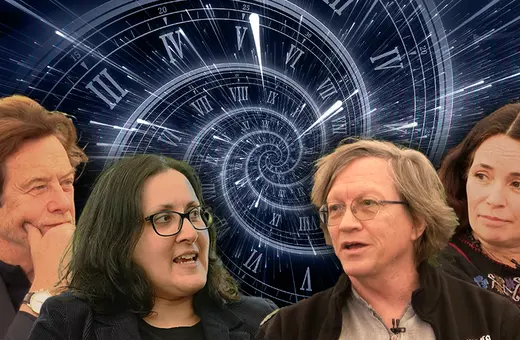
To see Melvin Vopson debate live the idea of whether information is fundamental, join him alongside Adam Frank, Ivette Fuentes and Daniel Whiteson, at the HowTheLightGetsIn festival this September. Also appearing will be world-leading thinkers like Roger Penrose, Sabine Hossenfelder, Emily Wilson, and many many more. Find out more here.
In recent years, a new paradigm in gravitational physics research emerged from information theory and information physics developments. Using the second law of information dynamics and the mass–energy–information equivalence principle, gravitational attraction can be interpreted as a data compression process that minimizes the information entropy associated with matter distributions in space. In this framework, matter evolves toward configurations that reduce informational complexity, producing an entropic force that manifests macroscopically as gravity. Remarkably, this information-theoretic approach naturally recovers Newton’s law of gravitation, suggesting that gravity may arise from fundamental information dynamics and may represent a computational optimization process occurring within the physical universe.
Gravity research has entered a period of renewed conceptual exploration driven by persistent empirical puzzles that challenge the completeness of both Newtonian gravity and General Relativity (GR). While GR has achieved extraordinary success across a vast range of scales, from solar-system dynamics to gravitational waves, it relies on the existence of dark matter and dark energy to explain observations at galactic and cosmological scales. Although these components together constitute roughly 95% of the inferred energy density of the universe, neither of them has been directly detected yet. Modified gravity models arise from the possibility that the apparent need for these unseen components reflects an incomplete understanding of gravitational physics itself. There are also additional key empirical motivations driving further developments of new gravity models.
The first major empirical motivation for modified gravity emerged from galactic rotation curves. Stars in spiral galaxies orbit at almost constant speeds far beyond the visible matter distribution, contradicting the Newtonian expectation that orbital velocity should decline with distance from the galactic center. Within GR, this discrepancy is resolved by postulating massive halos of non-luminous dark matter, while Modified Newtonian Dynamics (MOND), addresses this by proposing a modification to Newton’s gravitational force law at accelerations below a characteristic scale (~10^-10 m s^-2).

A second empirical motivation arises from the dynamics of galaxy clusters and large-scale structures. While dark matter models explain cluster masses inferred from gravitational lensing and velocity dispersions, modified gravity approaches attempt to account for these phenomena through changes to the gravitational field equations.
Want to continue reading?
Get unlimited access to insights from the world's leading thinkers.
Browse our subscription plans and subscribe to read more.
Already a subscriber? Log in
Love the iai?
Sign up to get exclusive access.

Related Posts:


Related Videos:

20th August 2026



Join the conversation
Piotr Sut 20 August 2026
I sympathize with information/thermodynamic theories of gravity because I think the similarities between gravitational phenomena and attraction/accretion and orbiting in the mental and cultural spheres are too close and too many to be accidental.