


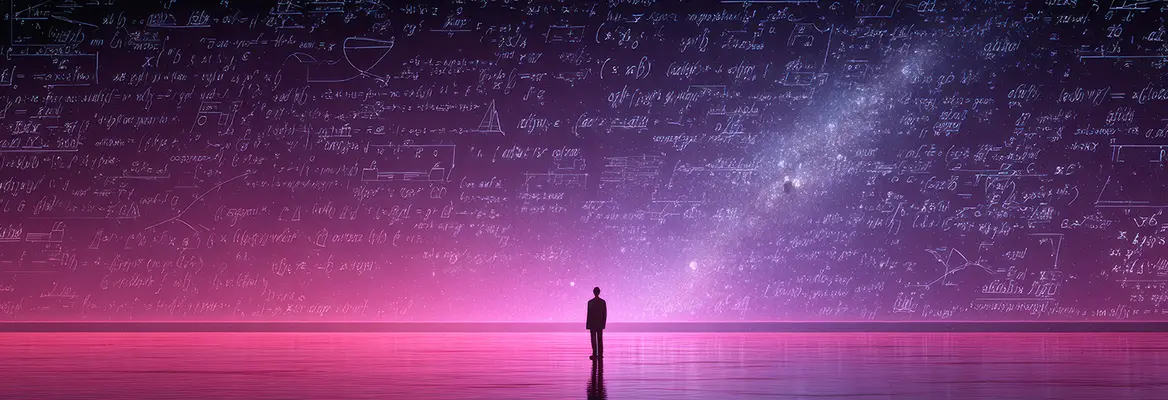

For centuries, scientists and philosophers—from Leibniz to today’s AI visionaries—have dreamed of mathematizing reality, fully describing the world in equations that a machine can compute. But this is a dangerous illusion, argue mathematician and biochemist Jobst Landgrebe and philosopher Barry Smith, whose work on scientific modelling has been utilized by institutions like the US military and the National Institutes of Health, making him one of the world’s most highly cited philosophers. Natural systems like the climate and the human brain, they contend, can never be fully captured by models, because they are fundamentally irregular and unpredictable. True progress depends on flexible heuristics, which allow us to intervene in reality without needing an exhaustive description of it.
Already in the seventeenth century Leibniz advanced the idea of a reasoning machine that could manipulate symbolic representations of all human thoughts—thereby essentially mechanizing thought itself. Scholars facing a disagreement could simply say “let us calculate” and arrive at the truth.
Today we live in a time of renewed belief in our ability to model the world mathematically, using physics and its manifold applications, supported by fantastically powerful reasoning machines called Large Language Models.
For example, we are told that we can have reliable predictions of the Earth’s globally aggregated weather (the climate) for the next 100 years. Or that we will soon be able “to develop genetic engineering technologies and techniques to be able to write circuitry for cells and predictably program biology in the same way in which we write software and program computers” (US Executive Order 14081 of September 12, 2022).
___
We will always be in a position where we can use mathematics to create predictive models of only small portions of reality.
___
We are also told that we will soon be able to emulate the human mind and human intelligence inside a machine. Indeed, there are some who hold that such emulations will perform so well that the machine will become conscious and surpass our intelligence. Others believe that we can optimize the human mind via genetic manipulation or brain implants.
Unfortunately, none of this is feasible. Moreover, the belief in these fantasies is harmful, since, by failing, they can lead not only to enormous malinvestments of scarce resources but also to harmful technology and harmful experiments.
1. How we came to believe we can model everything
It was not only Leibniz but also Kepler, Galileo, Newton, and Descartes who, in the course of the seventeenth century, invented mathematical physics. Not only did their ideas, especially the differential calculus, massively improve our ability to model the world, but they also led to a revolution in the design of technology to change the environments in which we live. Leibniz, for example, devised a new kind of mechanical operating system for the Falun copper mine in Sweden, which massively increased the mine’s output. Since then, physics and its applications in engineering have brought incredible progress and fundamentally changed the human world. On the other hand, these successes have also given rise to a widespread conviction that the trajectory of improvement of the world through science is limitless, and that we will be able to model, and over time predict, and technically manipulate, everything, from molecules to planets.
2. Why we can only model fractions of reality
Unfortunately, however, we will always be in a position where we can use mathematics to create predictive models of only small portions of reality. This is because such models, of any system, rely on regularities of the system’s behavior—and most systems do not behave in a regular fashion.
Want to continue reading?
Get unlimited access to insights from the world's leading thinkers.
Browse our subscription plans and subscribe to read more.
Already a subscriber? Log in
Love the iai?
Sign up to get exclusive access.

Related Posts:

Related Videos:

Barry Smith
24th March 2026



Join the conversation