


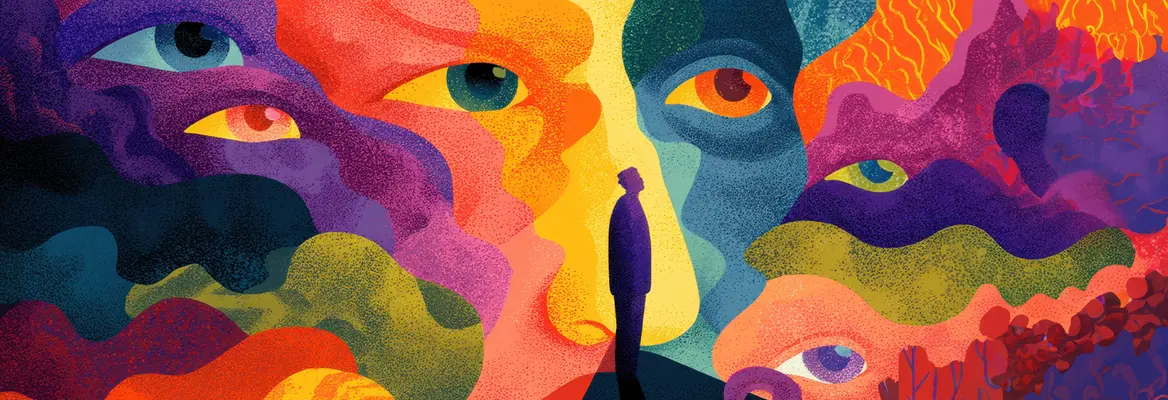

A new study has been interpreted as the strongest evidence yet that we all see the same colors, but philosopher Keith Allen argues this assumption is mistaken. The original study claimed that because we have similar structures of color experience - for example, this turquoise is more blue than green - then these similar structures point to us also experiencing the same underlying colors. However, even one instance of difference in a structure changes the relationships throughout it. Meaning if I do see red differently from you, I also perceive every other color differently too - even if our underlying structures of experience remain the same.
When you look at a tomato, is the color you see the same as the color someone else sees? According to the classic philosophical thought experiment, a version of which is described by the early modern philosopher John Locke, we can imagine two people whose color experiences are systematically inverted relative to each other: when one person looks at a tomato, it looks the same way that fresh grass looks to the other person, and vice versa. But could we ever know they have different experiences, if both people describe tomatoes as “red” and grass as “green”? Indeed, can we imagine someone who looks at the tomato and lacks conscious experience altogether, even though they talk and act exactly like everyone else? It seems easy enough to imagine robots that are able to identify tomatoes as red and grass as green, and in fact we already have LLMs that can accurately estimate similarities between colors (represented by hex color codes). Perhaps we can also imagine people like this, too: “philosophical zombies” who walk among us, behave exactly like us, but have no inner mental lives whatsoever.
Exciting new research by Naotsugu Tsuchiya, Masafumi Oizumi, and colleagues seeks to answer these longstanding questions. Rather than focusing on individual color experiences, and asking whether two people looking at the same object have the same color experience, their approach is holistic and analyzes relations between color experiences. According to recent coverage in the New Scientist, their study provides “the strongest evidence yet” that people share the “same subjective experiences of color.”
Colors stand in distinctive relations of similarity and difference: for example, green is more similar to turquoise than red; red is more similar to pink than yellow. The basic idea behind the research is to ask participants to make judgments about how similar or different pairs of colors are, and then use computational analysis to investigate whether different people’s experiences of color stand in the same overall relations of similarity and difference. The hypothesis is that if two people’s experiences have the same overall structure, then their experiences are identical; if two people’s experiences have different structures, then their experiences are different.
___
Large language models (LLMs) can generate color similarity structures that can be matched with those of normal perceivers, but it does not follow that LLMs enjoy conscious color experiences.
___
The goal of creating systematic representations of similarity relations between colors is not new. There is a long history of attempts to produce color-order systems that seek to represent relationships between the colors. A well-known example is the Munsell Color System. What is novel about this approach is the specific form of computational analysis it uses to compare what the researchers call different “qualia structures.”
Want to continue reading?
Get unlimited access to insights from the world's leading thinkers.
Browse our subscription plans and subscribe to read more.
Already a subscriber? Log in
Love the iai?
Sign up to get exclusive access.

Related Posts:

Related Videos:


18th June 2026


Join the conversation