


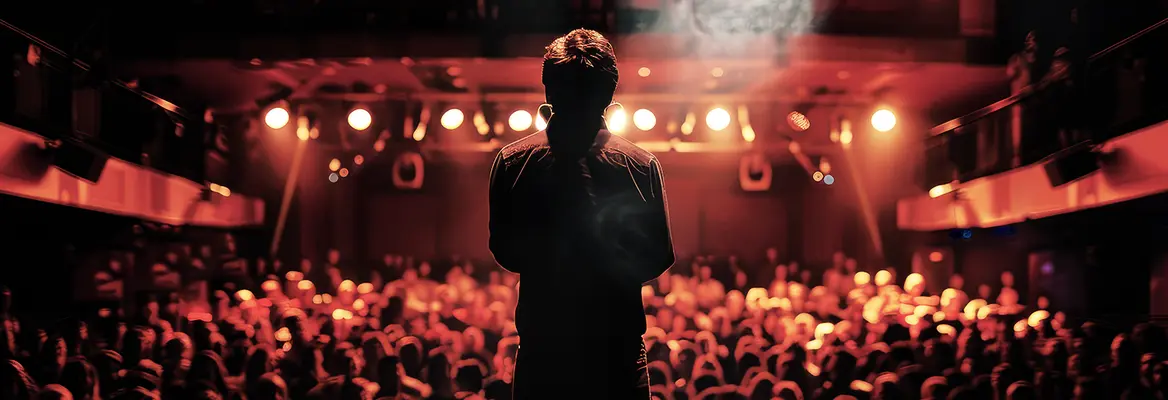

Comedy and satire are widely seen as forms of entertainment, but they remain vital tools for challenging power. Yet in today’s media landscape, dominated by fleeting stand-up routines and viral clips, mockery is easily absorbed, ignored, or contained by those it targets. Stanford Professor Richard P. Martin argues that this has stripped satire of its political force. While figures like Jimmy Kimmel show its continued relevance, real impact requires a return to more public, theatrical, and sustained forms of comedy.
Total moron. Short-fingered vulgarian. Fat orange fascist. The problem is, even the best jeers are satisfying in the moment but ultimately inefficacious. As schoolyard doctrine has long held, it is sticks and stones that really break bones. Yet adults (mostly) don’t feel good hurling rocks instead of insults (quite rightly). So that’s the frustration—how do we make mockery get results?
Real bullets bounce off Godzilla; forget about the verbal equivalent. People cling to the comforting belief that stand-up comedians, whether late-night TV hosts or gritty open-mic aspirants, are speaking truth to power. Nice idea, but naïve. Stand-up—the default medium for modern mockery—doesn’t cut it. Short blasts, however witty or venomous, dissipate like short-term memories. What is more, the potential threat from voices crying in the desert can easily be co-opted or ignored, as has recently been demonstrated by authorities in the US and Saudi Arabia.
___
What Kimmel’s reinstatement showed was just how irrelevant his excellent criticisms of POTUS had all been over the long run.
___
First: closer to (my) home. Jimmy Kimmel, the brilliant late-night comedian on ABC, had the temerity in September 2025 to point out that a recently murdered young activist, Charlie Kirk, was perhaps not material for canonization, despite fervent efforts by right-wingers to sanctify him. Immediately, conservative ire ignited. One of those who claimed to appreciate the late Kirk was the president of the US (hereafter “POTUS”—has no one yet realized that the Latin adjective meaning “drunk” is an odd acronym for a famous teetotaler?). Stung for years by Kimmel’s nightly barbs, this time POTUS backed his handpicked head of the Federal Communications Commission in threats to derail a merger deal involving the parent company of ABC (Walt Disney Co.). Within 48 hours of his original MAGA-infuriating monologue, Kimmel was off the air.
To its credit, a non-trivial slice of America—the place that one recent commentator aptly described as, “A nation of anxious primates trapped in a silicon casino of likes, retweets, and dopamine-soaked drudgery”—woke up long enough to protest the POTUS-sanctioned suspension, with lines of demonstrators snaking around Disney headquarters in Los Angeles and New York. Some suits in the C-suite had second thoughts, in which the phrase “advertising revenue” no doubt featured prominently, and within a week Kimmel was back, gracefully unapologetic. Surely a win for democracy, for free speech, for comedy!
To the contrary: what Kimmel’s reinstatement showed was just how irrelevant his excellent criticisms of POTUS (and FLOTUS and SCOTUS, to boot) had all been over the long run. Supporters tuned them out (or more likely never watched the show); the opposition imbibed them and felt good. But be assured: if Kimmel had really possessed the key to civic destabilization that some attributed to him, his show would long ago have been deep-sixed.
___
How do you mock, belittle, abuse, and deflate the monsters (given that they will never feel shame)? One answer is to leverage the brain and get dramatic.
___
Want to continue reading?
Get unlimited access to insights from the world's leading thinkers.
Browse our subscription plans and subscribe to read more.
Already a subscriber? Log in
Love the iai?
Sign up to get exclusive access.

Related Posts:
Related Videos:


2nd April 2026


Join the conversation