


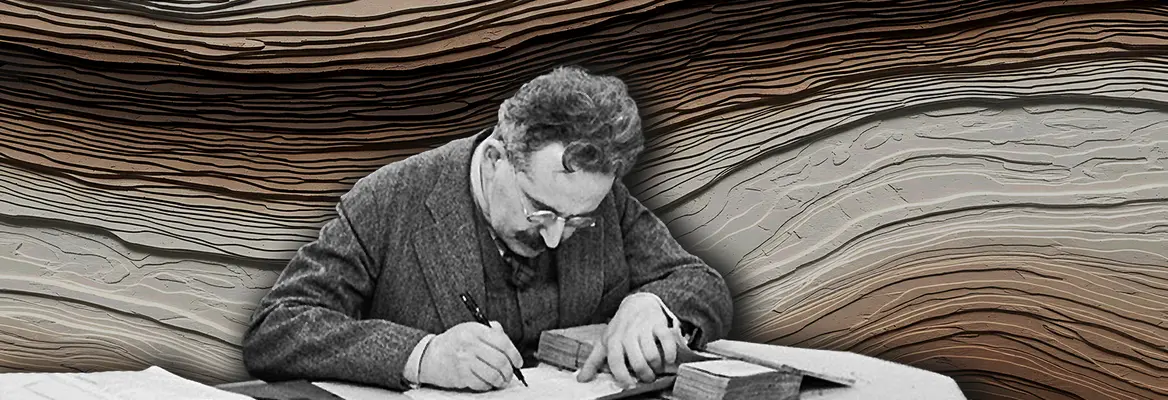
We tend to experience time as a river flowing inexorably forward: linear, orderly, with the past firmly in the past. But Timotheus Vermeulen, the cultural theorist who first popularized the idea that our era is “metamodern,” argues that such metaphors are misleading. Drawing on imagery from the philosopher Walter Benjamin, he proposes that temporal experience is closer to clay on a potter’s wheel, something we can grip, turn and remould. In poetry, film, memes and music, we play with time, using anticipation, gesture, rhythm and repetition to fracture its linear flow. Time is not simply a background condition of our experience—we can use it to sculpt and remake consciousness itself.
Sometime between 1914 and 1915, the German philosopher and cultural critic Walter Benjamin wrote an essay on two poems by the Romantic poet and misunderstood visionary Friedrich Hölderlin. It is a peculiar and little-known piece of writing. By the author’s own account, it should be a straightforward exercise in close reading. But by the time he draws his conclusions he has offered all of a circuitous metaphysics of poetry, an implicit contemplation of the nature of time, and an elegy for his childhood friend Fritz Heinle, a would-be poet who had killed himself earlier that year. It’s also unmistakably the work of a young writer still finding his voice: grandiose, purple, convoluted, banal, exciting, inconclusive, all impulse and little orientation.
Benjamin is celebrated today as one of the great stylists among theorists (especially compared to some of the others associated with the Frankfurt School), a master of prose as well as ideas. But this text, ironically, is as tortuous a read as Hölderlin’s notoriously intricate and impenetrable poems of which it tries to make sense.
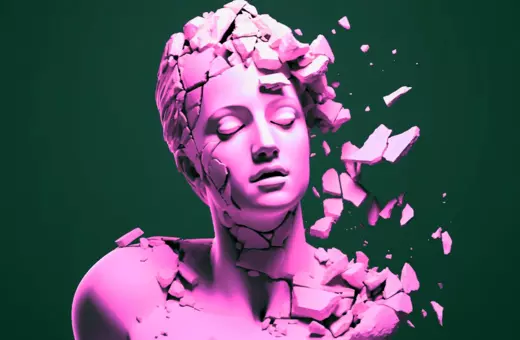
It may well be for these reasons that the essay has received little critical attention. It’s considered what literary critics often call “juvenilia” or “apprentice” work. To dismiss Benjamin’s essay would be a mistake, however. For somewhere between the overwrought musings on poetry and his youthful sentimentalism, a genuinely original and radical thesis is formulated (one moreover that would inspire Benjamin’s later writings). An intriguing observation about and a persuasive theory of time that opposed and questioned the standard accounts of time in the early twentieth century, and that continues to do so today. Time as Hölderlin’s poems sketch it, suggested Benjamin, was not an arrow nor a funnel nor a flow, but a sculpture-in-the-round: a matter that could be felt, held, turned, molded—“plastic.”
___
The order of time is not as fixed as we may think.
___
The dominant notions of time at the time Benjamin wrote the essay are still among the most widely accepted today: Immanuel Kant’s thesis that time is an a priori, universal condition for how we experience life, and Henri Bergson’s contrasting view that time is not prior to experience but consists in that lived experience itself. In the first, time is a “necessary” conceptual framework all of us are born with which allows us to see the world as we do: ordered, successive, measurable. It is what makes it possible to understand that one event follows another in a determinate sequence; that there is a now and a then, a present, a past, a future.
Want to continue reading?
Get unlimited access to insights from the world's leading thinkers.
Browse our subscription plans and subscribe to read more.
Already a subscriber? Log in
Love the iai?
Sign up to get exclusive access.

Related Posts:

Related Videos:

4th June 2026

Join the conversation