


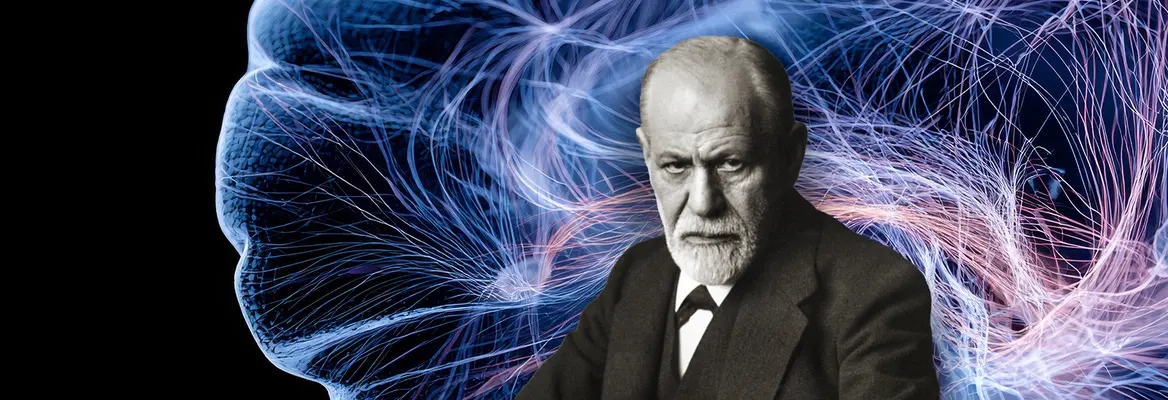
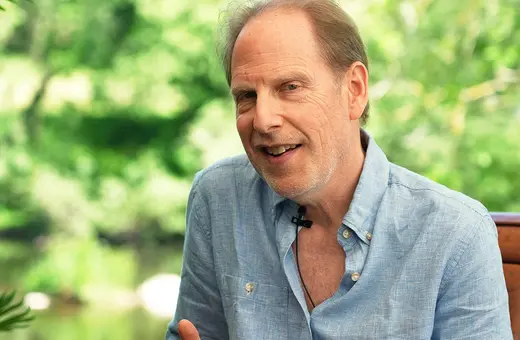
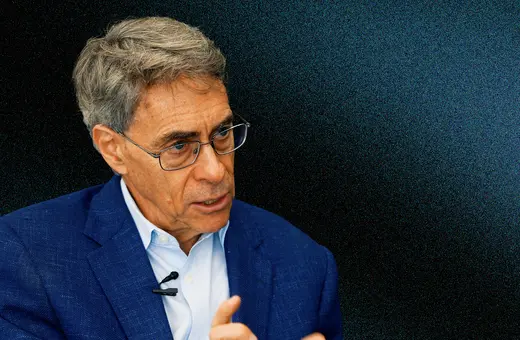
Neuropsychologist Mark Solms — the man entrusted with editing Freud's complete scientific works — argues that a century of neuroscience has been unknowingly proving psychoanalysis right. In this interview with Evie Manton, he traces our current theories of the unconscious, memory systems, and drive theory to their Freudian predecessors, and makes the case that following Freud back to the brainstem may hold the key to understanding consciousness itself.
Mark Solms will be appearing at the HowTheLightGetsIn festival this September, alongside other leading figures including Roger Penrose, Sabine Hossenfelder, Mariana Mazzucato, John Gray, and many many more. Find out more here.
Evie Manton: Most people think neuroscience buried Freud. You argue it has resurrected some of his deepest ideas. What exactly has neuroscience discovered that brought you to this view?
Mark Solms: There are many things Freud discovered that we have rediscovered in neuroscience entirely independently of him. It's not as if we were following a trail Freud left—it was truly independent rediscovery.
Let me start with the headlines. First, the very idea that there is an unconscious portion to our minds. You might think this is taken for granted, but when Freud spoke of the unconscious mind, it was considered an oxymoron. To the Victorian ear, "unconscious mind" sounded like unconscious consciousness—mind and consciousness were synonymous. Now, in neuroscience, it is mainstream. It's an empirically proven fact that the vast bulk of our cognitive activities go on unconsciously.
Closely allied to that is the idea that we have multiple memory systems. Freud pioneered that too. If you Google who discovered multiple memory systems, you're told it was Tolman, in the 1920s—and to add insult to injury, Tolman was a bloody behaviourist! Freud introduced the model in 1896, exactly as we believe today. He said memories are transcribed not once but many times over; that it's a dynamic process; that they're transcribed in different systems functioning according to different principles. He said there must be at least three: what he called the conscious, preconscious, and unconscious systems. Nowadays we call them short-term memory, declarative long-term memory, and non-declarative long-term memory. Exactly the same.
Then there's the idea that early childhood development is particularly formative for the personality—and that early adverse childhood experiences are terribly important for vulnerability to psychopathology. The idea of infantile traumatic experiences that are pathogenic, of critical periods, of what we now theorize under epigenesis—all of that Freud set out.
The embodied nature of the mind. Nowadays we speak of embodied cognition. All of that is just Freud—the idea that the mind does work on behalf of the organism as a whole, captured in his concept of drive. Damasio, Panksepp and others now emphasize the homeostatic nature of mental processes. Karl Friston too. The whole paradigm of predictive processing—what is prediction but the belief that if I wish to reattain a previous experience of satisfaction, I must do this? That's what Freud called wish fulfillment.
___
The feeling of an emotion is every bit as real as the existence of a chair. It's just easier to measure a chair.
___
And the functionalism attributed to Hilary Putnam in the 50s, Freud introduced in 1900. He called this method of dissecting the function rather than the organ a scientific novelty, but "I can see no harm in it as long as we don't mistake the scaffolding for the building."
Want to continue reading?
Get unlimited access to insights from the world's leading thinkers.
Browse our subscription plans and subscribe to read more.
Already a subscriber? Log in
Love the iai?
Sign up to get exclusive access.

Related Posts:

Related Videos:

Evie Manton
3rd August 2026

Join the conversation
Brian Balke 3 August 2026
Much of what is attributed to Freud here was understood by the ancient philosophers. Where Aristotle and Siddhartha surpassed Freud was in the understanding that psychopathology is a social convention. The struggle for all of us is to enter into a mature moral dialog with our community. Psychotherapy - led by Freud - has focused on pathology and fails to provide a moral theory of social contracts. Jesus, among the most mature commentators on the failure of conventional methods of social control, held that at heart we must evolve the capacity to give and receive love.
Freud was one of a number of authoritarian figures who held that the role of the therapist is to interpret behavior to reveal inner motivations. That is insufficient. No therapist can travel in the reality experience by the subject. It is in individuation - the surrender of parental deities and the assumption of moral responsibility - that we find self-trust that supports agency and fulfilment.