


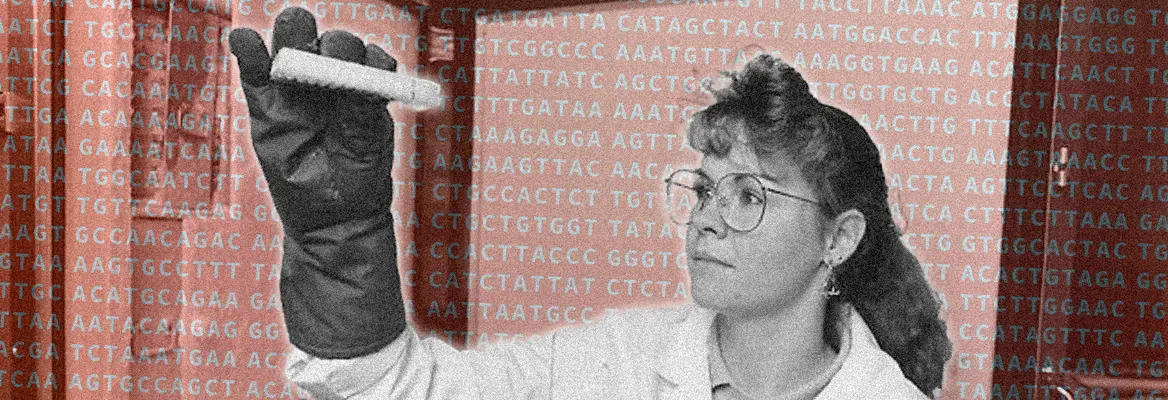

The Human Genome Project promised genetic-based cures for all the major diseases of mankind, from cancer, to Alzheimer, to schizophrenia. A quarter of a century later, and these sweeping cures haven't materialized. Biologist Denis Noble and his co-authors Raymond Noble and Reine Bourret argue that this failure reveals a flawed foundation in modern biology: treating genes as the system’s controllers rather than its tools. For 60 years this central dogma has mislead biology. Once we overthrow it, we can transform our understanding of how species evolve.

Figure 1: diagram of the Central Dogma
Biology during the twentieth century was firmly based on Watson and Crick’s famous work on the structure of DNA. They discovered (with important data input from Wilkins and Franklin) that DNA forms double helical threads, each thread being a complementary sequence to the other. The nucleotide bases C and G join together, while A and T also do so. So, a sequence like AACGTTCC in one thread is matched by the complement TTGCAAGG. They realized that this has an important implication. When the threads are unwound, each thread can attract its complementary sequence automatically, so creating two new threads. It is easy to imagine their excitement since the quantum mechanics pioneer, Erwin Schrödinger, had proposed self-replication “like a crystal” in his book What is Life? a decade or so earlier. Crick incorporated all of this into his Central Dogma of Molecular Biology.
All that remained was for Richard Dawkins to bake this idea into his book, The Selfish Gene, claiming that DNA replicates like a crystal, proteins are automatically formed from DNA templates, and so genes “created us, body and mind.” Biology became a determinate process, with DNA templates enabling RNAs to be formed that then enabled ribosomes to create amino acid sequences from the nucleotide sequences. There was no room for living cells themselves to orchestrate DNA replication. It became a purely chemical one-way process: DNA → RNA → PROTEIN, the basis of Crick’s Central Dogma.
___
Instead of being determinate, life exists on the edge between order and disorder.
___
Julian Huxley, in his 1963 revision of Evolution, The Modern Synthesis, detached evolutionary biology from the physiology of life, leading to the gene-centric biology of the twentieth century, in turn leading to the Human Genome Project and the promise of genetic-based cures within a decade for all the major diseases of mankind: cancer, cardiovascular disease, Alzheimer’s, schizophrenia, obesity, and so on, predicted by 2010.
The failure to find the promised cures
As you will surely have noticed, that monumental clinical outcome has not happened even a quarter of a century later. On the contrary, our health services are now swamped by the burden of the illnesses of old age as we face a gene-centric impasse. Health costs have soared way beyond the capacity of even the wealthiest nations. So what went wrong?
The reason for that failure is that an important test of the self-replication idea had not been performed. No one had checked whether chemical self-replication really works with the accuracy needed by living cells. That happened in 2012 when Rebecca Schulman at Johns Hopkins University let DNA self-replicate in purely chemical conditions. It did. Impressively so. Threads of nucleotides thousands of base pairs long reproduced. The authors even refer to the process as “robust”: just one error on average per 4000 base pairs. Fine for a small virus.
Want to continue reading?
Get unlimited access to insights from the world's leading thinkers.
Browse our subscription plans and subscribe to read more.
Already a subscriber? Log in
Love the iai?
Sign up to get exclusive access.

Related Posts:

Related Videos:

Raymond Noble
Reine Bourret
12th November 2026

Join the conversation