


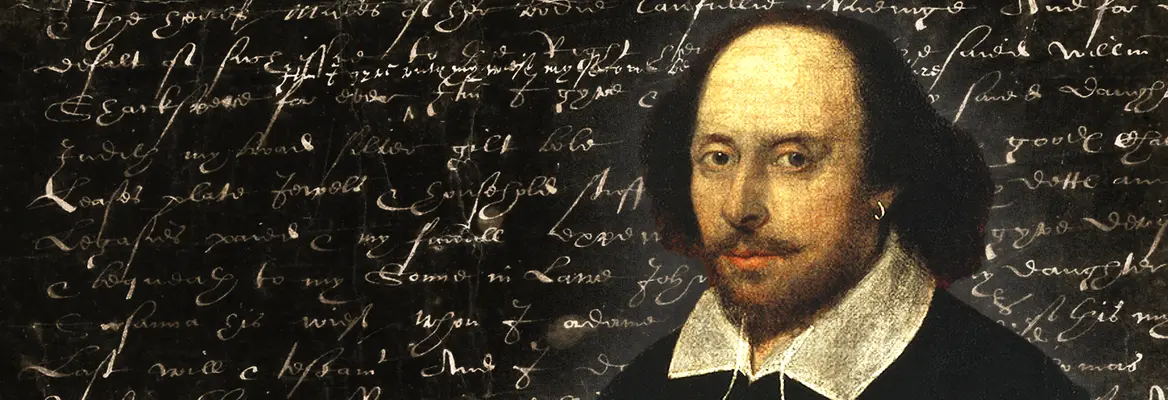

We think of Shakespeare as the ultimate master of words, but his plays frequently stage the moments where language fails. Simon Palfrey argues that Shakespeare purposefully pushed language to its breaking point to show that our deepest experiences—grief, desire, shame, and death—cannot be put into words. When we demand that people articulate these feelings, we are asking for something that cannot exist: a neat verbal account of experiences that are, by their nature, beyond speech.
It’s fair to say that Shakespeare had as much command over the spoken word as anyone who has ever lived. But he always knew that words might fail us when we need them most. The more inward we travel, the more words may start to coil and falter. Think of the most private suffering—shame, forbidden love, self-loss, imminent death—and there we will find Shakespeare, stalking the lands where shareable words, even speakable words, no longer exist.
Forbidden love is the subject of Romeo and Juliet, and Juliet in particular is intensely scrupulous about the language it demands. She would rather not speak at all than speak falsely, or still less swear on over-traded icons like the moon. Juliet is fiercely aware of the constraints upon her freedom to speak; but, could she speak her desire, it would shatter the bounds of both her social world and her body:
Bondage is hoarse and may not speak aloud,
Else would I tear the cave where Echo lies
And make her airy tongue more hoarse than mine
With repetition of my Romeo’s name.
No words can contain her ardor; she would cry her tongue hoarse, end speech entirely rather than subdue her desire. When she is denied Romeo’s presence her words become either empty situational lubricants (her false contrition and good night to her parents, knowing she will never speak to them again) or hyperbole that admits no conceivable response, correspondent to nothing but her world-annihilating will (her vow to leap from battlements, or lurk where serpents are, or hide in a charnel house covered with dead men’s rattling bones rather than be without her love). Language is a social art, designed to communicate. For the lovelorn Juliet, such social language is done with; she will act her final dismal scene alone, in a tomb that will eternalize her unknowable mind.
___
In a profound sense these characters have leaped beyond the playworld, into a dimension where words do nothing but echo in unanswerable isolation.
___
Cordelia in King Lear presents a variation on Juliet’s dilemma. The play begins with Lear’s notorious public love-test of his three daughters: Which of you shall we say doth love us most? Perhaps Lear believes, or pretends to believe, in the faithfulness of words to intimate relations. Or perhaps he believes that a rehearsal of words is sufficient; what matters is public compliance with the flattery-show. Whatever Lear believes, Cordelia is quite unable to heave her heart into her mouth. To do so would resemble a foul kind of vomit. Love, and be silent, she says in an aside to the audience, as Lear prepares his fateful summons. What can you say, asks her father, to get a richer gift than your sisters?
Cordelia. Nothing, my lord.
Lear. Nothing?
Cordelia. Nothing.
The insult, for Cordelia, is to expect words to perform her feeling. There is extraordinary pride here, but the insult to the virtue and simplicity of love is still more. Not just how can love be spoken, but why should it be spoken? The demand for words is the profoundest failure of trust.
Want to continue reading?
Get unlimited access to insights from the world's leading thinkers.
Browse our subscription plans and subscribe to read more.
Already a subscriber? Log in
Love the iai?
Sign up to get exclusive access.

Related Posts:

Related Videos:



29th April 2026


Join the conversation