


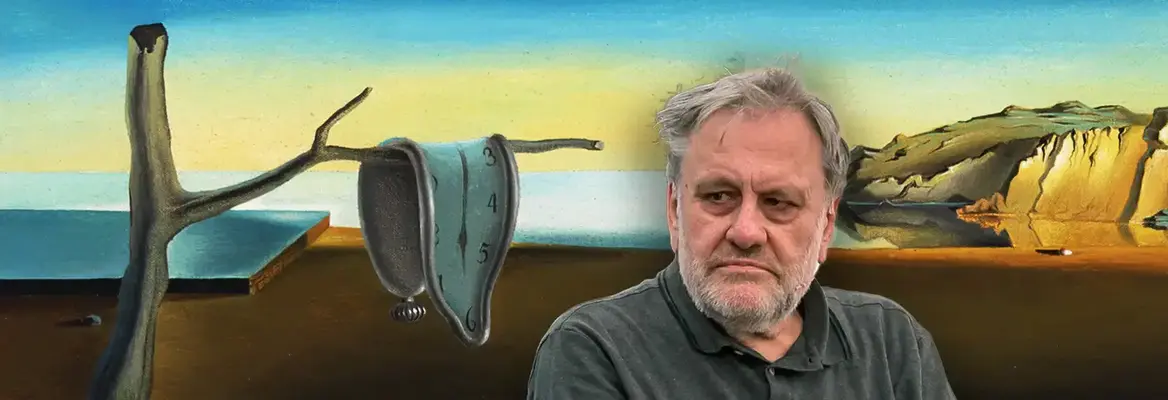

Dismissing the hope that either science or democracy will deliver a coherent future, Slavoj Žižek argues that quantum mechanics demands a new philosophy of “quantum history,” in which reality is incomplete and events retroactively reshape the past they emerge from. In conversation with IAI Contributing Editor Omari Edwards, Žižek connects this ontological uncertainty to contemporary politics, from AI and climate change to Trumpism and thinkers such as Curtis Yarvin and Wang Huning, claiming that the collapse of the liberal center is ushering in a new authoritarian moment.
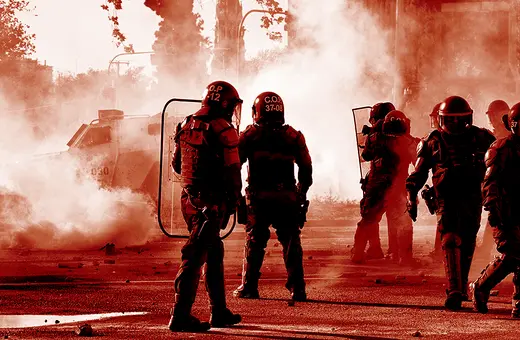
Interviewing Slavoj Žižek is like trying to divert a crowd already surging toward violence. Not with authority, not with barricades, but by stepping into its path and hoping that a sudden question, a sharp interruption, or a desperate redirection might slightly bend its trajectory before impact. There is always the sense that, if you misjudge the timing or the angle, the whole thing will break loose and carry you with it. You begin with quantum mechanics and are rapidly swept through Stalinism, psychoanalysis, theology, ecological catastrophe, and the collapse of Western liberalism.
The danger is not that nothing will be said, but that everything will be said at once, without mercy. Early on, Žižek describes himself, with deadpan seriousness, as “a moderately conservative communist”—a phrase that turns out not to be a joke but a key. He is suspicious of liberal pieties, hostile to revolutionary romanticism, and impatient with both technocratic centrism and utopian fantasy.
Beneath the jokes, the perversity, and the provocation lies something colder and more exacting: an attempt to describe a world that no longer coheres. His new book, Quantum History, is not a metaphor dressed up as physics, nor a philosopher’s flirtation with science. It is an ontological wager. Reality, he insists, is not merely difficult to know but fundamentally cracked. Incompleteness is not a failure of knowledge but a property of existence itself.
This interview, then, is less a discussion of a book than an effort to keep hold of a single question as it mutates across physics, ideology, history, and politics: what does it mean to act in a world that offers no underlying guarantee of coherence, progress, or sense?
Omari Edwards: You call your new book Quantum History: A New Materialist Philosophy. So let’s start directly. Are you making an ontological claim about the universe itself, or simply using physics as a metaphor?
Slavoj Žižek: No, I pretend to, at least pretend, to make a strong ontological claim. And this is, for me, already, we touched now the very core of my understanding of quantum mechanics. We touched the very core of what bothers me.
Because, you know what is, for me, the big revolution of quantum mechanics? The usual skeptical approach to reality is: reality is out there. We can only gradually approach it. There are things we know, there are things we don’t know. And that was, for example, Einstein’s reading, you know, quantum mechanics means there must be some hidden variables. It doesn’t give a complete picture.
But for me, the genius of quantum mechanics is its obvious incompleteness. We cannot know everything about reality. And this is not just epistemological, but ontological, in the sense that reality is in itself incomplete.
It’s very interesting how when Heisenberg got to this idea that you cannot measure the speed and the position of the particle at the same time, he still took it as an epistemological limitation. But then Niels Bohr, who is nonetheless my big hero, immediately said: no. This gap, this incompleteness, has to be in reality itself.
Want to continue reading?
Get unlimited access to insights from the world's leading thinkers.
Browse our subscription plans and subscribe to read more.
Already a subscriber? Log in
Love the iai?
Sign up to get exclusive access.

Related Posts:

Related Videos:


Omari Edwards
4th December 2025

Join the conversation
R H van der Gaag 1 6 December 2025
Very interesting, yes, but some editing might have been a good idea. Or just give us the video/audio.
It does seem Žižek is ripe now, and can be eaten.