


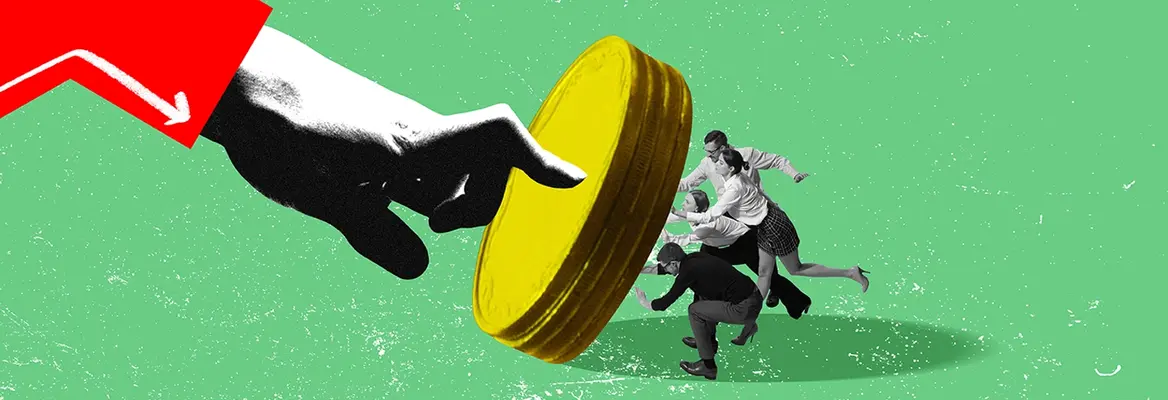

Beneath the clash between selfishness and solidarity lies an evolutionary truth: humans survived not just by competing, but by caring. Yet neoliberalism has treated only one side of our nature as real, redesigning society around the fiction of the purely rational, selfish actor. Paul Deutchman of University of Pennsylvania, drawing on his research into evolutionary psychology and human behavior, explains how this misreading now underpins inequality, democratic decay, and a fraying sense of the common good. To rebuild institutions worthy of us, we must reclaim the cooperative instincts that shaped our minds and design a political economy that lets both sides of our nature work in tandem.
There is a fundamental tension at the heart of human nature—we’re both inherently selfish yet also incredibly altruistic. We are capable of pillaging, oppression, and slaughter, yet we’re also capable of compassion, loving kindness, and self-sacrifice. While this may seem like a paradox, humans’ predisposition to be both selfish and selfless can be explained by understanding how evolution via natural selection has shaped our species’ psychology. By the end of this article, I will make a case for why an empirically grounded understanding of human nature offers important implications for our societies’ economic and political institutions.
The evolution of cooperation and morality
Humans, like all organisms, are fundamentally selfish at the genetic level—genes, the building blocks of life, have a sole “goal” of replicating themselves by transmitting their genetic material to the next generation. But if our genes are inherently selfish, why aren’t we entirely selfish as well? In other words, why does cooperation exist at all?
Following Charles Darwin’s publication of The Origin of Species, in which he laid out his theory of evolution by natural selection, a large body of research in evolutionary biology has investigated the mechanisms that facilitated the emergence of cooperation in our species. As a result of this work, we now have a firm understanding of how human cooperation evolved through genetic self-interest.
The first key to understanding human prosociality is non-zero-sum interactions. Non-zero-sum interactions are relationships in which all parties can benefit, allowing for the possibility of mutual benefit through cooperation. Cooperation emerges in non-zero-sum interactions when helping another organism also increases the cooperator’s own genetic fitness. This can occur directly, such as in the context of kin selection, in which an individual confers benefits to their genetic relatives. Or it can occur more indirectly, such as in the context of long-term reciprocal relationships between species (such as the mutualism between flowers and pollinators) or within species (such as in the context of human friendship). Regardless of the specific mechanism, non-zero-sum interactions facilitate the emergence of cooperation.
The second key to understanding human prosociality is to recognize that, much like evolution has shaped our bodies—hearts to pump blood, sensory organs to perceive our environment—it has shaped our minds. To understand how natural selection has shaped human psychology, we need to consider the types of recurring evolutionary problems our ancestors faced throughout our species’ evolutionary history. One of the most historically common and important problems our ancestors encountered were collective action problems.
___
Natural selection has shaped our species to be both highly selfish and selfless.
___
Want to continue reading?
Get unlimited access to insights from the world's leading thinkers.
Browse our subscription plans and subscribe to read more.
Already a subscriber? Log in
Love the iai?
Sign up to get exclusive access.

Related Posts:

Related Videos:



10th December 2025


Join the conversation
Brian Balke 10 December 2025
The most dangerous outcome of neoliberal politics has actually been codification of business codes that protect the wealthy from competition. It is not "free market" in the policy details. It is oligarchy in its worst form.
American culture is dominated by the goals of immigrants seeking freedom. In effect, this filters for people unwilling to struggle against the constraints of their home cultures. They are self-seeking. So, we see Fred Trump, pimp and real estate developer, raising a psychopath whose misogyny landed him in the Oval Office. This is a factor that is overlooked in this analysis. Our genes encode a flexible learning architecture in the brain that adapts to "what works." Parenting is the driving factor in guiding us away from psychopathy and towards collaboration. Workaholic parents (either by preference or necessity) leave a bunch of little Hitlers and Mata Haris to compete for social control.
The neoliberals fund their policy institutes by scaremongering among the morbidly rich. They tell the poor little rich boys that the government wants to take their money. In return, the tax codes, fiscal policy at the Fed, and SCotUS interpretation of corporate law all work to benefit moneyed interests. There is no "game" (zero-sum or otherwise). The federal budget is simply a trough that is filled by citizens and emptied by the oligarchs.