




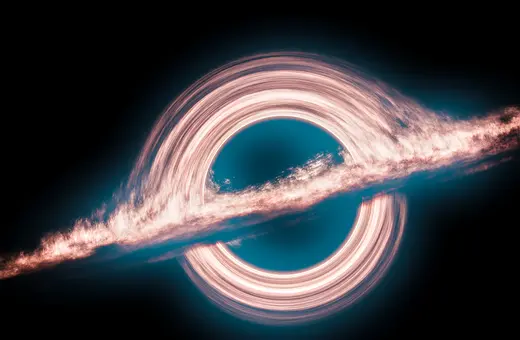
The universe seems to be fine-tuned for life. Were nature’s constants even slightly different, life wouldn’t exist. To explain this, scientists reach for bizarre ideas, like an infinite multiverse. But physicist and technologist Jeff Shainline thinks we’ve been missing a crucial clue. The universe isn’t just fine-tuned for life, but also for the creation of technology – humanity itself is just one step in this longer evolutionary process. He uses this observation to build a new case for an overlooked explanation of fine-tuning: Lee Smolin’s proposal that universes reproduce through black holes and, like organisms, evolve across cosmic generations towards fecundity. Life and technology, Shainline argues, are not the point of the universe, but parts of its reproductive strategy.
A deep puzzle has loomed over physics since the 1950s. The world we observe—from sub-atomic quarks to lightyear-spanning galaxies—has the properties it does because a short list of numbers takes certain values. These numbers are often referred to as constants of nature (I will refer to them as parameters), and they include quantities like the speed of light, the masses of fundamental particles, and the strengths of the fundamental forces. The puzzle arises because these numbers have very special values that allow life to exist. This is called fine-tuning. As an example, life depends on carbon, and carbon is made in stars. But the specific process by which carbon is made in stars is extraordinary, relying on a very peculiar coincidence of properties involving electromagnetism, gravity, and the strong nuclear force that causes alpha particles to fuse into carbon nuclei. If the parameters that describe our universe were even slightly different, stars would not create carbon, and life as we know it would not be possible.
It therefore appears that the parameters of the universe are fine-tuned to enable life to exist. There are several proposed resolutions to this puzzle. One is a statement of observer bias. According to this worldview, a vast number of universes with different parameters exist, and we find ourselves in this particular one simply because it is hospitable to our existence. This is referred to as the weak anthropic principle. Many physicists accept this explanation, finding it favorable because it gives no special role to life or humans, while many others find it unsatisfactory because it assumes a possibly infinite multiverse and only explains our residence in that infinitude by appealing to random chance. At the other end of the spectrum is the worldview that there is some property of nature that necessitates the eventual existence of intelligent observers. This is called the strong anthropic principle, and it asserts that our universe must eventually produce life. A third explanation is theism, which states that an omniscient, omnipotent deity selected these parameters during intentional creation, perhaps specifically for the purpose of allowing life to exist. Under some forms of this worldview, humans specifically are the reason the parameters take the values they do.
 SUGGESTED READING
Fine-tuning points towards a cosmic purpose
By Philip Goff
SUGGESTED READING
Fine-tuning points towards a cosmic purpose
By Philip Goff
To many, none of these explanations is satisfactory, since they involve profoundly improbable chance, or lack clarity as to why intelligence is required, or invoke a deity controlling nature from outside. To me, they also miss an important piece of the fine-tuning picture: fine-tuning doesn’t appear to be limited to life; the parameters of the universe also appear to be tuned to support advanced technologies—a fact completely missing from the anthropic principle, and one that I think points to the resolution, as I’ll describe below.
Want to continue reading?
Get unlimited access to insights from the world's leading thinkers.
Browse our subscription plans and subscribe to read more.
Already a subscriber? Log in
Love the iai?
Sign up to get exclusive access.

Related Posts:



Related Videos:

7th September 2026



Join the conversation