


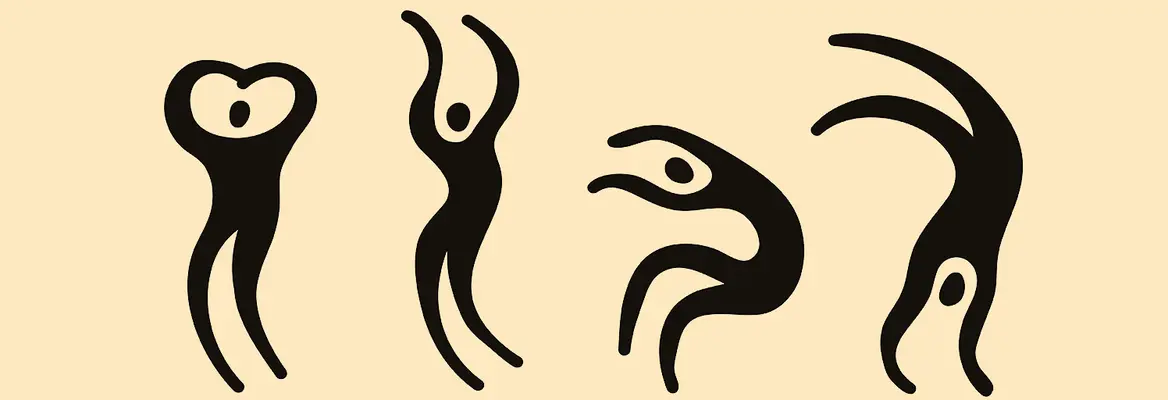

Philosophy is usually treated as a purely mental pursuit. But philosopher and dancer Kimerer LaMothe argues that the core skills of thinking—paying attention, imitating, experimenting, and practicing—grew out of the rhythmic, social movement we call dance. Drawing on evolutionary theory and figures from Plato to Nietzsche, she suggests that dancing is not an object for philosophy to analyse but the activity that makes philosophical thought possible. To understand how we think, she argues, we need to pay attention to how we move.
When it comes to philosophy, it is worthwhile to consider the Delphic maxim: know thyself. As critics observe, the enterprise often resembles the actions of a dog who buries a bone, only to search for it and, when finding it, celebrate his new discovery. The way philosophers ask questions may hide the answers they set out to retrieve.
When it comes to dance, the metaphor is apt. Philosophers intent on studying “it” tend to ask questions that bury the bone. Such questions include: What is it? How do we identify its essence and attributes (Sparshott)? In what way does dancing qualify as art (Kant), religion (Langer), or non-intellectual social praxis (Hegel)? How does dancing make meaning; communicate knowledge; affect social bonding, or otherwise function in relation to perceived social or personal goods?
Yet, philosophers who treat dancing as if it were an object to analyze ignore the very patterns of rhythmic bodily movement that enable them to consider dancing as an object in the first place.
___
Dancing ensures, in the words of Nietzsche that the values and ideals we create “remain faithful to the earth.”
___
For a philosopher who knows herself, as this essay argues, dancing is the enabling condition of philosophizing itself. The inborn, trainable capacities—that humans activate and educate when they dance—are the very capacities that enable philosophical thinking.
Dancing is a human universal. As anthropologists and psychologists document, every human infant before the age of one already responds to patterns of sounds and movement by moving their own bodily selves in tempo with what they hear, and in imitation of what they see.
So too, every human culture, from hunter-gatherer to post-modern, features culturally specific forms of dancing. Dancing, among the earliest forms of human culture, most likely generated the cultural forms of religion, morality, law, and art.
Notably, for the ancient Greeks, dancing is unremarkable. Humans dance. The question is not whether but how, when, where, and why. For both Plato and Aristotle, the practice of ordered, rhythmic bodily movement is essential to the education of human reason. Such bodily action promotes the development of ordered, rhythmic rational thinking. The practice of dancing channels the force of emotions and ensures an optimal balance between mind and body.
Even more importantly, for these philosophers, dancing cultivates grounds for discernment: philosophical choices must serve an inner and outer harmony, as well as the balance between. And in order to know this inner/outer harmony, philosophers must have a sensory-kinetic awareness of it within ourselves.
By practicing dance, the ancients claim, philosophers guard against the possibility that their musings drift into abstract fantasy realms; they hold their thinking accountable to actual experiences of sensory-kinetic bodies on Earth. Dancing ensures, in the words of Nietzsche, that the values and ideals we create “remain faithful to the earth.”
Any attempt to provide a philosophy of dance must account for this dance of philosophy.
 SUGGESTED VIEWING
The philosophy of performance
With Michelle Terry, Myriam François
SUGGESTED VIEWING
The philosophy of performance
With Michelle Terry, Myriam François
Want to continue reading?
Get unlimited access to insights from the world's leading thinkers.
Browse our subscription plans and subscribe to read more.
Already a subscriber? Log in
Love the iai?
Sign up to get exclusive access.

Related Posts:


Related Videos:
11th March 2026


Join the conversation