


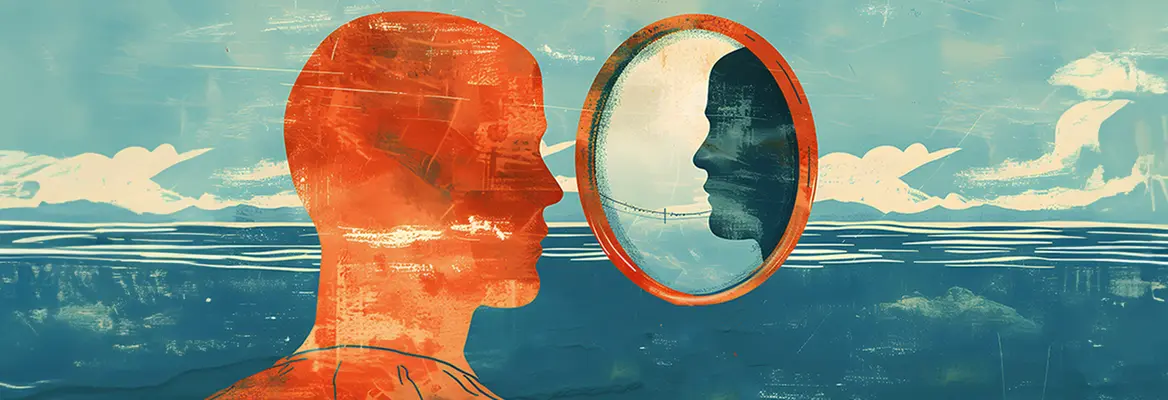

When we are young, parents point out our reflection in the mirror and tell us, “that’s you”. Yet something always feels uncanny and a little off. The reflection in the mirror misses something vital about our identity as human beings: our inner self, the consciousness inhabiting the body. Philosopher Marina Zilbergerts argues the consequence of this is that human beings and other creatures are not self-aware in the way we think they are. The mirror test as a test to judge self-awareness is a fantasy of psychology.
What do Snow White, The Picture of Dorian Gray, The Matrix, and Harry Potter have in common?
All of these archetypal stories return to the mirror as a way of exploring the different dimensions of self-awareness.
In Snow White, the mirror is an arbiter of beauty whose truthfulness drives the Evil Queen to rage. In The Picture of Dorian Gray, the portrait in the attic serves as a true mirror that reveals the protagonist’s moral condition. In The Matrix, Neo touches the mirror and is drawn into a liminal space where the boundary between appearance and mind is renegotiated. In Harry Potter, the Mirror of Erised reveals the heart’s deepest desires.
Looking into a mirror, we expect to see a correspondence between ourselves and our reflection. Yet what we see in the mirror does not always match our self-image. What lies at the root of this discrepancy?
The experience of seeing our reflection can be marked by an uncanny sense of mismatch, making us more keenly aware of what the mirror cannot reveal: our sense of self, our identity.
1. The mirror test
The “mirror test” has been used as a standard by psychologists assessing self-awareness in animals. We know, for instance, that chimpanzees, dolphins, and elephants, and even, as a recent study suggests, cleaner wrasse fish, can recognize their bodies in a mirror. Scientists observed these animals interacting with their own reflections by attempting to remove a mark from their bodies, or by using the mirror to inspect themselves. These behaviors were taken as evidence of their self-awareness.
However, this test has many limitations. For one, it does not assess self-awareness in animals that rely less on vision and more on other senses, such as smell, as in the case of dogs or cats. Other animals may simply not take the reflected image to be relevant to them, even if they do possess other forms of self-related awareness.
___
It seems that one could know every detail of the processes of one’s body, and still not know oneself.
___
The ability to recognize one’s body in a mirror may indicate a form of bodily self-recognition, but it does not necessarily capture an awareness of oneself as a subject, as a being with an inner life that unfolds in time.
In the era of AI, the question of self-awareness extends to non-living systems. What does it mean for AI to be self-aware? Cognitive scientists and AI researchers, particularly those working within a computational framework, rely on a functionalist definition: a system is considered self-aware if it contains a model of itself within itself and can access and convey information about that model. Interestingly, this definition sets a higher bar than the standard mirror test because it demands a more complex form of self-modeling.
Want to continue reading?
Get unlimited access to insights from the world's leading thinkers.
Browse our subscription plans and subscribe to read more.
Already a subscriber? Log in
Love the iai?
Sign up to get exclusive access.

Related Posts:


Related Videos:


11th June 2026

Join the conversation
Gregory Szelmeczka 15 June 2026
Very Interesting. The mirror test only provides evidence about the physical portion of the organism. It fails to address the psychological and social information the organism may have acquired.
Brian Balke 11 June 2026
Gregory Bateson, in "Mind and Nature," points out that all perception is driven by difference. This article comes close to the corollary regarding self-awareness: it depends upon the continuity of memory. Paradoxically, we are self-aware because we know that we became who we are through a plethora of infinitesimally small changes. Noone else is privileged to that awareness. It is ours and ours alone.
The neurophysiologists cannot locate the source of consciousness because they have no model of memory. The locus of storage has moved from synapses on down to cell membranes because "it must be there." In fact, the recording medium is in the structure of time - in the threads of spirit that glue our moments together. I laid this all out in "Mass and the Structure of the Void," which exposes the absurdities of string theory while presenting a unified theory of physics that is closed on what we actually observe.
We cannot understand material experience without recognizing spirit, and the model that was revealed to me explains so much more.