


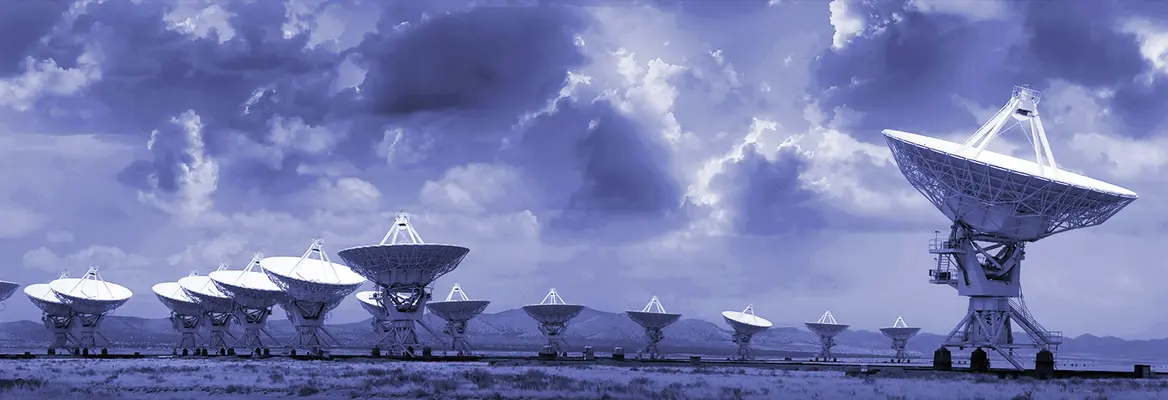

The universe contains trillions of planets, and scientists are more optimistic than ever that we are on the verge of finding life beyond Earth. But Christopher Cowie, Associate Professor in Philosophy at the University of Durham, thinks this optimism rests on a deceptively simple mistake. A vast universe doesn't mean a dense one, and unless life exists close enough for our telescopes to observe it, its abundance elsewhere is simply irrelevant to us. The universe, he argues, may be teeming with life. We just may never find any of it and we have never questioned why finding it matters in the first place.
There is growing optimism that we are on the brink of discovering evidence of life beyond Earth. This requires that life is out there to be found in the first place. And it seems, at first, eminently reasonable to think it is. The sheer size of the universe ensures it. There are just so many possible sites: planets and moons that host liquid water, and life’s basic constituent elements.
Writing in 2024, the British astronaut Tim Peake gave particularly clear voice to this thought. Peake, who wagered that we would find evidence of microbial life beyond Earth within just five years, said:
I think the universe is teeming with life. If you’re in any doubt as to the vastness and the scale of the universe, just go and Google some of these James Webb Space Telescope shots that we’re getting now … I mean, hundreds of billions of stars in our own Milky Way galaxy, which is very average.
His point seems persuasive. It is also commonplace. Because the universe is enormous, life is out there in large quantities. Hence, optimism in the search for life beyond Earth makes sense. But there is in fact a problem with this reasoning.
There are two very different things that Peake might mean when he claims that the universe is teeming with life. One is that the universe is dense with life; that life is, as it were, everywhere that you look. The other is simply that life is plentiful; that there is a lot of it. These sound similar, but they are very different indeed. An analogy helps to explain the difference. The population of Australia is approximately 30 million. There is a perfectly good sense in which this is an awful lot of people; imagine them all lined up, or crowded onto a beach (as Australians sometimes are). “What a lot of people,” you might say. But in terms of population density, Australia is actually one of the lower-ranking countries in the world, clocking in at only 3 people per square kilometre. Australia, we might say, is teeming with life in one sense, but not the other. Contrast this with, for example, the Netherlands. Its population is almost 20 million, but, given its small size, contains about 500 people per square kilometre. It is teeming with life in both senses.
Want to continue reading?
Get unlimited access to insights from the world's leading thinkers.
Browse our subscription plans and subscribe to read more.
Already a subscriber? Log in
Love the iai?
Sign up to get exclusive access.

Related Posts:

Related Videos:

10th August 2026



Join the conversation