


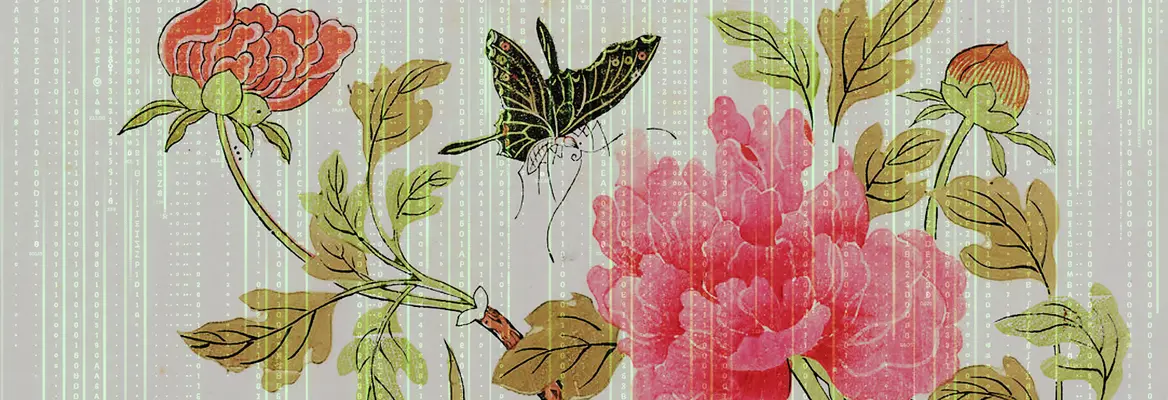

Investors are betting that AI can replace human creators. China’s AI movie industry is already valued at $3bn, and the American AI music-generation company Suno reached a $5.4bn valuation this year. This raises the question of whether there is anything unique about human creativity. Philosopher Davide Andrea Zappulli draws on Chinese philosophy to argue that human creativity isn’t just the recombining of old ideas, as machines do. It’s seeing reality in new ways, which requires a living body that interacts with the world and experiments with different ways of grasping it. Consequently, genuine creativity is beyond AI.
Creativity plays a central role in contemporary culture. As the philosopher Berys Gaut puts it, “our culture is obsessed with creativity.” And no wonder! Creativity is a driving force behind development in science, technology, and the arts. We also value creativity in our personal lives, read books about how to unlock our creative potential, and desire an education system capable of fostering it. At the same time, recent developments in artificial intelligence have started to threaten our confidence in the importance of human creative capacities. Is human creativity distinct or unique in some way? If not, what is its future in the age of AI?
To address these and other issues, we need to understand what creativity is and how it arises. Yet, doing this has proven to be remarkably difficult. While, at a general level, there is wide agreement that creativity is the capacity to generate ideas that are new and valuable, philosophers and psychologists have struggled to figure out how we generate such ideas and what kind of mental processes realize our creative capacities. In fact, some have gone as far as proposing the extreme view that creativity lies beyond explanation. For example, Immanuel Kant argued that since any explanation is given by reference to rules, and creativity is precisely what cannot be captured by rules, it is in the nature of creativity that it cannot be explained.
Some say that it is in the hardest battles that uniting forces is most needed. If so, explaining creativity might be the kind of enterprise in which integrating resources from different philosophical traditions could play a vital role. In particular, some help might come from one of the most influential texts in the Chinese philosophical tradition: the Zhuangzi.
The Zhuangzi took shape in ancient China during the second half of the Warring States period (475–221 BCE). This is the foundational period of Chinese philosophy, which witnessed the start of the schools of Confucianism, Daoism, Mohism, and Legalism. (This taxonomy is anachronistic, but we don’t need to get into that here.) The Zhuangzi is classified, albeit anachronistically, as a Daoist text. It is also a work of a singular kind, departing from other texts of the time in its peculiarly imaginative style—full of evocative stories, jokes, talking animals, and descriptions of wondrous metamorphoses. It is precisely where we might expect to find insights about creativity.
One such story occurs in the first chapter. There, Huizi (Zhuangzi’s friend) tells the character Zhuangzi that he has received a gourd as a present from the king of the state of Wei. Yet, the gourd was a very special one—so huge that it weighed more than 100 pounds! Asked by Zhuangzi what he did with it, Huizi replies:
Want to continue reading?
Get unlimited access to insights from the world's leading thinkers.
Browse our subscription plans and subscribe to read more.
Already a subscriber? Log in
Love the iai?
Sign up to get exclusive access.

Related Posts:


Related Videos:


10th November 2026

Join the conversation