


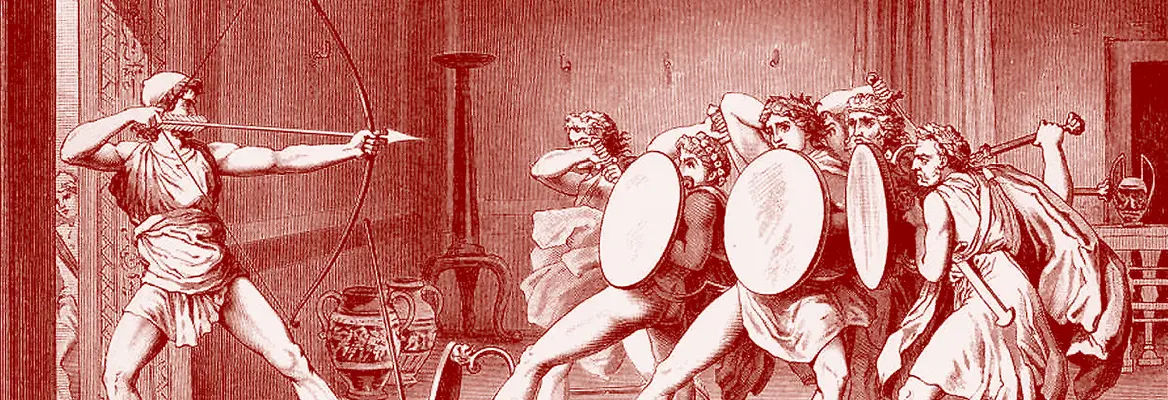

Emily Wilson has critiqued Christopher Nolan's Odyssey for being shallow. Philosopher of ethics Kathryn Lawson goes further. Using Hannah Arendt, Emmanuel Levinas and Simone Weil — three thinkers who turned to Homer to make sense of atrocity after the World Wars — Lawson argues that by giving Odysseus a contemporary conscience, Nolan made a dangerous mistake. Homer's Odysseus feels no guilt for his violence which serves as a warning that power rarely recognises its own cruelty and needs something external to stop it. By erasing that for a guilt-ridden hero, Nolan cuts the story’s ethical depth and leaves us with the fantasy that the powerful will change themselves once they understand what they've done. Reality, Lawson argues, suggests otherwise.
The aforementioned Emily Wilson will debate live this September at HowTheLightGetsIn, the world's largest philosophy and music festival, alongside hundreds of other talks, debates, music, and comedy. Emily Wilson will be appearing alongside world-leading speakers including Louis Theroux, Roger Penrose, Mariana Mazzucato, and many, many more. Tickets selling fast. Book your place now.
In this summer’s blockbuster movie adaptation of Homer’s epic poem, The Odyssey, the key theme is a variation of the New Testament Hebrews 13:2, perhaps best known to literary types as the welcoming words written on the wall of the famous Parisian bookstore Shakespeare and Company:
“Be not inhospitable to strangers, lest they be angels in disguise.”
Writer/director Christopher Nolan’s main theme in the film blends this law of hospitality with the Golden Rule: “Do unto others as you would have done to you,” another biblical invocation, this time in the New Testament’s Matthew 7:12 and Luke 6:13. Together, these imperatives form the film’s “Law of Zeus”. Perhaps surprising for a summer blockbuster, the movie is predominantly a meditation on the ethical demands of the stranger, with a similar lesson to Nolan’s 2023 summer blockbuster Oppenheimer.
Film critics aside, the movie has had mixed reviews from philosophers and classicists alike. Classicist Emily Wilson found it to be shamefully written, although entertaining in a plebeian kind of way, while philosopher Slavoj Žižek argued that it was not the monster blockbuster he expected, but rather a modest chamber drama. But love it or hate it, it is undeniable that the main theme is a timely reflection upon our age of steadily rising social and political polarization and xenophobia. Here I will not offer a strict “review” of the film but rather invite a conversation between it and the twentieth-century philosophers Hannah Arendt, Emmanuel Levinas, and Simone Weil, all of whom turned to Homer to consider this very theme during their own dark times. In this conversation between ages, I will consider the quietly hopeful arc of the film and why it ultimately fails to access the true crux of the ethical demand of the stranger.
Homeric ethics and the necessity of violence
For Arendt and Weil, Homer’s poem The Odyssey and its predecessor, The Iliad, are so miraculous because they narrate the war from the perspective of both the conquerors and the conquered. The implication of this narrative choice is that the poet(s) are able to recognize the humanity of those “enemies” in the city they have destroyed. The poem is able to contemplate a responsibility for atrocities without succumbing to the staggering abyss that may follow recognizing one’s own heinous crimes.
Want to continue reading?
Get unlimited access to insights from the world's leading thinkers.
Browse our subscription plans and subscribe to read more.
Already a subscriber? Log in
Love the iai?
Sign up to get exclusive access.

Related Posts:


Related Videos:



28th August 2026



Join the conversation
Larry Greer 31 August 2026
I think for all Nolan’s ascribing of anachronistic moral stances to Odysseus, the film captures well (despite itself, I think) the timeless human failure to get out of our system the “Great Man” dynamics that for so long have driven human history.
In this essay Kathryn says, “…this is ultimately why the film falls short in its ethical imperative: it requires the violent men in power to realize their own culpability.” In reading this passage and several others very much like it (and in watching the film) I found myself wondering when the central question raised by any filmic and other rendering of the human condition will be “When are we going to stop letting the ‘great men’ (like Paris and Menelaus and Agamemnon and Odysseus and Oppenheimer and Donald Trump and Elon Musk and so many others in so many of the spheres of our shared existence) keep dragging everybody less “great” than they are into all this awful squandering of our promise as human beings?”
It’s so troubling to me that at this late date humanity is still basically taking for granted that the ups and downs in the personal lives of “great men" (and “great women”) will be spilling over and making our lives more miserable than they need to be till the bitter end.