


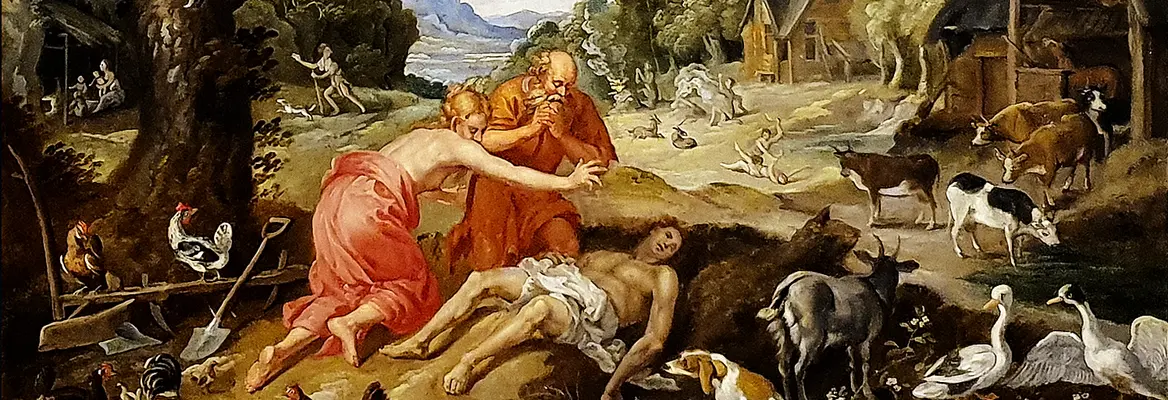

In East of Eden, Steinbeck instructs us to exercise our free will, break out of the bonds of fate, and put an end to cycles of violence. But there is little explicit argument for how this is possible. Contributing editor Noah Lazarides argues that the answer is hidden in the form of the novel itself: the retelling of myth. Unearthing the metaphysical ideas that might have shaped the writing of the novel, we find that for Steinbeck the way to change the future is to rewrite the past. In a world made of ideas, we each have the creative freedom to write our own self-fulfilling prophecies.
1. The problem with East of Eden
On first look, East of Eden wrestles with a contradiction between its two most prominent themes: fate and freedom. The novel weaves together a multi-generational story of two families—the Trasks and the Hamiltons—living in the Salinas Valley in California where Steinbeck grew up. The Civil War and First World War act as the historical bookends of the novel, but it is hardly free from conflict. It is, after all, a retelling of Genesis. And the unfortunate Trasks are fated to repeat the myth of Cain and Abel in violent refrain.
And yet, Steinbeck goes to great lengths to insist upon his characters’ freedom. The narrative vehicle for this theme is the Hebrew word timshel, which is lifted from the Cain and Abel story and discussed at some length within East of Eden’s dialogue. Samuel Hamilton (a fictionalized version of Steinbeck’s own grandfather) and Adam Trask (father, of course, to the stand-ins for Cain and Abel, i.e., Cal and Aron Trask) settle upon an alternative translation of timshel. The word is usually translated as “thou shalt rule over [sin],” but Steinbeck makes the case for “thou mayest” as a better fit. On this reading of the good book, God tells Cain that it is his choice whether he does right or wrong; he may do either.
But how is this possible? How can Steinbeck tell us that Cal Trask is free to do as he may, while showing us that his actions are determined by myth? To resolve this awkward interpretive challenge, I warn the reader that I am going to offer a non-standard interpretation of the novel and, indeed, of Steinbeck’s thought.
___
The defining act of timshel is not its blank assertion, but its re-translation.
___
The resolution of this conflict lies in the following radical philosophical position: the world is made of stories. For Steinbeck, your personality consists in the narrative of your personal history—the self-fulfilling prophecies we tell to ourselves. Yet in that storytelling we have some creative freedom. In other words, we are each bound to live by myths that, for Steinbeck, we are nonetheless free to rewrite.
At first, this might sound absurd—the idealistic flight of fancy we would expect of a novelist. But Steinbeck was seriously engaged with the philosophy of his time. And his position derives from the scientifically grounded, “no-nonsense” tradition of American pragmatism.
2. Pragmatism and the power of myth
When I first read East of Eden, I was struck by just how thoroughly American it felt. Perhaps it was Steinbeck’s immersion in pragmatism, the only American-grown philosophical tradition, which lent its distinctive lilt to the book’s themes. Led by Charles Sanders Peirce and William James in the nineteenth century, the pragmatists believed that the meaning of a concept lies in its practical implications. They sought to bring philosophy’s metaphysical concepts from their lofty, detached heights and ground them in practice.
Want to continue reading?
Get unlimited access to insights from the world's leading thinkers.
Browse our subscription plans and subscribe to read more.
Already a subscriber? Log in
Love the iai?
Sign up to get exclusive access.

Related Posts:



Related Videos:



23rd October 2026



Join the conversation