


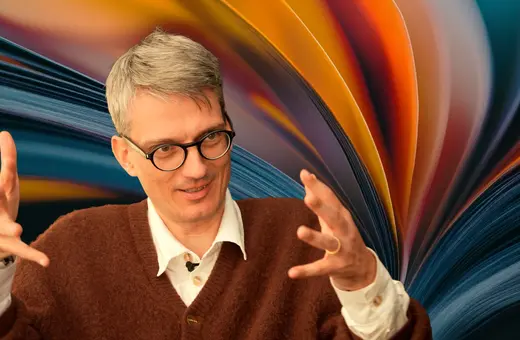
When the bombshell paper “Attention Is All You Need” appeared in 2017, it began today’s race for AI dominance. But what’s so special about attention? Princeton neuroscientist, composer and novelist Michael Graziano argues that attention is the most fundamental process in our brains. It builds our internal picture of reality, rations energy in our most energy-hungry organ, and is closely connected to consciousness. Indeed, he claims, subjective experience arises when the brain attends to its own attention in order to control it, like an artist painting a picture of themselves painting pictures.
The most energy-expensive organ in the body is the brain. The human brain, for example, coming in at about 2% of the body’s mass, uses 20% of the body’s energy. Neural tissue is so costly that evolution does not generally favor large brains. Otherwise, the entire animal kingdom would have evolved giant ones, instead of just a few species that have found a way to exploit that trait.
To pack as much capacity in as small a mass as possible, the brain has evolved a specific kind of efficiency. At any one time, it focuses on a limited set of items and processes them deeply. As you look around the room, moment by moment, your visual system focuses on less than one in a million details. That winnowing is called attention, and without it, you would need a brain the size of a house to achieve the same level of intelligence. In a sense, attention is merely a data-handling trick—but that trick is the most fundamental process in the nervous system. It makes us what we are. Attention turns out to be the crucial ingredient in much of psychology and neuroscience, in consciousness itself, and now even in artificial intelligence (AI). Its importance spans science, philosophy, and technology.
___
Attention is not just about neurons, or about the brain enhancing internal representations. Attention is a gateway to subjective experience itself.
___
William James, one of the founders of psychology, famously said in 1898, “Everyone knows what attention is. It is the taking possession of the mind, in clear and vivid form, of one out of what seems several simultaneously possible objects or trains of thought.” But if there’s one thing everyone knows in psychology, it’s that nothing is harder to pin down than the thing that “everyone knows.” Attention has been defined in at least half a dozen ways since James. Overt attention is where you’re looking. Covert attention is when your mind is focused on something off your center gaze. Spatial attention is when you deeply process a particular location, like a spotlight. Feature attention is when that spotlight is broadened over a larger scene, but attuned to a single type of object, such as when you look for the guy in the red hat amid a sea of people.
Want to continue reading?
Get unlimited access to insights from the world's leading thinkers.
Browse our subscription plans and subscribe to read more.
Already a subscriber? Log in
Love the iai?
Sign up to get exclusive access.

Related Posts:

Related Videos:



9th July 2026


Join the conversation