


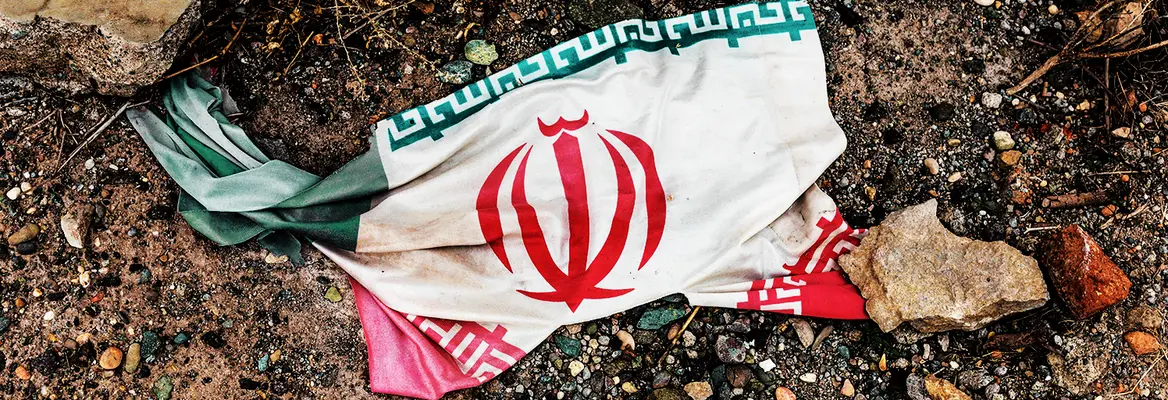

The war on Iran has dragged on far longer than the US administration originally promised, while regime change remains elusive. SOAS political theorist Arshin Adib-Moghaddam argues that to understand this war, we must look inside the Islamic Republic itself — at the factional struggles, the entrenched deep state, and the security-military establishment that has repeatedly answered its people's demands for reform with repression. From the student protests of 1999 to the Women, Life, Freedom movement, this internal machinery hollowed out the very legitimacy that might have shielded Iran from attack.
First things first: The Trump and Netanyahu administrations have failed miserably in their aggression against Iran. Their war will be recorded in history as one of the biggest strategic blunders in contemporary international relations. As a consequence, all of us are reeling from the economic effects. Innocent lives are lost on a daily basis, and only very few Western politicians, first and foremost Pedro Sanchez of Spain, have spoken out against the Iran war. If we are to cite one reason for the strategic blunders, it must be the sheer arrogance of the Trump and Netanyahu administrations, mixed with an anti-scientific attitude that favours ideology over knowledge. Reading the critical scholarship on foreign countries, a pattern emerges: we have advocated humbly in the corridors of power for years, only to witness policy disaster after disaster due to institutionalized ignorance.
Yet, there is another angle to this tragedy which explains why we are at war: The protection of the nation is the ultimate task of any state. Instead of maneuvering Iran safely through the anarchy of the world order by preventing internal upheaval, the Iranian state itself recurrently targeted its own people. Manufacturing consent through violence is not the same as true legitimacy. Bruised and battered, Iranians have been caught up in this violent cycle for reform at least since the revolution of 1979. The deep state in Iran—the hardliners embedded in the security and military organs and their right-wing theocratic allies—has never really resolved this struggle to the satisfaction of Iran’s incredibly potent civil society. Instead of actively accommodating the requests for human dignity, social emancipation and democratic accountability, the Iranian deep state has repeatedly resorted to violence and suppression. It has also adhered to an ideological differentiation between “good Iranians” and the “bad ones.” This claustrophobic us-versus-them doctrine has splintered Iranian society. Ultimately, crushing movements for reform has been self-defeating, as it eroded the power base of the Iranian state itself, making this illegal war more possible. Any state that is not carried by the overwhelming legitimacy of its people will confront recurrent domestic upheaval and external meddling.
The hardliners nestled in the Iranian deep state now position themselves as the heroic defenders of Iran. But the truth is that they have been part of the legitimacy dilemma that made it possible for Israel and the United States to attack Iran in the name of regime change in the first place. If the deep state in the Islamic Republic had allowed for reforms a long time ago, this war would not have happened. “Regime change” can only legitimate an illegal war like this one when the target country suffers from a legitimacy dilemma in the first place. The inability of the Iranian deep state to reform decisively even after 47 years since the revolution is not simply indicative of “bad governance.” It is a major analytical factor explaining why Iranians can be killed by foreigners right now.
___
Want to continue reading?
Get unlimited access to insights from the world's leading thinkers.
Browse our subscription plans and subscribe to read more.
Already a subscriber? Log in
Love the iai?
Sign up to get exclusive access.

Related Posts:

Related Videos:

6th August 2026

Join the conversation