


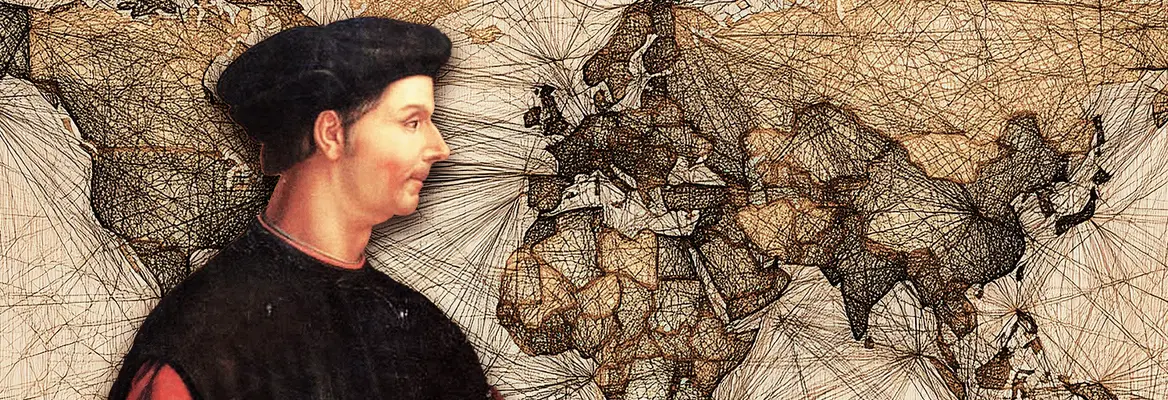

When we call a leader “Machiavellian” we mean they are ruthless, cunning, and amoral. But Machiavelli himself meant something close to the opposite. Political theorist Hartmut Behr argues that Machiavelli was describing the pathologies of princely power, not endorsing them—and that his real commitments, to republicanism, institutional checks, and peaceful diplomacy between small states, amount to a vision of leadership we have buried under centuries of misreading and which is needed now more than ever.
The normative and the analytical
The term “Machiavellianism” is used time and again by journalists, politicians, public intellectuals, and scholars. Their use is mirrored in the Cambridge Dictionary, where “Machiavellianism” is defined as the use of cunning, dishonest methods to deceive and win power and control. This reading of Machiavelli has a long history: thinkers from William Shakespeare to the Prussian King Frederick II have perceived Niccolo Machiavelli as advocating dishonest and expedient power politics.
But this popular interpretation has always been contrasted with another movement, which praises Machiavelli as a republican writer who warned against the perils of power politics and dictatorial leadership in the legacy of Aristotle and Cicero. This interpretation has been supported by James Harrington, Francis Bacon, David Hume, Baruch Spinoza, Charles de Montesquieu, and Jean Jacques Rousseau, who described Machiavelli’s Prince as “the book of Republicans.” In the present day, J.G.A. Pocock’s The Machiavellian Moment: Florentine Political Thought and the Atlantic Republican Tradition emphasizes that Machiavelli’s The Prince would have been an analytic study of how power relations operate in principalities. This interpretation—for which we would in contemporary language use the term “sociology of power”—is supported by the title of Machiavelli’s piece. It should not in fact be translated as The Prince, but as “On Principalities,” which would be a fair representation of its actual title De Principatibus.
___
If we declared Machiavelli an advocate of cunning and dishonest politics because he is describing dishonesty and violence, then we could also declare George Orwell a fascist for what he describes in Animal Farm.
___
So why have all these thinkers been drawn to alternative interpretations? To be fair, there are some ostensible contradictions in Machiavelli’s writings that we can either accept as contradictions or attempt to explain. I am inclined to do the latter. Quentin Skinner warns us not to read our own preconceptions into old texts, and if we follow this line of enquiry there is much to discover in Machiavelli: first, we learn from an early attempt in the political sociology of power; second, we receive ideas about the advantage of republics over principalities and of small republics over large ones; an argument that, third, feeds into Machiavelli’s advocacy for a republican international order, an idea that is usually allocated to Immanuel Kant and his writing On Perpetual Peace while ignoring its much earlier presentation in Machiavelli.
Want to continue reading?
Get unlimited access to insights from the world's leading thinkers.
Browse our subscription plans and subscribe to read more.
Already a subscriber? Log in
Love the iai?
Sign up to get exclusive access.

Related Posts:


Related Videos:

23rd April 2026



Join the conversation
Hartmut Behr 23 April 2026
I could have mentioned the very same outlet - this webpage here of IAI - next to the Guardian, CNN, and The Conversation promoting a misreading of Machiavelli, ironically advertised as "Suggested Reading" (by Andy Owen) in the course of my article ...