


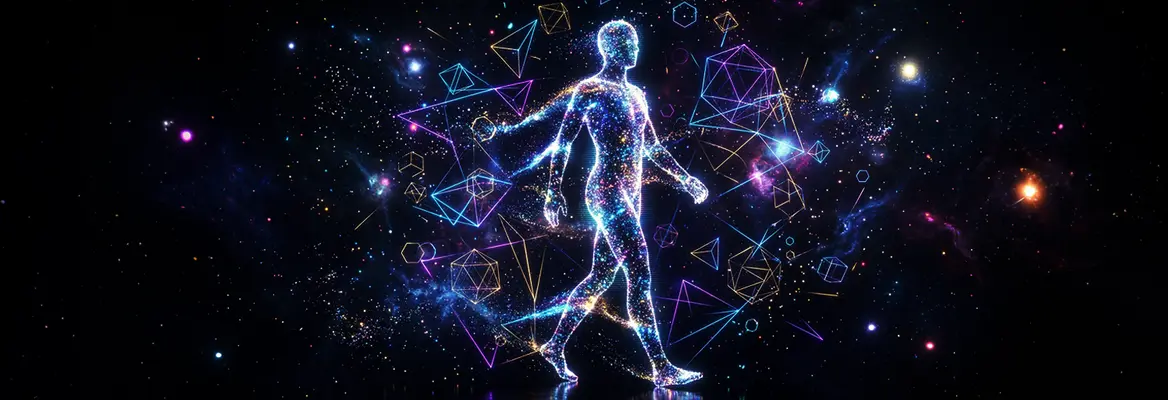

What is the difference between human and machine? Classically, embodiment has been a go-to answer. But as information itself becomes increasingly embodied, the tension between metal and flesh is heightening. What it means to be embodied at all is here brought into question by philosopher Gigla Gonashvili.
We are increasingly viewing ourselves as patterns rather than bodily presence, signals rather than substance. It is as if we are being evicted from the flesh, teleported directly into the realm of an alien intelligence. Yet, the body retains its own strange powers, as was already recognized by the materialist logic of the Stoics.
In How We Became Posthuman, N. Katherine Hayles writes that, with the arrival of the first wave of cybernetics, “information loses its body.” With the contribution of figures such as Norbert Wiener and Claude Shannon, information is divorced from lived meaning and context, falling into feedback loops and binary digits (“bits,” as coined by Shannon). The focus shifts onto function: just as a thermostat adjusts itself according to the room temperature, so too does a human body regulate its temperature by sweating. Wiener famously defines cybernetics as “Control and Communication in the Animal and the Machine.”
Consequently, information gets tied to patterns and probabilistic functions which have to resolve, or at the very least drastically reduce, uncertainty—the “noise” in communication. In this way, information acquires generality and universality; it can be transported and teleported anywhere. Bodies, too, get dematerialized: they start to linger in virtual spaces, as is abundantly present in the genre of science fiction. Invoking William Gibson’s Neuromancer, Hayles notes that the body becomes “data made flesh.”
___
It is not the greenness of a tree that substantiates itself in the world, but rather its greening that takes place, opens itself as a horizon, and creates a volatile state in which all the constituents (tree and green) encode and envelop each other.
___
Information liberates itself from a material substratum in order to establish and maintain its own ontological status, becoming a primary medium of communication. Curiously, we can discern a similar trend in Stoic philosophy, which holds a strongly materialist ontology (such as in Zeno of Citium and Chrysippus, 3rd century BCE). For them, the whole universe is comprised of bodies—not only of the usual material sort (a stone), but the soul, too, is a body (hot breath, pneuma), and even Reason and God are bodies: fine substances. Furthermore, only a body can act or be acted upon. There is no interaction except between bodies.
But there is a twist. Besides these through-and-through material things, there are also four immaterial things (asomata): time, place, void, and that which is relevant for us, the so-called “sayables” (lekta). The famous Stoic example is that of a knife cutting flesh. Even though all entities involved (knife, flesh) are material, there arises an immaterial predicate: “being cut.” This predicate is not a new body, but something that persists through change or merely subsists. The Stoics used the verb huphistasthai to denote this latter category and differentiate it from existence—Huparchein—which implies the power of a beginning (arché), of a principle that can produce an action, which can only be a body.
Want to continue reading?
Get unlimited access to insights from the world's leading thinkers.
Browse our subscription plans and subscribe to read more.
Already a subscriber? Log in
Love the iai?
Sign up to get exclusive access.

Related Posts:

Related Videos:


6th April 2026

Join the conversation
Bruce Adair 7 April 2026
"We are increasingly viewing ourselves as patterns rather than bodily presence, signals rather than substance."
Oh, we have always done this. For what is a spirit or a soul other than an old fashioned name for signal?
Brian Balke 6 April 2026
Somewhere in this environment of discourse, someone pointed out that it is exactly the indeterminism of human neural processing that creativity arises. We find ourselves constructing a thought and rather than "tree," the word "treaty" arises. We recognize the error, perhaps pausing a moment to wonder "Where did that come from?"
It is in this allowance for error that imagination finds purchase in the human mind. Is AI creative? Or is it merely an assistant in the realization of our intentions? If the latter, then what AI offers to us is a chance to refine and elevate the intentions that organize our imagination.
What is known is that AI engines do not contain information. Train an AI engine with the output of another AI engine, and in seven generations the output is completely incoherent. The essential character of language, as recognized by Wittgenstein, is to facilitate social collaboration. Without the intervention of an interlocutor that can evaluate the coherence of utterances, there is no transmission of information.