


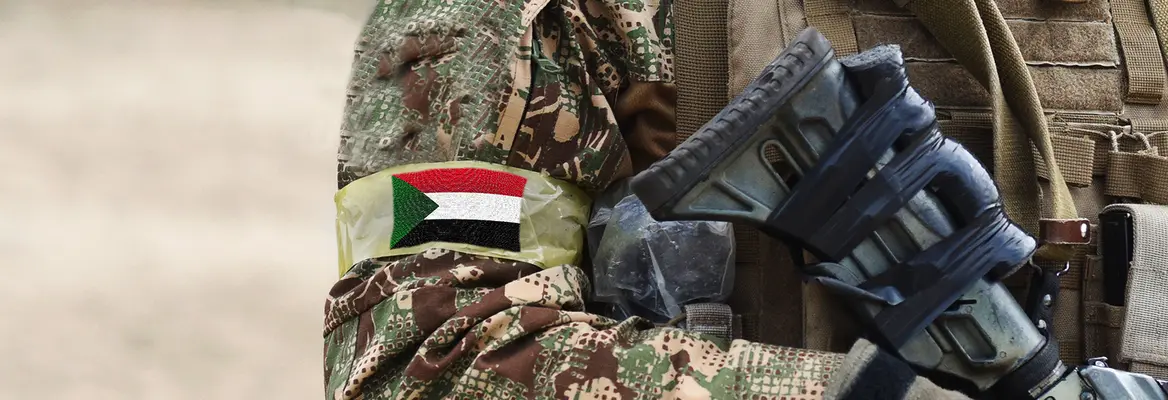

When the West looks at Sudan's war, it sees a humanitarian catastrophe beyond its understanding, despite its astronomical toll. But historian Matthew Benson-Strohmayer, Sudans Research Director at LSE's Conflict and Civicness Research Group, argues this account does not explain how Sudan's warring generals fund their violence: both sides have become commercial empires, commanding gold, trade and foreign patronage beyond any government's control. Until a peace deal can dismantle this machinery and heed the civilian actors working to take back control, ending the fighting will only reset the conditions for the next war.
Sudan is often understood as a catastrophe in which the world’s worst humanitarian crisis seems perpetual and therefore both lamentable and unsolvable. To the extent that media coverage is available, the world sees the numbers, or at least is told them. Since April 2023, the war has forced around 14 million people to flee their homes. Nearly 34 million now require humanitarian assistance. Earlier this year, almost 19.5 million people were experiencing acute food insecurity, while 825,000 children were expected to suffer severe acute malnutrition during 2026. Yet the international humanitarian appeal remains less than one-third funded.
To say that Sudan has been forgotten is therefore true, but incomplete. Sudan is made visible through a particular story, framed as a crisis and represented by famine warnings, displacement numbers, and images of devastated cities. While they can illustrate the depth of the crisis, Sudanese people appear primarily as victims of mass killing, evidenced through satellite images of massacre sites, and urgently in need of humanitarian relief. The resulting narrative blames the armed leaders who began the war, but in doing so, it paradoxically makes them seem like the only ones capable of ending it. The structures that finance those leaders, and the Sudanese civic actors who have tried to dismantle them, disappear from the narrative.
While such media attention is necessary to generate a much-needed humanitarian response, the all-too-familiar humanitarian lens often defaulted to for this seemingly distant tragedy also narrows the field of vision. The consequences of war come into focus, while the political and economic systems that make war possible and profitable are obscured. Sudan is presented as a place to which catastrophe has happened, rather than as a political crisis produced through a long history of militarized, internationalized extraction. The war has become a shorthand for familiar stories of primordial grievance, tribal war, or yet another African conflict. Such explanations make the conflict appear inevitable rather than politically produced, and therefore open to transformation.
So, while Sudan’s war is conventionally described as a civil war between the Sudanese Armed Forces (SAF), led by Abdel Fattah al-Burhan, and the paramilitary Rapid Support Forces (RSF), led by Mohamed Hamdan Dagalo, known as Hemedti, that description obscures the reality. While it identifies the main belligerents, it mistakes their struggle for a war between two social constituencies. Most Sudanese are represented by neither side and held hostage by rival military formations.
But, by April 2023, the SAF and RSF were not simply two military organizations competing for control of a state. They had become fiscal-military complexes: armed organizations able to control commercial assets to generate revenue, and to cultivate foreign relationships beyond civilian oversight. Together, they formed the armed core of what I call a hostage economy, in which military organizations command the revenues needed to sustain coercion, while civilians and public institutions face the costs.
Want to continue reading?
Get unlimited access to insights from the world's leading thinkers.
Browse our subscription plans and subscribe to read more.
Already a subscriber? Log in
Love the iai?
Sign up to get exclusive access.

Related Posts:


Related Videos:

9th September 2026


Join the conversation